Author: Nate Kreichman (Page 11 of 13)

Breaking Bad 5.03: Hazard Pay

SPOILER WARNING: This post will appear every Monday following a new episode of “Breaking Bad.” It is intended to be read after seeing the show’s latest installment as a source of recap and analysis. As such, all aspects and events that have occurred up to and including the episode discussed are fair game. 
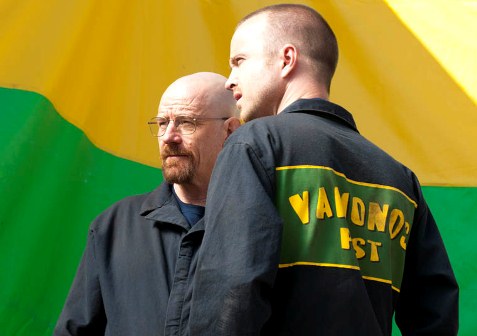
Walter White or Heisenberg?

The transformation is nearly complete. The artist formerly known as Walter White is almost pure Heisenberg, although the sympathetic family man we (along with his family and friends) once knew and loved is still in there, popping up now and again to, say, be fascinated by machinery and tell an anecdote about the summer he spent working in a box factory. Then poof, he’s gone as soon as he appeared, and we find that the only reason he was hearkening back to days gone by was to explain why such a location will not be a suitable for his meth lab.

This juxtaposition of (what’s left of) Walter White and his super villain alter ego Heisenberg is one of the major themes of the final season, but it played an especially large role in “Hazard Pay.” At any given moment, the viewer can and should be questioning just which “aspect” of the man is speaking and acting. Sometimes it can be hard to tell, and sometimes, as in the above example, you can be positive it’s Walter White, only to discover it was just the opposite.

“Hazard Pay” was chock full of such moments. Was that a man casually enjoying “Scarface” with his son, or a “real” ultra-violent drug kingpin idolizing a fictional one? Was the guy sitting on the couch with Brock awkward because of remorse or was he silently confirming that poisoning that very child was simply doing what needed to be done? Can it be both?

In those instances, maybe. But the best and most important Whitenberg contrast came during his (their?) post-cook beer with Jesse, while discussing love and honesty in relationships. At first it was a quietly beautiful moment of genuine discourse: the friend and father figure offering advice to his business partner while acknowledging that the choice was ultimately his own and treating him as an equal, perhaps for the first time. But by the time the commercial break rolled around I found it was something else entirely: Heisenberg subtly manipulating Jesse to ditch Andrea and Brock—the only loose ends remaining from the Gustavo Fring saga.

Jesse realizes this too, although it takes him a bit longer. After the money squabbles have run their course, Walt asks Jesse if he’s OK. Given their earlier conversation, Jesse believes Walt’s asking how he chose to deal with the Andrea situation, and says he’s broken it off with her, although he will continue to support she and Brock financially. Walt brushes this away, because in his mind, of course Jesse broke it off, that’s what he had intended, so that’s what’s occurred. Just a few days earlier, Jesse was honestly considering marrying this woman.

Instead, Walt is referring to the money. Seemingly out of the blue, he brings up Victor, the man whose throat Gus slit  just to send a message. Only he’s thinking that might not have been the whole story. Maybe Victor, who decided to begin the cook himself when Walt and Jesse wouldn’t, “flew too close to the sun, and got his throat cut.” It’s hard to know just what Walt’s really talking about, but I’ve got a guess: maybe Walt feels Mike is flying too close to him, the sun, and that sometime soon he’s going to get his throat cut, and Walt will take over the business end too. In this analogy, Walt is the sun, and the universe quite literally revolves around him.

Killing Gus has given the ever-prideful Walt a surge of confidence. He feels as though he’s untouchable and that everyone answers to him. When Mike asks if they should take a vote on the tented-house plan, he responds “Why?” as in, “Why? I made the decision and that’s all there is to it.” Mike’s noticed this and tries to set him straight with, “Just because you killed Jesse James doesn’t make you Jesse James.” Clearly, Walt’s not so sure that’s the case.
Skyler’s Breakdown

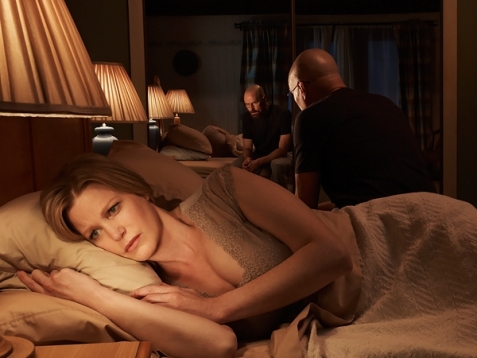
As she said, Skyler is afraid of her husband. Her murderous, drug-cooking, sociopath husband, and rightfully so. Indeed, Walter has abused her sexually, and now he’s moved back into the house without so much as asking her opinion on the matter. All she got to do was stand in horror and mumble questions about whether he thinks that’s the right decision. Just a few more notches in the Walt thinking he’s the invincible boss count. Why should there be a vote on where to cook? He’s decided. Why should there be a discussion about whether he should move back in? He’s decided.

Walt’s unannounced return is the last straw for Skyler. She’s visibly shaken, but can’t discuss these things with Walt, so it all comes out on Marie instead. When Marie demands to know the cause of her sister’s breakdown, Walt makes himself the victim, the cuckold, the honest, sympathetic man who’s still trying to put things back together despite his wife’s infidelity. That’s Heisenberg talking, there’s no doubt about it, and that’s Heisenberg who stops to chomp on an apple before checking up on Skyler. Then, when she finally emerges from her room to find him playing the good guy with their son and watching Tony Montana go up in smoke, it’s all her fears realized. Heisenberg is sitting there with their daughter in his lap and their son at his side, perfect father that he is, and asks Skyler to join them. After all, they’ve got popcorn. He’s doing his best Walt impression, but that’s the bad guy. She knows it, he knows it, and ultimately, we know it. It’s getting harder and harder to root for Walt, for those of us who still are (to some degree) anyway, and I’m wondering how much longer we can keep this up.

A few extra bits:

-It’s more than a bit ironic that it’s Walter’s genius idea to cook in houses being fumigated for pests. This is the same man (sort of) who once refused to cook because of a single fly in an otherwise immaculate laboratory.

-Walter notes that “everyone dies at the end” of “Scarface.” In that film, there’s a big shootout as the result of one arrogant drug kingpin’s rising too power way too fast. Probably just a coincidence Walt was buying that M60 in the first scene of the season, right?

Follow the writer on Twitter @NateKreichman.
 

Hidden Netflix Gems: ‘Tim and Eric’s Billion Dollar Movie’

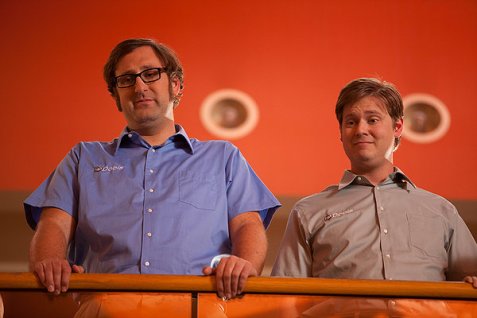
This week’s Hidden Netflix Gem: “Tim and Eric’s Billion Dollar Movie” (2012)

Everyone who’s kept up with Cartoon Network’s Adult Swim comedy block over the past few years has heard of Tim Heidecker and Eric Wareheim, the masterminds behind “Tim and Eric Awesome Show, Great Job!” And everyone who’s watched the show knows that after seeing it you’ll a) never be able to watch commercials the same way again, and b) notice how much influence these two fellas have had over what is now considered “mainstream” comedy.

“Tim and Eric Awesome Show, Great Job!” was a sketch show that ran from 2007 to 2010. It was freakin’ weird, to say the least, and its surrealistic, satirical humor mocking advertisements, public-access television, and everything in between has since spawned a spin-off, “Check It Out with Dr. Steve Brule,” which stars John C. Reilly, and the full-length feature “Tim and Eric’s Billion Dollar Movie” (B$M).

Continue reading »

Hidden Netflix Gems: ‘Trailer Park Boys’

This week’s Hidden Netflix Gem: “Trailer Park Boys” (2001-2008)

“Trailer Park Boys” is a Canadian mockumentary series following the exploits of Julian (John Paul Tremblay), Ricky (Robb Wells), and Bubbles (Mike Smith), lifelong friends and serial criminals living in a Nova Scotia trailer park—when they aren’t in jail that is. The three pals run petty scams and dream up get rich quick schemes. They grow pot, act in homemade pornos, run bars out of trailers and sell counterfeit CDs. Most of the time, their plans are so ludicrous they need no help getting caught. Nonetheless, the boys live under the watchful eye of cop turned Trailer Park Supervisor Jim Lahey (John Dunsworth), who’s constantly working to derail their plans. The series might just be the best thing ever to come out of America’s hat, and all seven seasons (55 episodes) are currently available on Netflix Instant.

Ricky, Julian, and Bubbles are surrounded by a colorful cast of characters, the residents of Sunnyvale Trailer Park, each with their own trademark mannerisms and personalities.  There’s wannabe rapper J-Roc (Jonathan Torrens), who honestly believes he’s black (he’s not), and Mr. Lahey’s perpetually shirtless, cheeseburger-loving sidekick, Randy (Patrick Roach). There’s Ricky’s on again, off again girlfriend, Lucy (Lucy Decoutere), his father, Ray (Barrie Dunn), a former trucker pretending to need a wheelchair for a disability check, and his fall-guy sidekicks, Cory (Cory Bowles) and Trevor (Michael Jackson), who are never seen without each other, and many more. A young Ellen Page (“Inception,” “Juno”) appears a few times in the first two seasons, playing Mr. Lahey’s daughter. Silly and stupid as they may be, all the characters are incredibly lovable and relatable.

Continue reading »

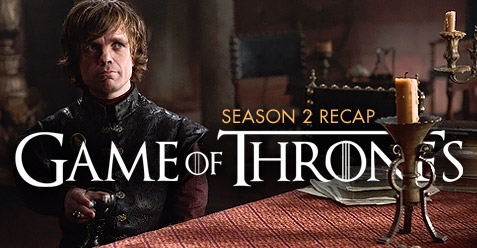
Game of Thrones: Season 2 in Review

SPOILER WARNING: All events that have occurred in the TV show are fair game. I have read the books but I will not go any further beyond small hints that only fellow book-readers will catch on to. You’ve been warned.

Note: Because it can be hard to keep all the names and faces straight, the first mention of each character contains a link to a picture of them which will open in a new tab.

Things were different this season. There really was no “Ned,” a central character for the viewer to grab on to, and as such, there really wasn’t a central story arc for us to stash all our hopes and dreams in (only to have them crushed, or, you know, sliced off).

Sure, the beginning of last season was confusing. We all know that every time we recommend “Game of Thrones” to a friend, it’s with the caveat that they’re going to have to fight through the cacophony of misunderstanding that is the first few episodes. All these issues we’re amplified in Season Two, when not only do we have a bucket load of characters (the largest cast on television), but all in different places. Seriously, name a location other than King’s Landing where more than two major characters reside. It can’t be done. And as if that wasn’t enough, the show decided (well, needed) to throw even more characters and locations at us.

It certainly makes for a manageable format for blog posts, but in different hands, the second season of “Game of Thrones” could have been a catastrophic failure. So let’s get a round of applause for showrunners David Benioff and D.B. Weiss, and of course, the cast, namely Peter Dinklage and Alfie Allen, who are headed for Emmy nominations or my name’s Aloysius, and it’s not. I mean that sincerely; whether you’re in a cubicle or your living room wearing your polka dot boxers, I want all of you to get up out of your chairs. I want you to get up right now and go to the window. Open it, stick your head out and yell, “I’m mad as hell and I can’t go another year without ‘Game of Thrones‘!”

Think of how ballsy it is, when upwards of ten locations could be present in any given show, to have an entire episode devoted to just one (“Blackwater”), leaving the finale to somehow wrap up every other story line. Amazingly, “Game of Thrones” was able to do it, everything else it had to, and so much more. Now, back to that manageable blog post format, where I’ll discuss the three best (or my three favorite) character and thematic developments of the season.

Arya the Ruthless, Tywin the Old Softy

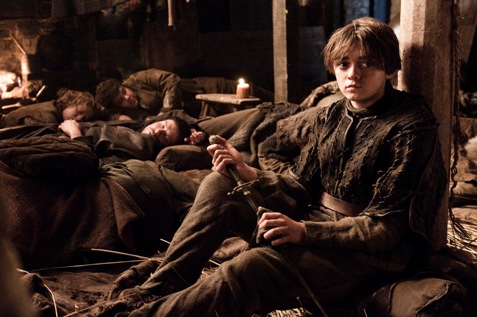
Out of necessity, Season Two diverged from the books a great deal more than the first season did. Some changes couldn’t be helped, and a slight few were questionable, but most breathed new life into the source material. Perhaps the best and brightest example of this is Arya serving as a cupbearer for Lord Tywin rather than Roose Bolton, one of her brother Robb’s bannermen.

I could get into the complicated scenario by which Arya comes to serve in a Bolton-occupied Harrenhal, but what you need to know is this: while the specifics were changed, the general theme and atmosphere of the arc remained the same, and condensing the scene meant interactions between the fantastic-despite-her-age Maisie Williams and old pro Charles Dance. But more important was the interaction between the two characters, which showed us two things: Arya’s continued growth into a cold killer fending for herself, and a softer side of the impossibly thick-skinned Tywin Lannister.

The line was altered for the show, but in “A Game of Thrones,” Ned tells Arya, “When the snows fall and the white winds blow, the lone wolf dies, but the pack survives.” Winter is coming, but Arya has been forced to watch as her pack has been taken from her one by one. She is the lone wolf, and if she hopes to survive she must grow up fast.

As of yet, that hasn’t been a problem. In episode five, “The Ghost of Harrenhal,” Tywin caught her in a lie. Arya claimed she was Maidenpool, but knowing she’s a Northerner, he asks where she’s really from, and Arya’s got the stones to follow it up with another lie. Then she looks him right in the eye and tells him she doesn’t believe Robb can’t be killed, as some in the North believe, because “anyone can be killed.” The subtext here is “even you.” She doesn’t even blink.

Continue reading »

Game of Thrones 210: Valar Morghulis

SPOILER WARNING: All events that have occurred in the TV show up to and including yesterday’s episode are fair game. I have read the books but I will not go any further beyond small hints that only fellow book-readers will catch on to. You’ve been warned.

Note: Because it can be hard to keep all the names and faces straight, the first mention of each character contains a link to a picture of them which will open in a new tab.

Last week’s episode, “Blackwater,” left the finale with a lot to live up to. Setting aside how plain awesome it was, when you spend the entire penultimate episode on a battle in one location, it leaves a lot of story lines to wrap up, especially considering “Game of Thrones” has the largest cast of any show on television.

As a result, the running time of “Valar Morghulis” was extended by ten minutes. That’s still not a whole lot of time to cram so many conclusions and cliffhangers into. The show did an admirable job in its attempt, and in its defense, the last few chapters of “A Clash of Kings” were equally hectic and oversaturated.

Tyrion’s Fall from Grace

Tyrion knew when he came to King’s Landing that it was all temporary, he was only acting Hand of the King. If we didn’t like him so much, we’d sit back, chuckle, and say “oh how the mighty have fallen” (that’s pretty much what Grand Maester Pycelle did). Of course, we love Tyrion, and we know King’s Landing would be rubble without him. But as Varys points out, he will not get the credit he deserves.

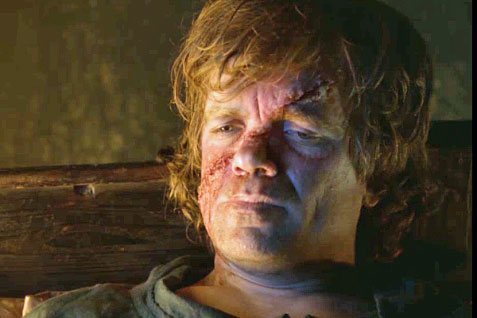
The Imp’s fall from grace has already begun. He’s left disfigured after being attacked by Ser Mandon Moore of the Kingsguard, and was moved from the Tower of the Hand to recover in a small, dank chamber in the Red Keep. Tyrion recognizes that Cersei must have ordered the assault, but with no way to prove it and his reign as Hand of the King over, there may not be much he can do about it.

However, Tyrion is still Tyrion, he refuses to run away with Shae because he intends to get his revenge somehow. “In the game of thrones you win or you die,” and Tyrion ain’t dead yet.

The Lion and the Rose, Sansa’s Future

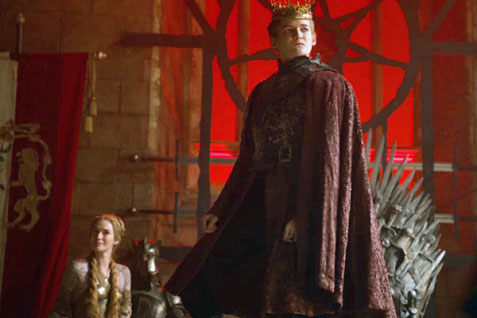
Meanwhile, Tywin has been named Hand and Savior of the City. Of course, he didn’t do it alone. Without House Tyrell and the strength of Highgarden behind them, the Lannisters would have been crushed. As a reward, Margaery is betrothed to Joffrey.

The Lion and the Rose are allies now, but their alliance is tenuous at best. The Tyrells are not as stubbornly honorable as Ned Stark, they know exactly what they’re getting into. We already know Margaery realizes how the game is played, recall that when Renly died, she didn’t want to be “a queen,” she wanted to be “the queen.” If you think she’s something, just wait until you meet Grandma Olenna, also known as the Queen of Thorns (who I really hope is played by Maggie Smith).

Although they’re now on the same side, look for the Tyrells and Lannisters to be fierce competitors and conspirators in the capital. Think of the way Cersei and Tyrion clashed this season minus any concerns about kinslaying and the whole “no matter what I kind of sort of love you” thing.

With Margaery in the picture, Sansa is now free of any obligation to Joffrey, or so she thinks. We saw many times that “Game of Thrones” had perfected the art of the fade from smile to grimace, but Sansa’s walk out of the throne room might be the first time we’ve seen the reverse. Then, she’s back to tears in her eyes and “I’m not good enough for him” when Littlefinger calls to her.

For her part, Sansa’s finally figuring out how to play the game, although, as Lord Baelish points out, she’s not quite as good as she thinks, nor is she off the hook with the king. Luckily for her, Littlefinger offers to help get her home, supposedly because of how much she reminds him of Catelyn. Of course, he’s turned on a Stark before, so we’ll have to wait and see if Sansa’s lucky or “lucky.”

Continue reading »

« Older posts Newer posts »

© 2026 Bullz-Eye Blog

Theme by Anders NorenUp ↑