
A friend just tipped us off on this band after seeing them at The Music Hall of Williamsburg.
Check out this live video from A Place to Bury Strangers.
A friend just tipped us off on this band after seeing them at The Music Hall of Williamsburg.
Check out this live video from A Place to Bury Strangers.
If you haven’t been watching A&E’s new series “Longmire,” you’ve been missing out on arguably the best original drama on the network…and in case you think that might be damning it with faint praise, I’ll go ahead and up the ante and suggest that it’s one of the best new dramas of 2012. With a tone that places it somewhere between FX’s “Justified” and CBS’s “Jesse Stone” movies, “Longmire” has the modern-day-western elements of the former but the pace of the latter, resulting in a series that isn’t afraid to take its time to get to where it’s going. I was fortunate enough to speak with “Longmire” executive producer John Coveny about the series wrapping its first season, prepping for its second, and how much more of the supporting cast we’ll get to see when the show comes back for its sophomore year.

Bullz-Eye: Season 1 of Longmire is just getting ready to wrap up. How have you enjoyed working on the show thus far? Do you feel like you’ve gotten a handle on these televised adventures of Walt Longmire?
John Coveny: I feel like we do. I’ve said this before, but when I come home, I’ve said, “I’ve never been more tired or more proud in my life.” [Laughs.] Just as far as what we’re creating, that kind of crazy creative alchemy that shows have, with the crew and cast, the writers and editors, the studio and the network, all seem to be on the same page. Or, by virtue of the experience of seeing a couple of episodes, they’ve gotten on the same page. We’re all making the same show, I guess you’d say, and we’re all ready proud of it. And we’re looking forward to ramping back up for Season 2. We like being kind of the unknown show that people are starting to discover. It’s a nice place to be right now.
 Brad Neely, perhaps best known for his hilarious “George Washington” and “JFK” music videos, has built an empire of off animatics (still images edited together with dialogue and sound effects). The creator of “Creased Comics” also invented a fictional town called China, Illinois, in which several strange characters reside, including a huge, baby-faced man named Mark “Baby” Cakes. In the series “Baby Cakes,” Neely explores the unique life and philosophy of this probably autistic, mostly gentle giant, and the results are very funny, always absurd, and even sort of profound and sad a surprising amount of the time.
The first six episodes of “Baby Cakes” find Baby Cakes transcribing his thoughts on a variety of subjects into his diary. The very first episode sets up a few recurring themes of the series, such as Baby Cakes’ belief that his father and his father’s professor friends are wizards, and his love of fantasy role-playing games. When one of his friends asks him if he’s a virgin, Baby Cakes’ reply is a perfect example of his strangely limited understanding of the world: “I said no, because I can’t give birth to a Jesus.” The episode also sets up Baby Cakes’ recurring songwriting, and some of the later episodes are entirely made of these songs.
The second episode introduces Baby Cakes’ grandfather and explores the relationship between the three generations, and demands a few repeat viewings in order to decipher the ridiculous bathroom graffiti Baby Cakes encounters in a gas station bathroom on the way to his grandfather’s house. The third episode is among the series’ very best, as it is the first one that really captures the sweet, oddly sad philosophy and worldview of Baby Cakes, a self-described “peaceful, sleepy giant making zero a year.” As Baby Cakes walks through the park, reflecting on the world around him, as he sees it, in a unique parlance all his own: “I have a big coat, with big pockets. Sometimes, kittens get in there. It’s cool with me as long as they keep their hook-socks curled.” The episode ends with a wonderful encapsulation of Baby Cakes’ views about life: “Even if my days don’t mean anything, I just hope that I die while hugging, and not while in a wine-drinking contest.”
The sixth episode expands on this strange but surprisingly insightful worldview, and just might be the very best episode of the entire series. It finds Baby Cakes digging up a time capsule he buried as a child, in which he placed his favorite thing and a note to his future self, in which he explains sex: “Sex is a people-spaghetti. Hairy pee-pees clash. They yell, ‘Yes! Yes!’ but their grody faces say, ‘Ouch!’” The rest of the episodes (the non-diary ones) are something of a mixed bag, but there are definitely highlights, and the whole series is only about 32 minutes long, with more brilliance scattered throughout than most full-length television series.
It’s probably a good thing that the Summer Olympics are going on right now, because this week’s new releases don’t offer a whole lot to get excited about. While horror fans will find a few titles worth digging into, the only real Blu-ray of note is the reissue of the Arnold Schwarzenegger sci-fi classic, “Total Recall” – unless you love Marilyn Monroe, in which case Fox’s seven-movie “Forever Marilyn” box set is an absolute must-have.

With a new version of “Total Recall” arriving in theaters this weekend, it was inevitable that Lionsgate would reissue Paul Verhoeven’s 1990 original on Blu-ray in conjunction with its release. It’s been a long time since I’ve seen the movie, and the first thing that crossed my mind upon revisiting the film was that I couldn’t believe my parents actually let me watch this at such a young age. Though not nearly as violent as Verhoeven’s other sci-fi cult classics “RoboCop” and “Starship Troopers,” “Total Recall” has its share of graphic gore, not to mention the grotesque (but brilliant) special effects by Rob Bottin. For as beloved as the movie is in certain circles, however, it hasn’t held up particularly well, with many of the futuristic props and production design coming off even cheesier and more dated than before. Of course, that’s the danger of the sci-fi genre, but it doesn’t change the fact that “Total Recall” is still a fun slice of escapist entertainment that, depending on which side of the “Was it real or a dream?” argument you fall on, is also a lot smarter than it looks.
Blu-ray Highlight: The audio commentary by director Paul Verhoeven and star Arnold Schwarzenegger is a great listen if you never got around to checking it out on previous releases, but the disc’s all-new interview with Verhoeven is a much more interesting retrospective on the film’s production process, with the director offering details on the script and its troublesome third act, working with Arnold, the visual effects and more.
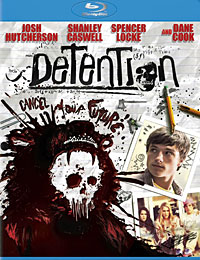
Joseph Kahn’s bizarre genre mash-up is one those movies that will likely earn a small cult following who swear that it’s a misunderstood masterpiece, but they’d be wrong. Those same people might even say that it deserves to be admired for its originality, and while that’s true to a certain extent, the entire plot is dependent on paying homage to a medley of films including “Scream,” “The Breakfast Club,” “Back to the Future,” “Heathers, “Donnie Darko,” and every Gregg Araki movie ever made. Though it shows some real promise early on (the opening sequence, in particular, is a hilarious meta-satire of teen slasher films), “Detention” gradually gets worse as the story begins to lose focus amid its scattershot collection of ideas – some good, some bad, and some just poorly executed. The movie is all over the place, and despite Kahn’s attempts to make sense of everything by introducing time travel to the equation, he only ends up creating an even bigger mess. There are some brief moments of comic brilliance scattered throughout, but why waste your time when you could just watch the far superior “Cabin in the Woods” instead?
Blu-ray Highlight: Regardless of how you feel about the movie, the picture-in-picture commentary track “Cheat Mode: The Unbelievably Mind Melting Making of ‘Detention’” is the kind of extra that I’d like to see on more Blu-ray releases. Unlike Universal’s similar U-Control feature, “Cheat Mode” runs the entire length of the film and includes interviews with the cast and crew, behind-the-scenes footage, photos and much more.
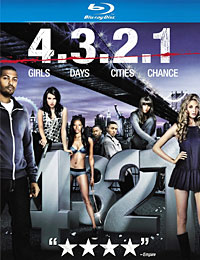
I don’t know what it is about the British and their obsession with crime films, but credit to “4.3.2.1” for at least trying to do something different with the genre. Unfortunately, Noel Clarke’s follow-up to his directorial debut, “Adulthood,” is a simple case of a good idea ruined by terrible execution. Presenting the film as a series of interconnecting stories is a difficult undertaking on its own, but organizing it in such a confusing manner (with each part of the tale told in its entirety, one after the other) causes a disconnect with the audience early on, as it’s difficult not to feel completely lost. Granted, by the time all four stories have unraveled, everything starts to make sense, but apart from the “ah-ha” moment that it provides, it’s wholly unnecessary. Most of the acting is solid, and the movie features some fun cameos from the likes of Kevin Smith and Mandy Patinkin (the former of which is the highlight of the whole film), but “4.3.2.1” gambles so much on its gimmicky plot device that Clarke has no one other than himself to blame when it doesn’t work out.
Blu-ray Highlight: The only included extra is a pretty standard making-of featurette comprised of interviews with writer/co-director Noel Clarke and the cast. It’s hardly must-see material, but fans of the movie won’t be completely disappointed either.
SPOILER WARNING: This post will appear every Monday following a new episode of “Breaking Bad.” It is intended to be read after seeing the show’s latest installment as a source of recap and analysis. As such, all aspects and events that have occurred up to and including the episode discussed are fair game.
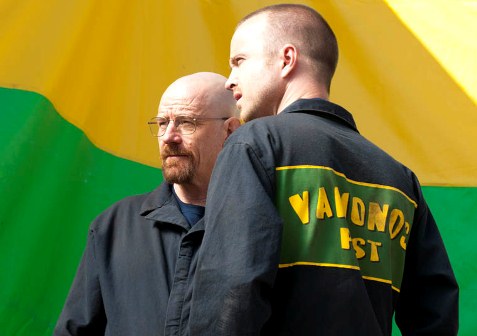
Walter White or Heisenberg?
The transformation is nearly complete. The artist formerly known as Walter White is almost pure Heisenberg, although the sympathetic family man we (along with his family and friends) once knew and loved is still in there, popping up now and again to, say, be fascinated by machinery and tell an anecdote about the summer he spent working in a box factory. Then poof, he’s gone as soon as he appeared, and we find that the only reason he was hearkening back to days gone by was to explain why such a location will not be a suitable for his meth lab.
This juxtaposition of (what’s left of) Walter White and his super villain alter ego Heisenberg is one of the major themes of the final season, but it played an especially large role in “Hazard Pay.” At any given moment, the viewer can and should be questioning just which “aspect” of the man is speaking and acting. Sometimes it can be hard to tell, and sometimes, as in the above example, you can be positive it’s Walter White, only to discover it was just the opposite.
“Hazard Pay” was chock full of such moments. Was that a man casually enjoying “Scarface” with his son, or a “real” ultra-violent drug kingpin idolizing a fictional one? Was the guy sitting on the couch with Brock awkward because of remorse or was he silently confirming that poisoning that very child was simply doing what needed to be done? Can it be both?
In those instances, maybe. But the best and most important Whitenberg contrast came during his (their?) post-cook beer with Jesse, while discussing love and honesty in relationships. At first it was a quietly beautiful moment of genuine discourse: the friend and father figure offering advice to his business partner while acknowledging that the choice was ultimately his own and treating him as an equal, perhaps for the first time. But by the time the commercial break rolled around I found it was something else entirely: Heisenberg subtly manipulating Jesse to ditch Andrea and Brock—the only loose ends remaining from the Gustavo Fring saga.
Jesse realizes this too, although it takes him a bit longer. After the money squabbles have run their course, Walt asks Jesse if he’s OK. Given their earlier conversation, Jesse believes Walt’s asking how he chose to deal with the Andrea situation, and says he’s broken it off with her, although he will continue to support she and Brock financially. Walt brushes this away, because in his mind, of course Jesse broke it off, that’s what he had intended, so that’s what’s occurred. Just a few days earlier, Jesse was honestly considering marrying this woman.
Instead, Walt is referring to the money. Seemingly out of the blue, he brings up Victor, the man whose throat Gus slit just to send a message. Only he’s thinking that might not have been the whole story. Maybe Victor, who decided to begin the cook himself when Walt and Jesse wouldn’t, “flew too close to the sun, and got his throat cut.” It’s hard to know just what Walt’s really talking about, but I’ve got a guess: maybe Walt feels Mike is flying too close to him, the sun, and that sometime soon he’s going to get his throat cut, and Walt will take over the business end too. In this analogy, Walt is the sun, and the universe quite literally revolves around him.
Killing Gus has given the ever-prideful Walt a surge of confidence. He feels as though he’s untouchable and that everyone answers to him. When Mike asks if they should take a vote on the tented-house plan, he responds “Why?” as in, “Why? I made the decision and that’s all there is to it.” Mike’s noticed this and tries to set him straight with, “Just because you killed Jesse James doesn’t make you Jesse James.” Clearly, Walt’s not so sure that’s the case.
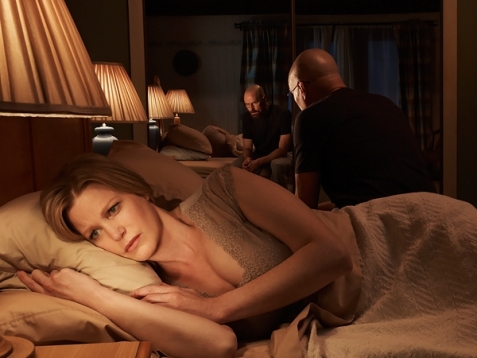
Skyler’s Breakdown
As she said, Skyler is afraid of her husband. Her murderous, drug-cooking, sociopath husband, and rightfully so. Indeed, Walter has abused her sexually, and now he’s moved back into the house without so much as asking her opinion on the matter. All she got to do was stand in horror and mumble questions about whether he thinks that’s the right decision. Just a few more notches in the Walt thinking he’s the invincible boss count. Why should there be a vote on where to cook? He’s decided. Why should there be a discussion about whether he should move back in? He’s decided.
Walt’s unannounced return is the last straw for Skyler. She’s visibly shaken, but can’t discuss these things with Walt, so it all comes out on Marie instead. When Marie demands to know the cause of her sister’s breakdown, Walt makes himself the victim, the cuckold, the honest, sympathetic man who’s still trying to put things back together despite his wife’s infidelity. That’s Heisenberg talking, there’s no doubt about it, and that’s Heisenberg who stops to chomp on an apple before checking up on Skyler. Then, when she finally emerges from her room to find him playing the good guy with their son and watching Tony Montana go up in smoke, it’s all her fears realized. Heisenberg is sitting there with their daughter in his lap and their son at his side, perfect father that he is, and asks Skyler to join them. After all, they’ve got popcorn. He’s doing his best Walt impression, but that’s the bad guy. She knows it, he knows it, and ultimately, we know it. It’s getting harder and harder to root for Walt, for those of us who still are (to some degree) anyway, and I’m wondering how much longer we can keep this up.
A few extra bits:
-It’s more than a bit ironic that it’s Walter’s genius idea to cook in houses being fumigated for pests. This is the same man (sort of) who once refused to cook because of a single fly in an otherwise immaculate laboratory.
-Walter notes that “everyone dies at the end” of “Scarface.” In that film, there’s a big shootout as the result of one arrogant drug kingpin’s rising too power way too fast. Probably just a coincidence Walt was buying that M60 in the first scene of the season, right?
Follow the writer on Twitter @NateKreichman.


© 2026 Bullz-Eye Blog
Theme by Anders Noren — Up ↑


