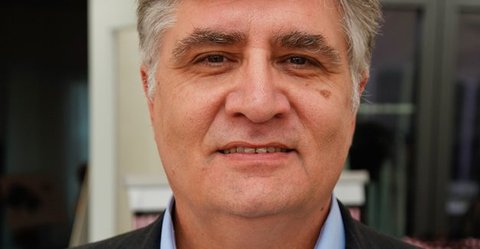
Maurice LaMarche has been my Facebook friend for several years, but I’d never actually met him, talked to him, or even traded email with him until a few days ago…which means, of course, that he really wasn’t my friend at all. I mean, not really, anyway. After I found out that he and I would be chatting in conjunction with the return of “Futurama,” however, I decided I’d tag him on my status update about our upcoming conversation. In turn, I drew Mr. LaMarche’s attention at long last…or, at least, one of my “likes” did.
Eh. Either way, Maurice LaMarche kinda sorta knew who I was when I got on the phone. I’m chalking it up as a win.
Maurice LaMarche: Now, I’m looking here on your Facebook page, and…who are your likes? Because I see you’ve got “The Newsroom,” and then you’ve got this guy with really tightly cropped hair, but then when I go into your page, you’ve got something like 1,200 “likes,” so I can’t tell who he is. Do you know who I’m talking about?
Bullz-Eye: Yeah, he’s…I’m blanking on his name right this second, but he’s part of the cast of USA’s “Suits.”
MLM: Hmmm. Because he looks like a guy who used to be on a show that I loved that got cancelled, a show called “Jake In Progress.” He played a magician, I think, but…God, that’s gonna drive me nuts now. I’ve got to look up “Suits” now! [Laughs.] Sorry! Then we can start. I’m a little compulsive…
BE: Well, look, I’ll help you out: that’s the same guy. His name is Rick Hoffman.
MLM: Yes! I love him! He’s so good. So funny. I love that guy.
BE: Yeah, I think I first saw him on “Samantha Who?”
MLM: Okay, so you never saw him on “Jake in Progress,” then…? Oh, “Jake in Progress” was my favorite show, and it just was treated so… [Puffs up his voice.] …ignominiously by ABC. Reminiscent of the way they treated a certain futuristic cartoon show, one might say.
BE: I’m sure I don’t know what you’re referring to.
MLM: I’m sure I don’t, either. [Laughs, then puffs up voice again.] But Comedy Central has treated us much better.
BE: Yes, “Futurama” continues to be the gift that keeps on giving. It’s like a zombie: Fox tried to kill it, but they couldn’t get rid of it.
MLM: That’s right. We just keep coming back at you. And we’ll try not to do any zombie storylines, so…thank you for your patronage. [Laughs.]
Raise your hand if, when you first heard about the USA Network series “Necessary Roughness,” the first thought that came to mind was the 1991 film . . .
Uh-huh. That’s exactly what I thought.
Oh, fine, so I couldn’t see how many people raised their hands. I still refuse to believe that I’m the only one whose mind went down that road, though I admit that it’s possible I was the only one who was also thinking, “You might, I might actually watch that…” Not that it was a great film, but it had a pretty interesting cast (Scott Bakula, Jason Bateman, Hector Elizondo, Robert Loggia, Larry Miller, Sinbad, and Rob Schneider), and the college-football-team premise is one that would be easy to pick up 20 years after the fact.
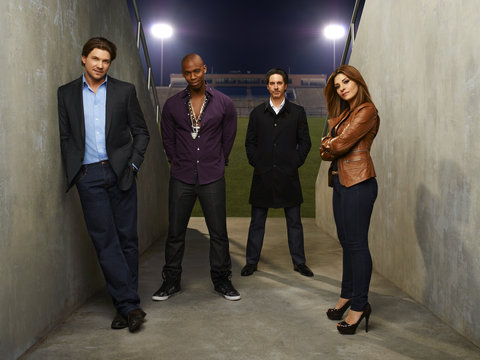
But, no, USA’s “Necessary Roughness,” while also about football, instead revolves around Dr. Dani Santino (Callie Thorne), a divorcée who reluctantly takes on a job as a therapist for a pro football team – the fictional New York Hawks – in an effort to keep herself and her children afloat financially. After settling into the gig, Dani’s success with the Hawks combined with a significantly increased profile lead to a sudden influx of new and equally high-profile patients. In addition to Thorne, who you may remember from her roles on “Homicide: Life on the Street,” “The Wire,” and “Rescue Me,” the show has several other familiar faces within its cast, including Marc Blucas (Riley Finn on “Buffy the Vampire Slayer”) as Hawks athletic trainer Matthew Donnally, Scott Cohen (Max Medina on “Gilmore Girls”) as Nico Careles, the team’s ex-SEAL head of security, and Mehcad Brooks (Eggs on “True Blood”) as T.K. King, the Hawks’ star player.
What’s that? You say you’re intrigued and want to know what you missed during the show’s first season? Wow, good thing USA thought ahead and put together the perfect collection of clips to summarize the first 12 episodes for you…
A few weeks back, USA was kind enough to offer me the opportunity to head down to the “Necessary Roughness” set, tour the facility, and meet with Thorne, Cohen, and Brooks. Each of these fine folks sat down with myself and my fellow TV critics, bloggers, and interviewers (I’m just trying to cover all the bases to avoid missing out on someone’s favorite term for themselves) and chatted about their work on the series thus far and what viewers can expect from the second season of “Necessary Roughness,” which premieres – yikes! – tonight at 10 PM.
That’s fine, go ahead and run set your DVR now, so you don’t forget. But rush right back, because the highlights of those on-set conversations are coming right up…
Former rock musician and current author and entrepreneur Jack Passion has been making an admirable living off of something most men actively remove from themselves on a semi-daily basis. Author of “The Facial Hair Handbook” and multiple world champion “beardsman” in the “Full Beard, Natural” category, Passion is a star of the IFC television series “Whisker Wars” and was most recently featured in Morgan Spurlock‘s new documentary “Mansome,” executive produced by Ben Silverman, Jason Bateman and Will Arnett. I recently got the chance to briefly interview Passion via email.
Ezra Stead: First of all, and I’m sure you get this all the time, how long did it take you to grow your beard to such length and fullness?
Jack Passion: I’ve had this beard for almost exactly nine years. I keep it trimmed, but this length would probably take 3-4 years to achieve. My book’s first law is “Healthy Man, Healthy Beard,” and I attribute the thickness of my beard all to my diet and health. I also take VitaBeard, the beard vitamin, which is very easy and helps quite a bit.
ES: Would you ever consider styling it in some weird, unique way, in order to compete in “Full Beard, Groomed” categories, as opposed to “Full Beard, Natural”?
JP: I have done styled categories in the past. I already look silly enough as it is, and the products required for those designs ruin the hair. When you see the German beard-styling masters with their beards un-styled, the beards don’t look great. I view the beard as a natural thing, and so I like to present it naturally and care for it naturally.
ES: My beard doesn’t seem to grow past about two inches. Are there any special techniques or products you’ve used to encourage yours, or is it pretty much all genetic?
JP: A lot of it’s genetic, but facial hair changes a great deal as you get older, so don’t give up hope! I mentioned VitaBeard, which has really changed the way I grow facial hair for the better, but I would also recommend waiting, as your beard grows in cycles. In your case, maybe it’ll plateau at two inches for several months before starting to grow again.
ES:How did you get involved with the documentary “Mansome”?
JP: I wrote a book called “The Facial Hair Handbook” and had won a few world titles in beard competitions, so when Morgan Spurlock’s team needed a beard, they came to me.
ES: Why did you decide to “quit and renounce music”?
JP: This is a long conversation, one that I absolutely love to have, but one that is outside the scope of “Mansome” and male grooming. Perhaps another time?
It’s likely you were first captivated by her Oscar-nominated performance in 2009’s “Up in the Air,” but that doesn’t mean the widely acclaimed comedy was Anna Kendrick’s first go-round in the world of big time performance. Ms. Kendrick, who is also a very fine singer, had been one of the youngest Tony nominees of all time when she was recognized for her work in a Broadway revival of “High Society” at age 12. Her first major film role was nevertheless four years away with another award-nominated musical appearance in the indie fave, “Camp.”
A few more years of hard work would land the young actress a leading role in the mostly well-regarded coming of age comedy “Rocket Science” and a recurring part in the pop culture behemoth we call “The Twilight Saga.” Still, it was only when Anna Kendrick wound up stealing scenes from George Clooney and Vera Farmiga that she became one of Hollywood’s hotter faces to look out for. She also earned the attention of geeks around the world with her role as Michael Cera‘s acerbic yet gorgeous younger sister in “Scott Pilgrim vs. the World”; her reported romance with director and uber-film nerd Edgar Wright (“Shaun of the Dead“) probably did no harm to her already impressive and growing dweeb appeal. The 20-something actress’s most recent non-“Twilight” major film appearance was as a romantically conflicted therapist in the cancer comedy, “50/50.”
Purportedly inspired by the self-help bestseller of the same name, “What to Expect When You’re Expecting” features Kendrick as a food truck proprietor whose fling with a high school flame (Chace Crawford) results in a surprise pregnancy. She was busily promoting the film when we caught up with Ms. Kendrick at the Los Angeles Four Seasons one Cinco de Mayo afternoon. There, she proved herself to be up to the 5 questions challenge, giving succinct answers to our slightly longish questions.
1. You play a professional chef in the movie. Do you cook in real life, and what was the most important thing you learned about food preparation while making the film?
I cannot cook. I bake a bit, but I cannot cook to save my life. We had to take lessons for this. [The most crucial thing I learned in them was] that you have to hold your hand like a claw and not lay it flat, so you don’t cut off your fingernails — like I did.
2. “What to Expect When You’re Expecting” is part of the ever-growing subgenre of interlocking story movies that includes everything from Robert Altman’s “Nashville” to Garry Marshall’s “Valentine’s Day.” What’s your favorite multi-story movie?
Now that you mention “Nashville,” I actually do love that movie. But as far as the modern version of that genre, I actually really love “Love Actually” — but “Nashville” is really great and I loved [Paul Thomas Anderson’s] “Magnolia.” That was one of those movies that, when I was a teenager, [I thought to myself], “Movies can be like this? This is great!”
3. You’re probably best known to the public for your really outstanding performance in “Up in the Air.” I was just watching the scene where you kind of break down, and you’re very funny. I was wondering what you think is the secret to comic crying, as opposed to sad crying? I’ll dedicate this question to Mary Tyler Moore.
I like to talk through the funny cry. That makes it sort of easier, but I’m a pretty ugly crier, so that makes it kind of easy also.
4. Let’s talk about your singing roles. What was it like being a 12-year-old Tony nominee? And what about being 16-years-old and making your first movie, “Camp” and blowing everyone away with your version of Stephen Sondheim’s “The Ladies Who Lunch”?
It was obviously incredibly exciting, but I think it’s probably good I didn’t fully understand what a big deal the Tonys were at that age. I think my little 12-year-old brain would have exploded. It was just exciting. I was just happy to be invited to a party really.
[“Camp”] was such a magical thing to make. It was everyone’s first film. Now, everyone says, “Making a film feels like summer camp,” but [during] that film we were living at that summer camp. We had no contact with the outside world. There were no cell phones, no computers, no TVs. So, it was just us and the film crew living in this place. It was a very intense and fun [thing] to do with a bunch of teenage non-actors.
5. There’s a clip online of you promoting “50/50” with your co-stars Joseph Gordon-Levitt and Seth Rogen and discussing how women tend get asked different questions from the press than men do. You get asked about health and beauty stuff, your workouts, etc. What is the most embarrassing or just plain stupid question you’ve gotten and how did you answer it?
In relation to [“What to Expect When You’re Expecting”], somebody asked me if I would be prepared for a one-night stand. I was like, “I don’t even know how to get out of this question in a joking way. That is so wrong and weird.”
Now that “Breaking Bad” is back in production for its final 16 episodes – which, if you haven’t heard, are going doled out in two parts – it’s time to start ramping up for the series’ return to the airwaves later this summer. As such, AMC is rolling out Q&A’s with some of the cast members. First up is someone Bullz-Eye’s never actually spoken with before: stand-up comedian Lavell Crawford, who plays Saul Goodman’s bodyguard, Huell:
Q: What was it like to go from being a stand-up comic to a tough guy on “Breaking Bad”?
A: I loved it, it was a great opportunity to be on a hot show. There were a lot of directors and they wanted to shoot so many angles — like the scene where I had to take a dump? They made me do seven different takes! They were like, “Do a little more, act like it came out a little more.” I was, like, “Jesus Christ, I’m about to crap on myself!”
Q: What did you think when you showed up on set to find that you were actually one of two comedians playing Saul Goodman’s henchmen?
A: When I walked in and saw Bill Burr (Kuby), I thought it was hilarious. We’ve worked together as comedians, so he laughed and I laughed too. It was so funny that we were playing these guys that were going to scare the hell out of Ted.