Category: Television (Page 43 of 84)

App of the Week: “The Walking Dead: Assault”

Developer:
Skybound LLC.

Compatible with:
iPhone 3GS and up (optimized for iPhone 5)

iPod Touch 3rd gen and up

iPad

Requires:
iOS 4.3 or later

Price:

$1.99

Available here

Between the amazing 3rd season of the AMC show, and the groundbreaking, incredible, indescribably inventive Telltale Games adventure series, we’ve been treated to more “Walking Dead” goodness this year than anyone could have possible anticipated. Yet for mobile developer Skybound, it wasn’t quite enough as they now bring us yet another reason to celebrate the increasing influence of the Robert Kirkman comic series on the digital world with their gaming app, “The Walking Dead: Assault”.

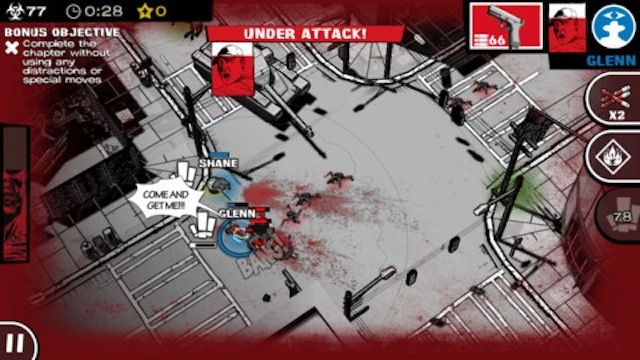
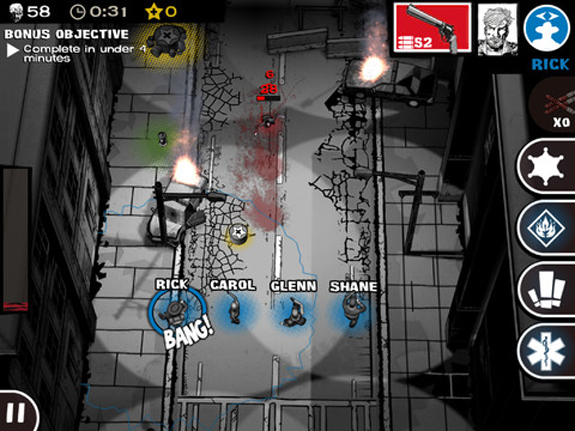
The game, much like Telltale’s, is based off of the original comic, and not the TV show, which is immediately evident by the appealing visual style, where most everything in the game is smartly presented in black and white except for aspects of characters, items, and blood. It lends a very necessary immediate appeal, and produces that always appreciated (if unwelcome) “someone looking over your shoulder while you play” effect.

Unlike the Telltale masterpiece though, this game is centered more on action than character interaction, as it employs a squad based  mechanic (think “X-Men Legends”) that feels right at home in this world. At its core, it doesn’t stray far from the usual tropes of the genre, as you select a group of 4 characters and take them through a series of levels completing mandatory and optional objectives, while fighting off waves of enemies. Along the way you can improve character and group attributes, acquire a range of supplies and weapons (melee and ranged) and take advantage of character’s unique abilities and group effects such as always hitting head shots for a short period of time, or increasing overall group damage. It makes the careful selection of your group vital and entertaining.

Outside of standard mechanics, the game incorporates some specific aspects of the zombie apocalypse nicely through elements like the sound detection system, which allows you to use environmental distractions to draw zombies (though too much noise will bring down the fury of the entire horde). It also does a nice job of compensating for the limits of the touch mechanics, and everything from managing the group, to managing the camera, is handled smoothly. Meanwhile, features like your group auto firing when enemies are in range help keep the action from being upset by poor design, and really show off the potential of this type of game on the mobile format when done well.
“The Walking Dead: Assault” is designed to perfection, which is great since underneath it all is an intensely fun adventure that’s multiple sections and objectives provide a lengthy experience that satisfies that immediate “kill all zombies” urge, but also lends some real substance to the proceedings with the leveling and ability functions. Thanks to the style and execution of the game, the constant bombardment of action never really feels repetitive, and the story of the comics is well implemented through comic book panel interludes.

Right now the game is only the first in a planned series of chapters, but even if more weren’t on the way, this title would be an easy recommendation. Zombie games are a dime a dozen, and mobile squad games rarely work out as they should, but of course it’s the “Walking Dead” series that again breaks new ground. Much like pulling the trigger on a walker, anyone with a slight interest in this game can’t afford to hesitate and should snatch this app up at the introductory $1.99 price.

It was Romero’s “Dawn of the Dead” that theorized that when there is no more room left in hell, the dead will walk the Earth. While that was meant as a warning of the end of days, in this case it’s a welcome happenstance that lends us the chance to play “The Walking Dead: Assault”, a no-brainer (pun very much intended) app of the week.

Sons of Anarchy 5.12: Darthy

SPOILER WARNING: This post will appear following a new episode of “Sons of Anarchy.” It is intended to be read after seeing the show’s latest installment as a source of recap and analysis. As such, all aspects of the show up to and including the episode discussed are fair game.

Can “Sons of Anarchy” accomplish the unthinkable, can it make Clay Morrow a likable character again? Over the course of the second half of this season, Clay has become more and more sympathetic. He’s not actually sympathetic, not yet anyway, but the Clay of late is at least a human being. His confession to the club was real, the most honest words we’ve ever heard him utter. That’s not to say they were the complete truth or that they didn’t contain some element of self-preservation. And granted, if Bobby got even a whiff of bullshit, I’m sure he would’ve joined the rest of the club in voting “yay” on Clay meeting Mr. Mayhem. But the confession was still a revelation. When we saw Clay ask for some time alone so he could break down and cry, it may have been our first ever glimpse at the person behind the crimes. I had to remind myself of the crimes to stop from feeling sorry for the person.

Clay now hopes to start and lead his own small club to earn money. It’s a dream that has clear parallels with Nero’s hopes of settling down with his son on his uncle’s ranch, completely free of the life he left behind, or Jax’s desire to mold the club to fit his father’s vision (as well as last season’s goal of escaping Charming with Tara and the boys). These are exactly the type of fantasies we expect from the manchildren that populate this show, ambitions that are almost adorable in their simplicity and improbability—like when a toddler tells you he’ll grow up to be a professional baseball player. But just like the characters, we want to believe.

Clay’s retribution is something we’ve yearned for since season four at the latest (the pilot at the earliest), and it was accomplished in a way that met and subverted our expectations at the same time. Clay was brought to the table during the influx of his humanity, and as a result, the verdict on his survival brought both relief and frustration. Part of me enjoyed every moment of the beating Jax handed out afterwards, because I wanted Clay to die too. But at the same time it was the perfect illustration of Jax’s spiral out of control—the way anger and a thirst for revenge are driving him more than the good of the club ever did. It seems Clay’s justification for his dealings with the Nomads made sense in a fucked up, Clay sort of way. He was right that Jax wasn’t ready for the pressures of leadership, just not in the way he expected. Jax has been a fantastic president for the SAMCRO Clay built. But that wasn’t what he wanted when he took the gavel, he wanted to be a great leader for the club as he and his father envisioned it. The protester outside the White House clamors for world peace, but would he have the strength to make it a reality it if he was the one sitting in the oval office?

Love-hate-love (and vice-versa) arcs have always been “Sons of Anarchy’s” bread and butter. In the case of almost every major character, the show has started us out feeling one way and then worked to push us in the other direction. Often, when a character reaches the other side of the spectrum, the show turns him or her right back again. If you, like me, are starting to lose respect for the man Jax has become, it’s a mark of the show’s success. Shooting Wendy with heroin, given that she is an addict in recovery, was truly reprehensible. It’d be easier for us to see Wendy has a point about being the best person to raise the boys if not for the fact that Jax (and to a lesser extent Tara) are the protagonists. Likewise, Pope advises Jax to find a way to have Clay offed indirectly. Maybe it’s what Clay deserves. But at the same time, Jax going behind the club’s back to off him despite the vote to let him walk, purely for his own purposes, would be a trademark Clay move. If that’s the road Jax goes down, it will be the ultimate symbol of his transformation. Actions like these will give his inevitable redemption all the more emotional impact. I’m certain that by the series finale, we’ll be back in Jax’s corner. But I wouldn’t hold my breath. It might take the entirety of the final two seasons to accomplish.

Speaking of Pope, with Clay now stripped of all power, he’s sure to be a major source of conflict moving forward. I still don’t know if I believe Jax is just going to hand Tig over, even if Clay’s ousting means Tig’s usefulness is diminished (or even gone). At the same time I think the new Jax genuinely looks up to Pope. He tells Bobby that “you can’t sit in this chair without being a savage,” and given that Pope is the ultimate mentor in savagery, it makes sense that Jax would continue to seek his counsel. Whether he’s planning to turn Tig over or go to war with Pope, Jax is going to need every play in the savage book. Jax’s decision on the Tig front will either cement Pope as a friend or an enemy during the finale (if it’s the latter, Jax will have a plan to make it seem like he’s giving Tig up until the very last moment before taking Pope out).

Another source of conflict will be Lee Toric, the retired U.S. Marshall played by Donal Logue whose sister was the nurse Tara accidentally helped Otto murder. I predicted this meta motivation last week based on the fact that the actress who played said nurse was Logue’s real-life sister. Tara played her deposition almost perfectly. It’s clear her interrogator had his doubts about her innocence and naivety, but it’s not hard to imagine a scenario in which she gets off and Toric is forced to seek his own justice. Toric is next season’s big bad, meaning he’s here to stay. His appearance during the ending montage showed him holed up in the dark with enough weapons for a small army and a bag full of pill bottles (perhaps he’s addicted to painkillers or some other pharmaceutical, which would give him a weakness and explain why he’s a retired U.S. Marshall). The most unsettling thing, however, may have been Toric’s choice of literature, “Watchfiends and Rack Screams,” by Antonin Artaud. The book was written during the last three years of Artaud’s life, which he spent incarcerated at a mental asylum, and it reads like it. I made that joke about Jax needing every play in the savage book, well, he might have to ask if he can borrow it from Toric first.

Check out the preview for next week’s episode below and follow the writer on Twitter @NateKreichman.

The Light from the TV Shows: A Chat with Joe Berlinger (“The ‘Paradise Lost’ Trilogy”)

I can still remember the first time I watched “Paradise Lost: The Child Murders at Robin Hood Hills,” about the so-called West Memphis Three, a trio of teenagers – Jason Baldwin, Damien Echols, and Jessie Misskelley – who in 1993 were accused of the murder and sexual mutilation of three prepubescent boys in West Memphis, Arkansas. Maybe Baldwin, Echols, and Misskelley weren’t the most clean-cut teens imaginable, but watching the sad but undeniably enthralling “Paradise Lost,” it’s pretty easy to believe that their imprisonment was unjust, a case of the justice system gone horribly wrong.

Indeed, I was sufficiently affected by it that I continued to keep tabs on the case over the years, right up through when Baldwin, Echols, and Misskelley were finally released after almost 20 years behind bars. Similarly, directors Joe Berlinger and Bruce Sinofsky, the gentlemen behind the camera for “Paradise Lost,” continued to follow the saga of the West Memphis Three, resulting in two sequels, “Paradise Lost 2: Revelations” and “Paradise Lost 3: Purgatory.”

The whole trilogy has just been released in a four-disc set – one for each film, plus an extra disc of bonus material – and upon receiving a review copy, I was pitched an interview with Berlinger. At first, I hesitated, thinking, “Geez, do I have any place to run this?” Then I realized, “Hello, technicality: all three films made their debut on HBO, so I’m calling in a loophole and putting this baby in ‘The Light from the TV Shows’!” The next thing you know, I’m on the phone with Mr. Berlinger, having the chat that sits before you now. Read on…

Bullz-Eye: I should probably start by telling you that I’ve just spent a fair amount of the preceding 24 hours plowing through the new “Paradise Lost Trilogy” set.

Joe Berlinger: Oh, my God. Watching it in one fell swoop…

BE: Yeah, I said on Facebook, “This is a whole lot of depressing footage to watch and know that you’re only going to get a semi-happy ending in the end.”

JB: Yeah, I know. Imagine me living it! [Laughs.] At least I spread it out over two decades. But to pile it all on like that…I’m actually curious: how does it feel watching one after another? Does it feel repetitive?

BE: No, it doesn’t. [Hesitates.] Well, okay, there are moments, I guess. But they’re acceptable knowing the fact that each one was made several years after the next.

JB: Okay, so it holds up as a trilogy, watching one after another?

BE: I’d say so.

JB: Cool!

Continue reading »

R.I.P. Larry Hagman

Who shot J.R.? Is was one of the great mysteries in TV history, as ultimate badass and villain J.R. Ewing was shot at the end of season 2 on “Dallas.” Larry Hagman created a very memorable character in J.R., but it sounds like he was a pretty interesting guy himself.

The popularity of “Dallas” made Hagman one of the best-paid actors in television and earned him a fortune that even a Ewing would have coveted. He lost some of it, however, in bad oil investments before turning to real estate.

“I have an apartment in New York, a ranch in Santa Fe, a castle in Ojai outside of L.A., a beach house in Malibu and thinking of buying a place in Santa Monica,” Hagman said in a Chicago Tribune interview.

An updated “Dallas” series began in June 2012 on the TNT network with Hagman reprising his J.R. role with original cast members Gray, who played J.R.’s wife, and Patrick Duffy, who was his brother Bobby. The show was to focus on the sons of J.R. and Bobby.

Hagman had a wide eccentric streak. When he first met actress Lauren Bacall, he licked her arm because he had been told she did not like to be touched and he was known for leading parades on the Malibu beach and showing up at a grocery store in a gorilla suit. Above his Malibu home flew a flag with the credo “Vita Celebratio Est (Life Is a Celebration)” and he lived hard for many years.

In 1967, rock musician David Crosby turned him on to LSD, which Hagman said took away his fear of death, and Jack Nicholson introduced him to marijuana because Nicholson thought he was drinking too much.

Read the entire obituary. It sounds like he was one of a kind and he’ll be missed.

« Older posts Newer posts »

© 2026 Bullz-Eye Blog

Theme by Anders NorenUp ↑