SPOILER WARNING: This post will appear following a new episode of Justified. It is intended to be read after seeing the show’s latest installment as a source of recap and analysis. As such, all aspects of the series up to and including the episode discussed are fair game.
Almost every popular television drama has that character: the breakout, the one who isn’t the protagonist but becomes a fan favorite (and thus often a big part of the show’s advertising strategy). Boardwalk Empire has Richard Harrow, The Wire had Omar, The Walking Dead has Daryl Dixon, Sons of Anarchy has Chibbs, Breaking Bad has Jesse Pinkman, not to mention Mike Ehrmantraut. The list goes on. We often wish this character got more screentime, but understand that part of the draw is that we’re always left wanting more. That’s not the case in Justified (or Breaking Bad). Unlike those other shows, its story doesn’t follow one main character while the breakout badass ducks in and out. Instead, its version of the trope, Boyd Crowder, has become so vital that he’s every bit as much the protagonist as Raylan is (ok, he’s a deuteragonist if you really want to get technical about it, nerd). Pretty impressive considering Walton Goggins’ name wasn’t even in the opening credits until season two.
Those of you who know their Justified trivia know that Boyd was originally supposed to die from the bullet Raylan put in his stomach in the pilot episode, as he did in the Elmore Leonard short story on which it was based (“Fire in the Hole”). In fact, Goggins only agreed to be in the show to begin with as a favor to his friend Timothy Olyphant. But after both creator Graham Yost and test audiences saw how electric the character (and the actor’s performance) was, it was decided Boyd would live to fight another day. The move was even approved by Leonard, who tends to get upset when adaptations of his work stray to far from the source material. It’s not unusual for this kind of character to have their death cancelled—Jesse Pinkman, for instance, was originally meant to die at the end of the first season of Breaking Bad.
So where am I going with all this? Here: As Boyd has slowly risen through the ranks from one-off to co-protagonist, the writers have generally woven him into the story pretty gracefully. He had his side adventures and independent activities, but the first three seasons each had a single decidedly main plot, and Boyd always played an important role in its events. That is, until this year, when they’ve had nary any interaction at all. Until this week.
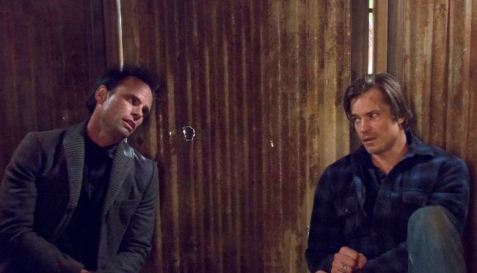
Prior to “Kin,” the writers appeared to be floundering for both a reason and a method to keep Boyd around. Save an interaction here or there, you could’ve edited his and Raylan’s plotlines into two separate shows that happened to share a setting, assuming you already knew all the characters. It seemed the two were each along their respective merry ways, and despite Boyd having very little to do in what was meant to be “Raylan’s show,” he was simply too good a character to toss out the window for a reason as “trivial” as not having anything to do with the plot (not that I’m complaining, I’d watch a show that was only about Boyd). But Justified’s bread and butter was, is, and will always be the intersection of the two characters.Whether it’s Boyd versus Raylan or Boyd and Raylan forming a tenuous alliance to take down some common foe, the whole is always greater than the sum of its parts. Boyd himself put it best (as usual) when he and Raylan found themselves locked in the hill people’s makeshift cell, “You wanna start a fight, Raylan? Nine times out of ten I’d be more than happy to accommodate. But right now I think we got more pressing concerns.” What made “Kin” such a special, exciting episode is that Boyd’s entrance into the rat race to find Drew Thompson delivered a return to that basic, ever-electric formula. We even got both versions of it: Boyd and Raylan have different reasons for wanting to find Thompson, but they work together against the aptly-named hill people.