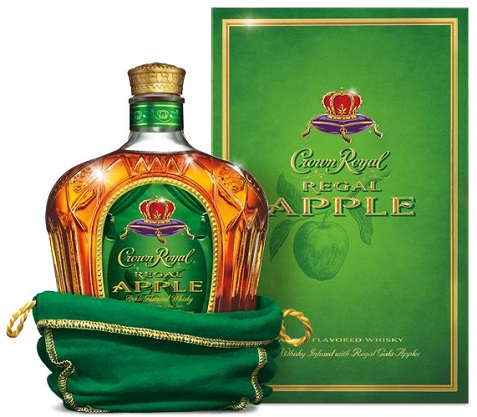
I’m a huge fan of Crown Royal Canadian Whisky, so I was looking forward to trying the all-new Crown Royal Regal Apple. The flavored whisky arrived in a sweet emerald green carton with the iconic Crown Royal bag in green and gold tones. Crown Royal Regal Apple is a combination of the well-known, premium taste of Crown Royal whisky infused with natural apple flavors. It’s delicious as a chilled shot as the strong apple flavor jumps out and you can use it for a number of great cocktails as well. With the beautiful packaging and the iconic Crown Royal brand it’s also great for a gift or something to bring to a party during the holiday season.
Walk into any liquor store and you’ll see hundreds of options. You can zero in on someone’s favorite drink when picking a gift, or you can get creative and choose something they wouldn’t buy for themselves. Also, remember that you don’t want to come to a party empty-handed, so get in the habit of at least bringing a bottle.
And for more gift ideas, check out the other categories in our Holiday Gift Guide.
Craft Beer Club
If you have a beer lover on your list, you can give him or her the gift that keeps on giving. The Craft Beer Club discovers exceptional craft brews from around the country and delivers them each month direct to you or your gift recipient. Every selection is produced by small-production, independent brewers who use only traditional brewing ingredients and time-honored brewing methods. In addition to traditional bottled beers, they also embrace the hundreds of small craft brewers around the country that offer their hand-crafted beers in cans. It’s a great way to enjoy craft beers and it’s ideal for the holiday season.
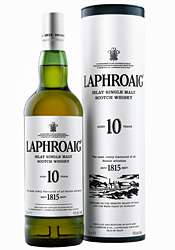
Laphroaig 10 Year Old Islay Single Malt Scotch Whisky
If dad, your buddy, your tomboyish gal pal or anyone else on your holiday list loves a very good bottle of Scotch, then consider this rather dandy, unusually enjoyable single malt. Outstanding on the rocks, with a splash of water or soda, or neat for you purists, the Laphroaig 10 Year Old is also more mixable than you might assume; on the other hand, it’s good enough that many will consider even the finest cocktail made with it a crime against nature. The website tells us that it’s got traces of salt and seaweed along with the usual peat and smoke flavors, but we don’t completely agree. It’s definitely got smoke – indeed, you might get hungry for barbecue after you take a good whiff and, yeah, that’s some salt in there, but that’s not all. Every good Scotch has its share of several indescribable tastes and smells of nature. We haven’t been to Scotland, but we wouldn’t be one bit surprised to find ourselves tasting the essence of this concoction in the clear cool air of the highlands. Cheaper than super-duper premium single malts but nearly double what you’ll likely pay for Chivas Regal, this is an outstanding gift for a true blue Scotch enthusiast.
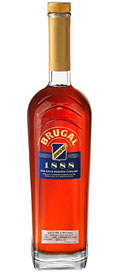
Brugal 1888 Dominican Rum
If you’re in search of a bottle for the man or woman who’s drunk everything, Brugal 1888 is something genuinely new under the sun and it’s completely remarkable. An aged Dominican rum that thinks it’s a premium Scotch or Bourbon, it has the tantalizing, woody and astringent flavor you might get in very a high-end single malt, plus a hint of something that somehow reminds us of our dad’s old fake-leather chair. (That’s a good thing, believe it or not.) At the exact same time, it has a boldly sugary undertone that goes well beyond what you’re likely to find in the sweetest bourbon. We tasted more than a hint of maple syrup or maybe turbinado. Regardless, it’s delicious and probably not like anything you’ve had before. You can drink this on the rocks, with a bit of water, or neat. You can also put on your mixologist hat and go to town as this is a flexible beverage that won’t be out of place in an Old Fashioned, especially if you use real maple syrup in place of the usual sugar or simple syrup. High priced for rum but worth every gosh darn penny, this is one boozy gift that won’t be forgotten.
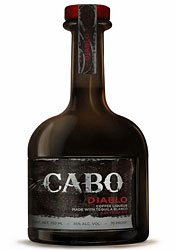
Cabo Diablo
This is the best new spirit we’ve tried in a long time. Cabo Wabo is known now just as much for its excellent tequilas as it is for its founder Sammy Hagar, and this new Cabo Diablo should attract many more fans. Cabo Diablo features a delicious coffee flavor and tastes amazing when you drink it straight. It’s sweet, but not too sweet, and it’s not think and syrupy like some liqueurs. So it’s a fantastic sipping drink that men and women should both enjoy. But better yet, it’s a tequila, so it’s also a great way to get a party going, as tequila makes everyone a little nuts at times. It is made with 100% blue agave Cabo Wabo Silver tequila, then kicks in notes of fresh roasted coffee, vanilla and chocolate for a striking combination. It’s excellent served chilled or on the rocks. With the holidays around the corner, this makes for a great gift for men and women, and it’s a great bottle to bring to a gathering to get the party started!
Flashy cars, hot girls, stacks of money, and of course … the partying.
Rappers like Eminem, 50 Cent, Ice Cube, Notorious B.I.G., Tupac, and many others get behind their brands. There is no shortage of the hard stuff whenever you catch one of their videos and if you happen to catch them in a club you’ll quickly see them poppin’ bottles at a table.
This love for the booze has even gone as far as to catch the attention of researchers which found that out of 700 top billboard hits almost 23% of them had some mention of alcohol.
The question becomes … which ones and what kind of drinks can you make with ‘em?
1. Wild Turkey
Whiskey and bourbon are two fine choices you’ll often hear mentioned in videos.
These are the drinks of gangsters – to whom many rappers try to replicate at least in image.
The aged drink shows sophistication and says that you’re not just there to chug down grain alcohol.
Of these brands, the Island of Kentucky has been putting out some of the best.
At around 86 proof (43% alcohol) you can expect to get turned up on one of these bottles.
If you want to drink with sophistication than consider the Sazerac:
• 2 oz Bourbon Whiskey
• 1 tsp Ricard Pastis
• 1 tsp Water
• 2 dashes Peychaud Bitters
• 1/2 tsp Superfine Sugar
• 1 twist of Lemon Peel
Preparation
Chill an old-fashioned glass. In a separate mixing glass, muddle the sugar and Peychaud bitters together. Add the whiskey and ice to the bitters mixture and stir. Rinse the chilled glass with Ricard Pastis by pouring a small amount into the glass, swirling it around and discarding the liquid. Strain the whiskey mixture from the mixing glass into the old fashioned glass. Garnish with a lemon twist.
The tequila that doesn’t taste like the devil and a favorite among rappers.
Patron is going to set you back a bit of money depending on the size of the bottle (expect to pay about $45 and up for a decent size) but it’s worth it once you taste the difference.
You ain’t going bottom-shelf on this one.
This legendary alcohol has been a favorite among rappers for decades. Tequila is usually one of those drinks that completely floors you but everyone has seemed to take a liking to Patron (probably because it doesn’t give you the rot gut, massive hangover the next day, as easily).
Drink with style via Patron Diablo:
• 1 1/2 oz Patron Silver Tequila
• 3/4 oz Creme de Cassis
• 1/2 oz Lime Juice (fresh)
• 1 splash(es) Ginger Ale
Preparation
Fill cocktail glass with ice then add the Patron Silver Tequila, Creme de Cassis, and fresh Lime Juice. Top off with Ginger Ale. Garnish with a lime wedge.
Hennessy go real popular once the hip hop crowd found it with big mentions by the likes of Tupac, Biggie, Drake, Dr. Dre, Wu-Tang, and a bunch of others. The reason why you’ve probably heard of the name is most likely because of a hip hop song.
Drinking it straight is always choice but if you want to be adventurous then try a Tap that Ass:
• 1 oz Hennessy® cognac
• 1 oz Alize® Red Passion liqueur
• 1 oz Alize® Gold Passion liqueur
• 1 splash cranberry juice
• Top with soda water
Preparation
Fill the hurricane glass with ice. Pour the Hennessy, Red Alize, and Yellow Alize. Splash in some Cranberry Juice and top it off with soda. For garnish you can add a slice of pineapple and cherries.
If you’re thinking about stocking up one some booze for your next party or if you just want to have some around the house than these three choices are great for building up that stock.
You don’t have to party as hard as the hip hop heads but you can certainly drink like ‘em.
Try out some of the mixes, too.
Remember: you don’t always have to drink it straight from the bottle.
This will probably drive me out of the cocktail writers’ club, but my regular, recipe-centric, DOTW was preempted by a cold. I know this will make me sound a bit wussy to some of you, but I personally do not find that alcohol “kills the cold germs” It’s more like granting the virus superpowers. Moreover, when I’m sick, some generic Alka-Seltzer Plus more or less does me just fine. In short, liquor has not passed these lips in over a week.
On the other hand, being sick also allowed me to wipe my DVR clean of “Mad Men” episodes…including episode 12, “The Quality of Mercy,” which my device decided to turn off about 1/3 of the way through the episode. I tried recording it again last night, but the show my DVR thought was “Mad Men” turned out to be CSI or NCIS or SVU or something else with letters or what not. I’m sure I’ll catch up with it all by next Sunday. The point is that “Mad Men” is whipping up more controversy and hysteria than ever, and it’s lovable/hatable alcoholic antihero/hero, Don Draper, has done more than his share to revive interest in classic cocktails in general and one ultra-classic, in particular, the Old Fashioned.
If you want a recipe, as such, you can find not one but actually two if you read my last look at the Old Fashioned closely. That was just a little over two years ago, but the two approaches to the drink in it remain pretty close to the way I often make it now…except I’m slightly more open-minded about the use of soda water. Still, I say keep it minimal if you use it at all.
On the other hand, that’s not quite what Mr. Draper does in this memorable scene from a long-ago season when he makes a new and short-lived friend in Conrad Hilton by making him an Old Fashioned. Yes, we’re breaking the format this week and in lieu of a recipe, you’re getting this legendary moment in televisionary cocktailing.
Now, watching this again, it occurs to me I’ve never made an Old Fashioned precisely this way. Don uses a bit more soda water than I would prefer. And note how he doesn’t really stir it, but just sort of dashes the bar spoon on the ice cubes a couple of times. On the other hand, his wetting of one sugar cube per glass (they look like rather large brown sugar cubes to me) with Angostura bitters and then muddling them is absolutely classic. The fact that he includes a cheap, bright red, non-Luxardo maraschino cherry in his muddling would, on the other hand, horrify many in the crafty cocktail set, but I don’t think it’s a problem.
No, if I were drinking tonight, I’d probably make pretty much exactly that drink, though I’ve never been a big Old Overholt guy. This rye has become the craft bar standard recently — I can’t speak for its popularity in 1963 — but I prefer my bonded Rittenhouse Rye or Don Draper’s favorite not-quite-rye, Canadian Club. (CC, by the way, sponsors a brief tutorial with their version of an Old Fashioned as an extra on the Blu-Ray/DVD of “Mad Men” Season Five.) Right now, I’d be using Bulleit’s Rye, because that’s what I’ve got. I’m sure it would be decent.
And that’s actually the thing about an Old Fashioned — even more than a Martini or a Manhattan, it’s sturdy and flexible. Paradoxically, it’s also easy to foul up completely, as most non-craft bars do, if you use too much sweetener, water, or even whiskey. One teaspoon for two ounces of whiskey is pretty much the right proportion, and it’s definitely also the maximum if you’re muddling fruit. Also never, ever, use the syrup that comes with the sweet-supermarket maraschino cherries as your sweetener. Don’t.
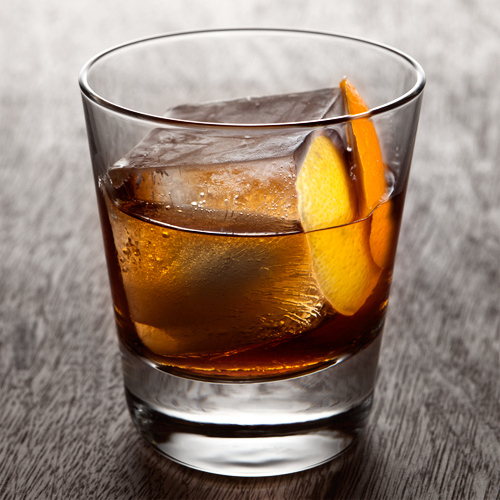
Still, like I said, there’s that a lot of leeway with your Old Fashioned. You can make the very severe kind with only a teaspoon full of soda water, a sugar cube, bitters, and not very much ice — or, the fashionable craft bar favorite, one giant and slow to dilute cube — or you can make the lusher version I mostly lean towards, in which I muddle an orange slice and maybe a cherry, too, while throwing in a splash or two, or three, of plain water and enough ice to fill my rocks glass.
There’s an idea out there that there’s one way to make a perfect Martini or Old Fashioned, and I’m here to tell you that’s balderdash. I’ve mad dozens of these drinks in dozens of ways — I’ve even served an Old Fashioned up, shaken, as if it was a Martini or Manhattan — and it nearly always works, at least a little bit.
At bars, I’ve had two truly great Old Fashioneds. One was for probably $15.00 at a very high end joint in Century City on November 4th, 2008 and used Michter’s Rye (or maybe Bourbon). The other was a $3.00 happy hour beverage with the well bourbon (Evan Williams, I think) by a nameless bartender at the Hudson in West Hollywood several months back. I’m sure they were made in completely different ways.
So, I guess what I’m trying to say is that these recipes — all of them — are guidelines. I’ve veered between the various poles of making Old Fashioneds and I’ve yet to find a consistently great way to make the drink, but some of my tries have been very good. Some have also been disappointing. I still think the official recipe I wrote two years back is the most reliable, but my results always vary.
It’s pretty much the same way as it goes with a great television series like “Mad Men.” Maybe the season closer will be a real humdinger, or maybe it won’t. We should all just relax and let it be whatever it is.
Unless, of course, the nuttier online tea-leaf readers are right and the Manson Family or stand-ins really do end up killing Megan Draper. That, my friends, would be more stupid than sweetening your Old Fashioned with two tablespoons of the cheap maraschino cherry syrup.
With most fathers, you really can’t go wrong giving them booze, especially if they have young kids or teenagers. And for more great ideas, be sure to check out the other categories in our Father’s Day gift guide.
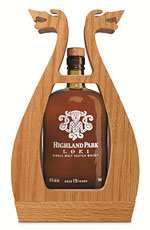
Loki from Highland Park
Loki is a 15-year old single malt Scotch that is part of Highland Park’s Valhalla Collection, a set of four unique whiskies taking inspiration from the Nordic gods of old. This creation is not for the faint of heart, as it was inspired by the “unpredictable, shape-shifting Loki character.” This Scotch was matured in both Spanish cherry casks along with heavily peated casks, so the result is a whisky with a very smoky punch. The taste is very complex and whisky aficionados will definitely want to try this one out. It comes in the spectacular packaging, and though it’s not cheap at $249 per bottle, for the right dad Loki can help you mark a memorable Father’s Day.
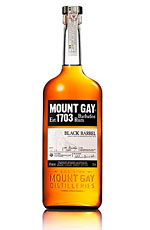
Mount Gay Black Barrel
This iconic rum brand from Barbados is celebrating its 310th anniversary, so you know you’re going with quality that a dad can appreciate. This new version is hand selected by Master Blender Allen Smith, and the only one to be finished in charred bourbon oak barrels, resulting in a bold (but silky smooth) rum, with pepper, spice and wood notes. It’s great for sipping neat or on the rocks. This will definitely help your dad enjoy a nice summer day for this holiday.
CAMUS Ile de Ré Cognac
CAMUS is known for Cognac, and its latest Cognac offering comes from Ile de Ré (Island of Ré), an island just off the west coast of central France that is also a legal cognac appellation. This new and rare Cognac offers a different taste profile that is perfect chilled and will appeal to both scotch and cognac drinkers. Ile de Ré is very small, so the grapes absorb the sea spray from the air, giving the cognac a salty, maritime quality. Options include Ile de Ré Fine Island Cognac, Ile de Ré Double Matured Cognac and Ile de Ré Cliffside Cellar Cognac.




 This will probably drive me out of the cocktail writers’ club, but my regular, recipe-centric, DOTW was preempted by a cold. I know this will make me sound a bit wussy to some of you, but I personally do not find that alcohol “kills the cold germs” It’s more like granting the virus superpowers. Moreover, when I’m sick, some generic Alka-Seltzer Plus more or less does me just fine. In short, liquor has not passed these lips in over a week.