Author: Ezra Stead (Page 5 of 6)

Weekly Web Series Review: Drunk History

Derek Waters’ “Drunk History” is one of the strangest, funniest, most absurd concepts in web series history. Playing on the inherent comedy of drunken incompetence and memory loss, each of the series’ six episodes takes a different comedic actor or writer, puts way too much booze in them, and then follows their muddled, profane accounts of important historical events. The episodes then cut between these slurred, rambling monologues and dramatic reenactments of the events, featuring famous actors such as Jack Black, Will Ferrell and Zooey Deschanel. The genius of these reenactments is how closely the actors follow the exact words of the inebriated nonsense that forms the basis of their script, lip-syncing the dialogue perfectly right down to the inadvertent sniffles and hiccups of the actual speaker.

The first episode features Mark Gagliardi recounting the story of Alexander Hamilton’s famous duel with Aaron Burr after drinking a bottle of Scotch. Though it is unclear how large the bottle was, it was clearly quite a bit of liquor, as he spends most of his segment reclined on a couch with a bucket nearby, just in case. Hamilton is played by a suitably innocent-looking Michael Cera in the reenactment, but the real show-stealer is Jake Johnson in a brilliantly shifty-eyed performance as the loathsome Aaron Burr. In episode 2, Eric Falconer takes on the famous story of Benjamin Franklin‘s discovery of electricity, expounding upon his theory that it was actually Franklin’s “bastard son,” William (Clark Duke), who actually flew the legendary kite with the key tied to it. This is also the series’ first instance of vomiting in the midst of the storytelling, but not its last, so be warned that the series is not for the weak-stomached. Jack Black portrays Franklin again in a special volume 2.5 episode, in which Falconer tells a hilarious tale of Franklin’s sexual deviance.

Episode 3 features Jen Kirkman‘s account of Oney Judge (Tymberlee Hill), a female slave of George Washington (Danny McBride) that is especially funny because of the way the actors incorporate Kirkman’s frequent hiccups into their performances. The fourth episode features J.D. Ryznar‘s unwise decision to drink vodka and beer together, which obviously leads to more vomiting, and his account of the U.S. president William Henry Harrison (Paul Schneider), who died after only 32 days in office. Jen Kirkman returns for episode 5, in which Don Cheadle gives a hilarious performance as Frederick Douglass; there is something especially funny about Kirkman’s slurred words coming out of this revered actor’s mouth. Finally, in episode 6, Duncan Trussell follows six beers with a half-bottle of absinthe, and more vomiting ensues. He also tells the story of Nikola Tesla (John C. Reilly) and his contentious relationship with Thomas Edison (the always intensely weird Crispin Glover).

These are the only official episodes of the series (plus a very special Christmas episode included below), so beware of the unofficial knockoffs, most of which are pretty terrible. In fact, the one I linked to there is pretty much the only one that’s watchable, and it’s still nowhere near as good as the real thing. In addition to the recognizable stars, look for Waters’ name and also that of series director Jeremy Konner to avoid being duped.
Weekly Web Series Review: Blue

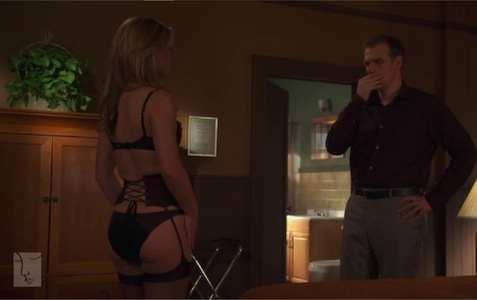
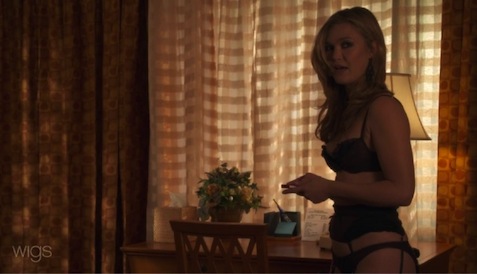
Julia Stiles in Blue

Julia Stiles stars as the title character in “Blue,” a new web series produced by the YouTube channel Wigs, which is described as “a digital channel producing high-end, original, scripted dramatic series and short films about the lives of women.” “Blue” certainly fits this bill, as it has high, network-standard production values and explores the life of Francine, aka Blue (Stiles), a single mother who works in an office and moonlights as a prostitute. We are introduced to her in the middle of serving a client, Cooper (David Harbour), who turns out to be an old acquaintance from high school. Cooper has more than a simple professional interest in her, and there is speculation that he might be the father of her 13-year-old son, Josh (Uriah Shelton).

Josh is a precocious, A-student who is beginning to be curious about sex and who is too smart not to know that his mother is hiding something about herself from him, though he is not yet sure what. He befriends Cooper, seeming to need a father figure in his life to complement the good relationships he has with his mother and his grandmother, Jessica (Kathleen Quinlan), a sexy older woman prone to over-sharing about her love life. Meanwhile, beginning in the third episode, Blue has an oddly mentor-like relationship with her office co-worker, Lavinia (Sarah Paulson), who looks up to her, thinking Blue really has her life together. Lavinia seeks Blue’s advice about her relationship with her ex-husband, Walter (so far unseen), who seems to be using her for financial support due to his ailing health.

The series is created, written and directed by Rodrigo Garcia, who is known for his work on feature films like “Mother and Child” and last year’s “Albert Nobbs,” as well as television series such as HBO’s “The Sopranos” and “Six Feet Under,” the latter of which has a similarly soap opera feel to it. The first season runs 12 episodes, each around eight minutes long, which means the entire first season is roughly the length of a relatively short feature film, and each episode is basically a single long scene, or two shorter, connected ones. Some of these work better than others; while Blue and Josh have great chemistry and really good dialogue in the second episode, and a subplot involving Josh’s troubles at school in the tenth and eleventh episodes is especially interesting, I have to admit I have very little interest in the relationship between Blue and Lavinia. Paulson is a very good actor, but her character is sort of weak and whiny, and it remains to be seen if her subplot will garner more interest. On the other hand, the first season ends with an intriguing development involving an older man from Blue’s past, and fans of soapy drama will definitely want to tune in for new episodes once they become available.

Julia Stiles in Blue backside view

HP Previews New IPS and Internet Monitors

Hewlett-Packard (HP) presented a product preview of several new professional and consumer desktop computers yesterday afternoon at the Edelman Offices in Manhattan. The presentation pointed to HP’s future, which seems to be streamlining its efforts toward more all-in-ones, as opposed to the more traditional tower and monitor design, in response to consumer demand. Many of the new products presented will not be available in the United States until August or September of this year, but one of the most interesting models is already on the market as of today.

The HP Passport 1912nm Internet Monitor is a relatively inexpensive option for direct access to online content without the use of a PC. Starting at $259, the monitor provides quick and easy internet service through its “plug-and-play” set-up, and is especially designed for consumer-oriented business environments such as lobbies, waiting rooms, cyber cafes, airports and conference centers. According to HP’s official press release, this monitor “delivers access to email, videos, images and music through an easy web interface with a locked-down operating system that prevents vulnerability to viruses. With an Ethernet input and plug-and-play connectivity options, the HP Passport 1912nm offers a four-in-one HP Media Card Reader and five USB ports to support digital cameras and other accessories.”

Also previewed yesterday, and expected to hit the U.S. market on June 24, was the new HP 2311xi IPS LED Backlit Monitor, which features a 23-inch diagonal full HD display in an ultra-slim chassis designed to fit into any environment without taking up too much space. Its IPS panel technology provides an exceptionally sharp, clear picture with rich, vibrant colors and wide viewing angles. Perhaps its most unique and exciting feature is its 178-degree viewing angle, which makes photo or video sharing, as well as gaming, much more convenient for large groups of people. With this monitor, even sitting far to the side of the screen allows for a comfortable and clear viewing experience, making any seat in the house as good as any other.

HP continues to be on the vanguard of exciting new professional and consumer products that make life easier in both business and pleasure settings. As Jun Kim, vice president and general manager of HP’s Display Business Unit, says, “The needs of customers continue to evolve, and HP is well-positioned to meet these new demands by expanding its award-winning display portfolio. HP’s new IPS monitors bring professional-grade technology directly to consumers, while our internet monitor serves as a new tool for businesses to engage with their patrons.”

Axe Launches New Interactive Game and Social Networking Hub

Last night at Manhattan’s Bowlmor Lanes / Greenwich Village Country Club, Axe previewed its new interactive global gaming experience, “AxeMan,” at a special, exclusive event shrouded in secrecy. Guests were taken by pre-paid car service to the venue near Union Square, where we were served complimentary food and drinks such as Axe’s signature drink, the “AxeMan” (basically just a good, strong Manhattan), and uniquely delicious breaded-and-fried mac & cheese bites.

We quickly learned the reason for the event’s top-secret, exclusive guest list: as we were seated with our drinks, all the event’s guests were provided with complimentary iPads on which we were given a tutorial on how to play “AxeMan.” In this case, the “axe” in question is an electric guitar played by a tough-looking bro reminiscent of Jack Black‘s “Brutal Legend” character, Eddie Riggs, but with shorter hair and nicer clothes. The game itself combines “Guitar Hero” with a first-person shooter, such as the classic “GoldenEye 007,” though its game-play is a much less complex horizontal scroll.

The object of the game is to collect curvaceous, scantily clad women (hereinafter referred to as “honeys”) to your “crew” while simultaneously defeating bad guys, just like in real life. The game’s setting is the fictional university “PWN U,” and the bad guys are frat-boys who throw either dodgeballs, beer bottles or free-weights at you as you attempt to gain honeys. You can block these by tapping them as they come toward you, and you kill the bad guys by strumming guitar notes at them from a fretboard at the bottom of the screen. The “boss” at the end of the game’s first level is the school’s mascot, a huge bull that comes to life and charges you, depleting your supply of honeys until you defeat him or die. It sounds pretty stupid, and to be honest it is, but it’s also surprisingly fun and addictive.

In addition to the “AxeMan” game, Axe has also launched “Planet Axe,” a social networking hub containing “AxeMan” and other games, where players can connect to share their high scores and talk trash. “AxeMan” also features a user-generated soundtrack of songs supplied by your own iTunes or other music player, so if you prefer to shoot bad guys to the sound of heavy metal, while your friend would rather pick up honeys to the sound of smooth jazz, everybody still wins. Watch out for the bull at the end, though – music of any kind will not likely sooth that savage beast.

Guinness Brews Up New Believers in NYC

GuinessGuinness gave a simulated tour of its famed St. James’ Gate Brewery at the Altman Building in New York City last night. Though the actual brewery is, of course, in Dublin, the Guinness folks provided a virtual tour via video screens, and talked the audience through a brief history of the company. Founded in 1759 by Arthur Guinness, who signed a 9,000 year lease at St. James’ Gate, Guinness is now watched over by master brewer Fergal Murray, who is in charge of making sure the dark, creamy beer maintains its consistent texture and flavor. One of the most interesting things I learned was that the famed harp logo associated with Guinness also happens to be the logo of the Irish government. If the harp is facing right, it’s Guinness; if left, it’s the government.

According to the official slogan, it takes exactly 119.5 seconds to pour a perfect pint of Guinness; that half a second is allegedly the difference between a good pint and a perfect one. After being given a perfect (and, more importantly, free) pint upon entering the event, an announcement was made that “our show will begin in 119.5 seconds,” at which point a countdown began. Charismatic comedian Dan Soder then appeared onstage to give us some background on the classic Guinness draught we had just imbibed, which is nitrogenated, a process that sets it apart from other beers and gives it that unique, smooth texture. He also gave us some helpful hints on how to mix Guinness with other beers made by the same company, such as Harp Lager and Smithwick’s Ale: Guinness mixed with Smithwick’s is a “blacksmith,” while Guinness mixed with Harp is a “half and half.”

GuinessWe then proceeded to try mini-pints of a few special brews developed by Guinness. First up was the Foreign Extra Stout, a tasty brew with slightly more bite to it than the classic Guinness and also a bit more sweetness, giving it a flavor similar to very dark chocolate. The Foreign Extra Stout contains more hops and more alcohol (7.5% ABV) than any other Guinness brew, because it was originally developed to be shipped long distances overseas, and alcohol and hops both act as preservatives. The last beer we sampled was Guinness Black Lager, which was my personal favorite of the three. It is cold brewed with roasted barley, giving it a crisp, clean taste that is lighter and more refreshing than the standard thick, creamy finish of the brew for which Guinness is best known. Though not as strong as the Foreign Extra Stout, it is definitely a better summer beer, and one that I will likely sample again in the coming months.


« Older posts Newer posts »

© 2026 Bullz-Eye Blog

Theme by Anders NorenUp ↑