


Author: Bob Westal (Page 38 of 65)

Movie Review: “Lovelace”

Starring
Amanda Seyfried, Peter Sarsgaard, Sharon Stone, Robert Patrick, Chris Noth, Hank Azaria, James Franco
Directors
Rob Epstein & Jeffrey Friedman

1972’s “Deep Throat” was the porn flick that took blowjobs out of the closet and put them on “The Tonight Show.” It’s star was by far the most famous pornographic performer of all time and, it turns out, a victim of shocking abuse.

The only surviving film of a pair of planned projects about the woman who will forever be known as Linda Lovelace, “Lovelace” stars Amanda Seyfried as Linda and Peter Sarsgaard as her first husband, sexual Svengali and tormentor, Chuck Traynor. The most interesting thing about “Lovelace” is its structure. The film breaks down pretty clearly into two parts: one largely comedic, the other brutally tragic.

Part one is mostly a shockingly cheerful porn biopic that will please those who are longing for a less weighty “Boogie Nights” follow-up. It shows us how a sleazy but nevertheless charming and love struck Traynor seduces sweet and only slightly damaged 21-year-old Linda Boreman away from her unpleasantly rigid, super-traditional Catholic mom (Sharon Stone), her low-key security officer dad (Robert Patrick) and her understandably suspicious best friend (Juno Temple). The tone grows more blackly comedic as skeezy Chuck gets involved with pornsters and sells them on his wife’s borderline disturbing ability to suppress her gag reflex. Linda Lovelace is born.

Sometime after we see Hugh Hefner (a miscast James Franco) suggest that life should imitate art in a very specific way during a screening of the now hugely successful “Deep Throat,” “Lovelace” abruptly takes us six years later into 1980 as Linda Marchiano – she’s now married to apparent good-guy cable installer Chuck Marchiano (Wes Bentley) – passes a polygraph test and promotes her book, “Ordeal,” on the “Phil Donahue Show.” Just as abruptly, the film circles back to give us Linda’s very personal point of view of the events surrounding “Deep Throat.” It’s no prettier than the visible bruises on her legs.
Continue reading »

Drink of the Week: The Rye Sierra

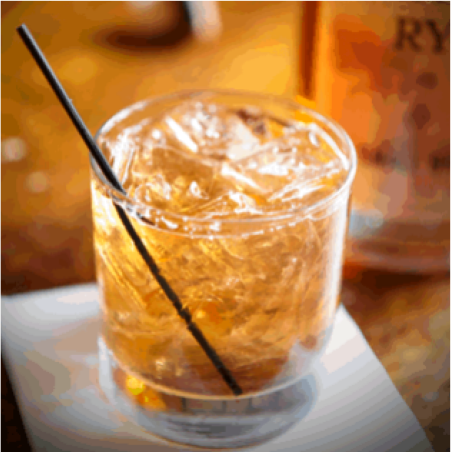
The Great Unnamed Beer and Rye Cocktail. It’s just possible that it has escaped your attention up to this moment, but today is International Beer Day. Of course, for many people, truly every day is International Beer Day, or at least every Sunday during football season.
The ironic thing is that beer, which was once just about the least respected of alcoholic brews in the United States, has achieved more of its props with the rise of craft beer, microbrews and what not. These days, many people who wouldn’t know the first thing about a genuine Old Fashioned or Sazerac and who might freak out if confronted with the ultra-bitter/ultra-sweet flavor of Campari, included in this week’s DOTW, have no problem with the more familiar but no less bitter flavors of some dark beers.

Be calm, however. There’s no need for conflict as I’m happy to say that beer and cocktails are proving to be two great things that, if handled properly, can go great together. Today’s beverage is a delightfully refreshing case in point.

Though it came to me without a name, like the good native son of the West that I am, I have christened today’s beverage the Rye Sierra, after its two main ingredients. It comes courtesy of a mysterious benefactor connected to the makers of the very excellent Templeton Rye Whiskey. Sierra Nevada Pale Ale gets a plug, too — even if I had to spring for my own bottle.

My first attempt at this drink was a true delight, but you’ve got to be certain you don’t fall from a great height with this one. Just make sure you bring plenty of ice and don’t overuse the swizzle stick.

The Rye Sierra

1 ounce Templeton Rye Whiskey
4 ounces Sierra Nevada Pale Ale
1/2 ounce Campari
1/2 ounce fresh lemon juice

Combine the rye, lemon juice, and Campari in a double rocks glass (i.e., like a regular Old Fashioned tumbler, but about twice as big). Stir, and add plenty of ice. Top off with four ounces of the very lovely Sierra Nevada Pale Ale — resist any urges to stir it again at this point. Just let the brew site on top of the summit where it belongs. Salute the mountain range of your choice.

****

If ever there was a drink perfect for a hot day where you’re allowed to eat nothing but popcorn, salted nuts, and wasabi peas, this might well be it. Still, I must reiterate that you are to use plenty of ice and zero stirring is allowed after you have added the beer. Much in the way an Irish Coffee must only be enjoyed through its cap of heavy cream, the rye, Campari, and lemony goodness must only be enjoyed through the ale.

Finally, I realize that a lot of you out there don’t have any double rocks glasses. I actually ran out and bought a couple myself for $3.99 each. That’s because I’m a professional. You amateurs out there can simply cut the proportions in half and drink this out of a regular rocks glass, even if you’re buzz will take twice as long that way.

Also, you have my permission to try this with other brands of rye. I did — and I bet it would have worked great too if I didn’t find out too late someone in my house had Bogarted most of the ice.

Drink of the Week: The Jupiter

the Jupiter. Sometimes the hardest thing about writing and preparing for DOTW is simply picking out the drink. I can spend, it seems, many hours online trolling for a cocktail that won’t take hours to make and where I won’t have to spend an arm and a leg buying several expensive ingredients I barely have room for at stately DOTW Manor.
So, I alway love it when some cool person suggests a possible mixed drink or cocktail (people I read keep telling me there’s a difference) for me to try. In fact, if anybody would like to  come up with a suggestion for a drink that hasn’t been featured before in comments or e-mail, I promise to give it a fair hearing.

In this case, the cool person suggesting the drink was the highly esteemed Christopher Tafoya, Facebook friend, mutual real life friend with other real life friends, and cocktail enthusiast. Christopher provided an interesting find that’s forcing me to diverge from orthodoxy just a bit, while only forcing me to purchase one very interesting and odd new ingredient. It’s also got a name with just enough of a touch of science fiction to it to make it semi-appropriate for the week of Comic-Con. That’s where I’ll be by the time you read this, and also the reason this series will be taking a break next week. Anyhow, here’s this week’s cosmic selection.

The Jupiter

1 1/2 ounces dry gin
1/2-3/4 ounce dry vermouth
1 teaspoon fresh squeezed orange juice
1 teaspoon parfait amour

This one’s as easy to make as they come. Combine the ingredients in a cocktail shaker. Shake. Strain into a cocktail glass. Sip, preferably while listening to the music of the spheres or at least Richard or Johan Strauss.

****

Remember when I implied my take was a bit heretical? Well, credit for the revival of the Jupiter in recent years goes mainly to the revered Ted Haigh, author of Vintage Spirits and Forgotten Cocktails, who picked the drink out from a number of older tomes. He, however, declared that it was the one drink in his entire book requiring the most precision. Depart by even the difference between a measuring teaspoon and a dining teaspoon and, as far as Haigh is concerned, the drink is mostly done for.

Part of the reason for that is Parfait Amour. This somewhat obscure and not too easily found liqueur, extracted from exotic oranges and vanilla pods, is both very sweet and very purple. It also gives the Jupiter it’s slightly grey, otherworldly hue. I can’t disagree with Haigh that a little goes a long way, but I’d like just a little more, proportionally speaking.

So, when Mr. Tafoya let me know that a slightly different recipe existed — I’d looked in a number of places and had seen exactly the same recipe he first gave me — I had to give the alternative version a try. What a shock that it turned out to be, to my taste buds, quite a bit better. Basically, I found that a quarter of an ounce less vermouth made for what I found to be a brighter, more enjoyable beverage.

So, dear readers, I’m giving you a choice: 1/2 or 3/4 ounce of dry vermouth. Which drink would the evolved Dave Bowman choose?

See you in two weeks, star children.

Drink of the Week: The Old Pal

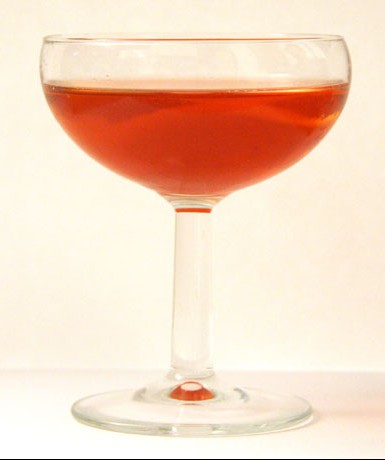
the Old Pal.Can a drink be like an old friend? Should a drink be like an old friend? It’s way too late as I’m writing this to even begin answering those questions, but I can tell you I much prefer the older version of this prohibition era cocktail to more recent iterations.

I actually first found this one in my copy of 1930’s The Savoy Cocktail Book but it appears to date back several years prior. However, later versions that are supposed to be adjusted to modern day tastes failed to impress my personal tastebuds as much as this very simple and basic drink, a rather close relative of the Negroni and the Boulevardier. Still, like an old pal, the appeal of this drink is rather simple and easy to understand – with my favorite brand of wonderfully value priced Canadian whiskey and dry vermouth lightening up my favorite controversial cocktail ingredient, oh-so-bitter, oh-so-sweet Campari.

The Old Pal

1 ounce Canadian Club Whisky
1 ounce dry vermouth
1 ounce Campari
1 lemon twist (garnish)

Combine the liquid ingredients in a cocktail shaker or mixing glass. Stir or shake vigorously – I lean slightly toward stirring on this one, for some reason – and strain into our very old pal, the chilled cocktail glass or coupe. Add your lemon twist and toast, I imagine, an old pal.

***

If you don’t like Campari, it’s likely that the Old Pal will be no friend of yours. While the bourbon and sweet vermouth in the Boulevardier puts up a decent fight against the Campari, Canadian Club whisky — which is very specifically called for in the original recipe — and dry Martini & Rossi or Noilly Pratt is simply no match for its undeniable  flavors. Even adding a solid, high proof rye whiskey like Bulleit, and increasing its proportion, didn’t change the Old Pal nearly as much as you might think. When I tried the more recent variation, which calls for 1 ½ ounces of rye to ¾ of an ounce of Campari and vermouth, it was still very much a Campari-forward drink, only less bright, less crisp.

I should have known, you simply can’t change your Old Pal. Not that you should ever want to.

007 One by One: “Diamonds are Forever”

Bullz-Eye continues its look back at every James Bond film, 007 One by One, as part of our James Bond Fan Hub that we’ve created to celebrate the 50th anniversary of the first Bond film.

It’s Vegas, baby, for James Bond, and he’s played by Sean Connery for the last time (until 1983). The jokiest and the most violent of the Bond films up to that point, it’s no one’s favorite 007 entry – and it’s a lot of people’s least favorite – but we still think it’s got way more panache than many of the films that followed. It’s…

“Diamonds are Forever” (1971)

The Plot

Diamond smuggling turns out to be, naturally, only the tip of the iceberg as a graying Bond (Sean Connery) unravels a chain of deception that leads him to a Las Vegas-based ultra-reclusive mega-tycoon (Jimmy Dean), and then onto 007’s not-actually-dead arch nemesis, Ernst Stavro Blofeld (Charles Gray). It turns out that killing Bond’s wife simply isn’t enough for the social climbing super-villain; he’s once again making 007’s life hellish while also having the bad manners to peddle thermonuclear supremacy on the world market. Bond, meanwhile, is nearly wearing out his license to kill.

The Backstory

Though it’s an underrated film and beloved of many serious Bond fans, 1969’s “On Her Majesty’s Secret Service” with George Lazenby was deemed insufficient as a blockbuster. It did well enough abroad, but it’s all-important American grosses was about half that of earlier Bond entries. By 1970, Lazenby was already one for the “where are they now?” columns.

A replacement was needed, and so was a big hit. Stolid American heartthrob John Gavin (“Psycho“) had been contracted as a fall-back Bond, but moguls Albert R. “Cubby” Broccoli and Harry Saltzman set their sights on the one actor alive least interested in stepping into the very big shoes of Sean Connery – Sean Connery. While the Scottish unknown-turned-superstar has always insisted he was very grateful for his Bond stardom, to all appearances, Connery was over James Bond — now and forever.

On the other hand, we all have our price. Connery’s was £1.2 million – quite a lot of money in 1970 and enough cash for the actor to start his own charity, the Scottish International Education Trust. To sweeten the deal, United Artists also allowed Connery the chance to take the creative lead on two of his own movies. The understanding was, however, very clear that Connery would never again play Bond…for the Broccoli and Saltzman’s EON team, at least, that turned out to be true.

Continue reading »

« Older posts Newer posts »

© 2026 Bullz-Eye Blog

Theme by Anders NorenUp ↑