Month: July 2011 (Page 3 of 7)

Breaking Bad 4.2 – “Go Home, Walter.”

Tonight’s episode begins with a lesson for all casting directors: if you’re on the lookout for a grizzled-looking good ol’ boy who’s filled to the gills with folksy wisdom, you need look no further than Jim Beaver. You’ve seen him on “Deadwood” and “John from Cincinnati,” you’ve seen him on “Supernatural” and “Harper’s Island.” Accept no substitutes: Jim Beaver’s got what you need, and he delivers every time…and, yes, that includes tonight, when he played Lawson, an :::cough, cough::: independent businessman helping Walt to procure a handgun.
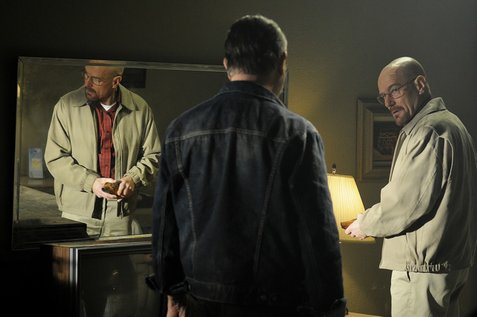
It’s pretty clear that most of what Walt knows about guns came from watching TV westerns, because every time he draws his weapon, he looks desperately like he’s trying to be the fastest gun in the west. Lawson offers up a lot of helpful advice, including a beautifully delivered line explaining why Walt should stick with a .38 special over an automatic: “If you can’t get it done with five, then you’re into spray-and-pray, in which case I wouldn’t count on another six sealing the deal.” Lawson tries to be the gun dealer with the heart of gold, recognizing Walt’s handicap as a marksman (“You’re gonna want to practice your draw…a lot“) even pointing out the merits of buying legally over illegally, but when Walt refuses to concede that the gun will be used for anything other than defense, he has little choice but to shrug and say, “I’m happy to take your money.” The next time we see Walt, it’s clear that he’s taken Lawson’s advice about practicing his draw to heart…as well he should’ve. You know, I think you have to wonder just how much of Lawson was on the pages of George Mastras’s script and how much was turned into gold simply by Beaver’s pitch-perfect delivery, but either way, Lawson = awesome.


Continue reading »

Entourage 8.1 – Home Sweet Home

Tonight’s season premiere of “Entourage” was about one thing and one thing only: picking Vincent Chase up out of the gutter and getting his career back on track… again. After a 90-day stint in rehab, Vince is finally free to return home, but little does he know that Drama has been obsessing over making sure that his baby brother doesn’t relapse. Along with getting rid of all the real drugs and alcohol in the house, Drama goes so far as to even prevent any pill-shaped substance from being in sight, whether it’s an Advil or a Tic-Tac. It doesn’t take long for Vince to realize that the gang is babying him (even more than normal), and how could he not? Everyone was acting so awkward the minute he stepped out of the rehab clinic that it was only a matter of time before he called them out on it.

Vince seems willing to put up with all the coddling, however, if it means he can get back to work. And amazingly, Warner Bros. still wants him as the star of that Stan Lee superhero film, “Airwalker,” as long he’s willing to take a drug test. But the movie doesn’t start shooting until March, and Vince is raring to go, so he suggests directing his own film about a real-life story of Romanian miners getting trapped underground. The rest of the guys think it sounds terrible (a Lifetime movie-of-the-week at best), but because they’re trying to be supportive, they refrain from telling him the truth. That is until Eric, who’s still a little pissed at Vince for ignoring him while he was away, speaks his mind.

You can hardly blame him for being so grouchy lately. Though he’s enjoying professional success after taking over Murray’s management agency alongside Scotty Lavin (who, despite being partners, still fight like a couple of siblings), Eric’s personal life is in the dumps following Sloan’s decision to call off the marriage when he refused to sign a prenup. I’m guessing it was more of a matter of integrity than Eric simply being greedy, but that didn’t stop Sloan from sending back the engagement ring in an envelope. And as the gang so humorously points out, “not even a padded one.”

Continue reading »

Drink of the Week: The Negroni

It is with some shame that your humble writer admits that, until a few days ago, he had never tasted Campari. In case you don’t know, Campari is theoretically a very popular Italian apéritif — that’s “before dinner drink” to us English speaking barbarians — that’s essentially a drinkable variety of bitters. You see it consumed with soda in European films and every bar in the world seems to stock it but, classic spirit or not, nobody we know seems to drink it or anything made with it.

So it was with great curiousity that yours truly brought home a bottle of the stuff and broke the lifelong Campari drought. First, a surprising and delicious burst of orangey sweetness reminiscent of a really tasty Italian vermouth, then, a bracing bitterness. A bit strong and not 100% pleasant in the usual sense, but fascinating. Time for had another sip.

the NegroniYep, it was good to take the bitter with the sweet. It was better to try the most famous cocktail made using Campari.

The Negroni

1 ounce Campari
1 ounce sweet vermouth
1 ounce dry gin
Twist of orange peel (garnish)

Shake like the dickens and serve in a chilled martini glass. Semi-optional final step: swirl the orange twist around the rim of the glass and “express” it (twist it) over the drink. Drop it in.

If the above seems a bit too sweet for you, feel free to increase the gin slightly and decrease the Campari and vermouth. (David Wondrich‘s version is 1.5 ounces gin to 3/4 ounce Campari and vermouth, and it works beautifully.)

*****

Folks, I’m going to drop the “royal we” I’ve been using and say in the first person that I really love the Negroni. It appeals to my sweet tooth while also being plenty refreshing on a warm summer day and offering a delicious complexity thanks to the one-two sweet-bitter punch of the Campari, softened by the sweet vermouth and with a terrific tang coming from the gin. For some reason, bartenders I’ve met are skittish about this drink and it has a somewhat “difficult” reputation. My take is that, if you can enjoy a Manhattan, you’re probably more than definitely ready for a Negroni and it’s a lot more accessible than a martini. I love this drink and think you will, too.

The Negroni is often served on the rocks, particularly in Europe, but I tried it that way and, like most “up” drinks served on the rocks, the results were not exciting, almost sickly sweet. It’s also often served anti-James Bond style, stirred and not shaken, on account of the bar worker’s lore that gin should only be shaken when non-alcoholic ingredients are present. I tried that too and decided that worrying about the gin here was complete balderdash. Negronis demand a good shaking.

Oh, and if you’re wondering where the name comes from, it’s simple enough. It seems that a turn-of-the-20th-century Italian count named Negroni was drinking another Campari-based cocktail, an Americano, (we’ll cover that some other time) and wanted a stronger version with some gin in it. That’s the whole story.

Friday Video – Slade, “Run Runaway”

The opening drums might be faker than 60% of Posh Spice’s body, and sadly you’ll have to look elsewhere to hear them, because they were cut off of this upload, but hot damn, does this song still sound cool to us now. Not every rock song made it out of the ’80s alive. Most of Tom Werman’s productions, in particular, sound hollow and dated, and when a friend played a homemade best of Dokken he had made, the question that kept popping into our heads was, “Didn’t we just hear this song?” Ah, but “Run Runaway” still sounds awesome today. Huge power chords, those chugging synthetic drums, the fiddle, the chain gang backing vocals…love, love, love. The clip the band shot, though, is just silly, with lead singer Noddy Holder just making goofy faces at the camera for a good 10 seconds straight. Imagine Michael Bay or McG putting a shot like that in a video. The urge to hyper-edit will surely consume them.

All right, so maybe this isn’t a video to watch, but rather to listen to. And remember, Quiet Riot’s biggest hit was written by these guys, which would explain why the band went back to the Slade well for their next album by covering “Mama Weer All Crazee Now.” (That one didn’t work out so well, peaking at #51.) Happy Friday, everyone. Rock on.

First Drive: 2012 Hyundai Genesis

2012 Hyundai Genesis

I traveled out to the Hyundai America Technical Center in Michigan to drive the new 2012 Hyundai Genesis. The drive event took place on a beautiful summer day as you can see from the photos and I had the opportunity to drive a couple of different models of the new Genesis, mostly around the scenic country roads around Ann Arbor.

The Genesis has been a big hit for Hyundai, due in large part to its elegant styling and its impressive value proposition. The Genesis has experienced 24 months in a row of year-over-year sales increases. In their presentation to the media, Hyundai executives stressed how the Genesis appeals to affluent buyers who were also practical and frugal. The “millionaire next door” profile fit many buyers of this vehicle. They aren’t the aspiration-type buyers who stretched their budget to show off a BMW or a Mercedes. Rather, they want to show off how many luxury features they could get from a new Hyundai for thousands less than what one would pay for their German competitors.

Exterior

The 2012 Genesis offers an aerodynamic yet elegant look that fits nicely in the luxury segment. It’s a refresh of the 2011 model, so the exterior styling has been updated without major changes. The new LED headlamp accents add a nice touch, and the front grille and front bumper have been updated to create a powerful and aggressive stance. New 17-inch and 19-inch wheel designs are also available, and I particularly liked the 19-inch wheels. You can see from the photos above why this vehicle is doing so well in the luxury market, particularly when you consider the costs savings versus its competitors.

Interior

The interior offered everything you would expect from a luxury sedan. The entire feel of the interior exudes comfort and luxury, and the leather seats were particularly soft. Many luxury features are standard in the 3.8 base model, while a Premium Package and Technology Package are available in the 3.8 and come included in the 4.6 and 5.0 models. The overall feel is a classic design with modern accents that will appeal to professionals and others looking for a luxury experience. I was also struck by how quiet the Genesis was as we cruised around.

Performance

With the 2012 model, Hyundai provided the Genesis with some impressive upgrades under the hood, introducing Gasoline Direct Injection (GDI) for the 3.8-liter V6 and a new 5.0-liter V8, representing the most powerful Hyundai engine to date. The new Genesis also features a new 8-speed automatic transmission with Shiftronic. At 333 HP, the new V6 has 43 more horsepower than the previous V6, with 291 lb-ft of torque and fuel mileage of 19 city/29 highway. The new V8 features 429 HP and 376 lb-ft of torque, with fuel mileage of 16 city/25 highway.

I drove the 3.8 V6 model first, followed by the 5.0 V8. Both offered solid power and a great ride. The V8 certainly offers more of a kick and it makes a great sound when you punch it on a straightway, but I suspect many buyers in the target market will be more than happy with the power and feel of the V6. I was able to test both of them on a wide variety of roads and my impression of the power and handling were consistently positive. The ride was very smooth even on bumpier country roads, while the suspension offered the level of grip you would expect from a luxury sedan.

Overview

The MSRP on the base 3.8 Genesis starts at $34,200, going to $39,000 with the Premium Package and $43,000 with the Technology Package. The 5.0 V8 has an MSRP of $46,500. This tells the story of the sales increases for the Genesis as it’s available for thousands less than other vehicles in its class. When you drive the vehicle you get an appreciation for the value proposition. Take it for a text drive and you might end up saving yourself a lot of money while getting all the luxury you need.

« Older posts Newer posts »

© 2026 Bullz-Eye Blog

Theme by Anders NorenUp ↑