
Make no mistake, this is not only your dad’s but also your grandfather’s whiskey. Depending on your age and where your family was during prohibition, it might even be your great-great-grandfather and/or grandmother’s whiskey. Say what you like about Canadian whisky, it’s stood the test of time.
 Sometimes referred to, particularly in Canada, as rye despite the fact that it’s primarily made with corn spirits, Canadian whisky, unlike now resurgent American rye whiskey, never threatened to go away. Still, while some uninformed bartenders still think rye is just the name of a type of Jewish bread, it’s the rare bar that doesn’t stock Seagram’s V.O., Canadian Club, Crown Royal and often Black Velvet. Its the even rarer connoisseur or cocktail aficionado who will admit to being excited about them, with some liquor snobs deriding Canadian as “brown vodka.” Following their lead, younger drinkers who have taken to premium brands of bourbon and Scotch, have largely ignored it. That’s not to say unassuming Canadian Whisky has no fans among the cognoscenti. We kind of love it and no less an authority than cocktail historian David Wondrich suggests Canadian Club — a value-priced favorite of ours — as the perfect vehicle for an Old Fashioned, the most purist-friendly whiskey cocktail we know.
In any case, pop culture seems to be slowly becoming more aware of American rye whiskey’s almost-as-retro northern cousin. The 2008 primary elections saw Hillary Clinton swigging a much-discussed shot of Crown Royal, the very smooth Chivas Regal of Canadian. Though the label is angled so that the logo is just slightly out of our view, it’s clear that Canadian Club — first brewed by distilling legend Hiram Walker — is Donald Draper’s poison of choice on “Mad Men.” (In the first episode, newbie secretary Peggy Olson is informed that rye is the same as Canadian, and told it’s what her new boss drinks.) It also sure looks to be Canadian Club that washing up on the Jersey shore in HBO’s bootlegging themed early gangland drama, “Boardwalk Empire.” By law, Canadian whisky must be aged at least three years, though Canadian Club and Seagram’s V.O. are both aged for six
In fact, the popularity of Canadian whisky — which many insist must be spelled sans “e” — in the U.S. goes back to those dark days for everyone but gangsters between 1920 and 1933 when the sale and manufacture of liquor was illegal in the land of free and home of the brave, but thoroughly legal up north. Jewish-Canadian entrepreneur and liquor distributor Samuel Bronfman became wealthy and powerful beyond anyone’s wildest dreams by staying more or less on the right side of the law while doing business with the likes of Al Capone. He purchased Joseph E. Seagram’s and Sons and launched what became, for a time, a massive commercial and media empire. (It’s worth noting that the line’s flagship brand, Seagram’s 7 Crown, best known as the non-7-Up ingredient in a “7 and 7,” is not technically Canadian whisky. The U.S. version, at least, is bottled in Indiana and marketed as “an American whiskey,” whatever that is.)
Since it’s primarily blended and is generally not a very complex kind of a whiskey, it’s likely that Canadian will never have the cachet of bourbon, rye, or Scotch, but its hipness quotient may be improving slightly. Canadian Club has shrewdly played on its history with a series of attention-grabbing print ads with the slogan “Damn right, your dad drank it.” The ads alluded to the allegedly racy lifestyles of fathers of yore and used actual family photographs from Canadian Club employees.
As for cocktail and liquor aficionados, New York Times writer Robert Simonson blogged some time ago that his contacts in the gourmet and mixology worlds became obviously bored at the mere mention of Canadian whisky. However, Simonson’s April 2011 article details how there are real changes brewing in the world of Canadian booze. He specifically cites the highly acclaimed Forty Creek distillery and also attempts by better known makers of Canadian whiskey to brew blends that will appeal to drinkers used to the more complex flavors of today’s premium whiskeys.
Forty Creek does appear to be the most prevalent of the “new style” Canadian whisky manufacturers and we were able to pick up a bottle on sale at out local big-box beverage emporium. Our reaction was a bit mixed; we still think Canadian Club is more tasty and given its extremely low price, difficult to beat. Even so, we anxiously await the arrival of more and better Canadian whiskys. It’s time to see if our polite and funny friends to our north can create some premium whiskeys that will give some real competition to Kentucky and Tennessee, not to mention Scotland and Ireland.
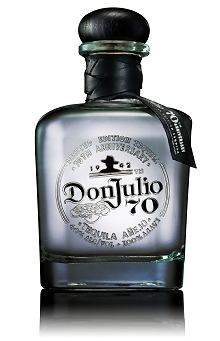
 Don Julio has introduced a new addition to its portfolio of ultra-premium tequilas in celebration of the 70th anniversary of the year Don Julio González began perfecting the art of tequila making – the world’s first Añejo Claro tequila, Tequila Don Julio 70. The good folks at Don Julio were good enough to send us a sample so we could enjoy their new creation. What we found was a unique flavor that tequila fans will love.


 Sours are an entire family of cocktail which mostly utilize some combination of lemon juice and sugar. (The sour mix used by many bartenders is, in my experience, slightly revolting.). The Latin American favorite, the pisco sour, is probably a better known drink in many quarters these days, but the whiskey sour has been one of the


