Category: Cars (Page 34 of 69)

First Drive: 2014 Toyota Tundra

The styling of the Toyota Tundra has been completely updated both inside and out for the 2014 model year which you’ll notice right away with the more muscular and chiseled front grille. Sales in the full-sized pickup truck market are booming this year and Toyota expects to grab its share of that market with the redesigned half-ton, full-size pickup truck. The 2014 Tundra will be available in 5 grades – SR, SR5, Limited, Platinum and a special 1794 Edition, which reflects a western lifestyle theme as a tribute to the ranch, founded in 1794, on which the Tundra plant is located in San Antonio. I traveled out to Knoxville, Tennessee for an up-close look at the new truck and a chance to drive it on a variety of roads.

Exterior

The redesign and the new front grille definitely enhance the look of the Tundra. It’s a great-looking truck as you can see from the photos above with the bold and powerful look that buyers expect in this segment. The Platinum version has a little less chrome and I liked that one the best, but buyers will have plenty of choices with the multiple trim levels. I liked the feature of having “TUNDRA” stamped into the sheet metal on the rear, and along with the new tail lamps the vehicle looks great from this angle. Toyota listened to customers who explained how they used the truck in rugged settings, so both the front and rear bumpers have been changed from one piece to three for lower replacement costs. Three cab styles are offered with the two-door Regular Cab, four-door Double Cab, and the super-sized four-door CrewMax. The Regular Cab and Double Cab models are offered in standard bed (78.7-inch) or long bed (97.6-inch) configurations and the CrewMax comes with a 66.7-inch bed, with all beds being 22.2-inches deep.

Interior

Many upgrades were made to the interior to make it more refined. The interior is very spacious and comfortable, and in the Limited, Platinum and 1794 editions buyers will find the luxury items you expect in higher end vehicles. I liked the leather seats and leather accents on the dash, particularly in the Platinum edition which featured perforated, diamond pleated premium leather seats, door and instrument panel inserts. The center stack screen and controls were laid out nicely and easy to use. The upgraded Entune audio system and app suite is easy to use with some nice customization features.

The rear seats in the CrewMax edition offer plenty of space for passengers and can now be folded up for additional cargo carrying capability as well.

Performance

The engine options remain the same on the new Tundra, as Toyota executives explained that drivers would not see any real-world mileage gains with a turbo V6 offered by competitors. Toyota’s most popular engine is the 5.7-liter, DOHC i-Force V8 which generates 381 horsepower at 5,600 rpm and 401 foot-pounds of peak torque at 3,600 rpm with a six-speed electronically controlled automatic transmission. Fuel efficiency on 4×2 models is 13 mpg city, 18 mpg highway and 16 mpg combined while the 4×4 achieves 13 mpg city/17 mpg highway/15 mpg combined. My test vehicles featured this engine and it performed nicely on roads that varied from winding hills at various speeds and inclines to highway driving. The Tundra was a pleasure to drive and it handled well.

Toyota also offers a 4.6-liter, DOHC i-Force V8 offers 310 horsepower at 5,600 rpm and 327 foot-pounds of peak torque at 3,400rpm that gets slightly better fuel mileage.

Buyers can also choose a 4.0-liter Dual Overhead Cam (DOHC) V6 which is standard on Tundra Regular and Double Cab models and produces 270 horsepower at 5,600 rpm and 278 foot-pounds of peak torque at 4,400 rpm. It is paired with a five-speed automatic transmission with uphill/downhill shift logic. EPA-estimated fuel economy is 16 mpg city, 20 mpg highway and 17 mpg combined.

Drivers can control the driving experience to adapt to road surfaces or driving conditions. In “normal” mode, Vehicle Stability Control (VSC), Traction Control (TRAC) and Automatic Limited-Slip Differential (Auto-LSD) all function to help enable traction and control capability. These modes can then be turned off to adjust to various conditions.

Overview

Toyota executives are stressing the “American-born” nature of the new Tundra which should play well with buyers in this segment. The redesigned Tundra was once again engineered by Toyota Technical Center in Ann Arbor and the design was created by Calty Design Research centers in Newport Beach and Ann Arbor. The Tundra is assembled in San Antonio and its V6 and V8 engines are built in Alabama while transmissions are built in North Carolina.

The large truck segment is very competitive with excellent products, but it’s also growing like crazy as the economy improves. The new Tundra will definitely catch the eye of buyers and we recommend test driving it if you’re looking for a big truck. Toyota has a well-deserved reputation for durability and reliability which is important if you’re looking for a workhorse.

Car Review: 2013 MINI Cooper S Paceman ALL4

mini_cooper_1

You can’t help but notice the lower stance and more aggressive look when you first check out the 2013 MINI Cooper S Paceman ALL4. This car is the result of years of real world testing and customer feedback that enabled MINI to build the car that many people crave. That’s a good thing for MINI.

EXTERIOR

With a sporty new exterior design and styled as a coupé interpretation of the Countryman, the inspired look of the 2013 MINI Cooper S Paceman has that It factor! Packed with MINI character and obvious design cues which tie it to the rest of the range, the three-door Paceman’s unique exterior styling is what immediately catches the eye. Built on the Countryman platform, bumper to bumper the car is 4,109 mm (4,115mm for MINI Cooper S Paceman and Cooper SD Paceman), which makes it almost identical in size to its sibling.

With a contemporary and expressive body shape, the Paceman has been created to appeal to a new type of design-conscious customer. The prominent horizontal lines and dynamic curved surfaces give the promise of sporting performance, yet there is an elegant simplicity to the overall form of the car. The upright front grille, complete with hexagonal radiator grille and broad chrome surround, gives the Paceman genuine presence. Its coupé-style stretched side profile features long doors, while the blacked-out pillars create a “floating roof” concept, as already seen on the MINI Coupe. Available in either black, white or body colour, the roof gently slopes towards the rear of the car, ending at the integrated spoiler. The horizontal arrangement of the rear lights, which accentuates the car’s width, is a first for MINI. The Paceman is the only member of the brand’s line-up to be identified by a rear nameplate.

Some of the upscale features included power folding mirrors, heated mirrors with washing jets, a huge dual pane panoramic sunroof and 19-inch alloy wheels.

INTERIOR

As with all MINIs, the cabin space is much more than anticipated, and the Paceman comes through with an inspired interior that is both smart and sporty. The car’s interior has been designed specifically for this model. It’s highlight is the innovative rear seat, which has been styled around a lounge concept. Two individual chairs provide generous levels of head, shoulder and knee room with outstanding comfort and support. Armrests have been integrated into the rear trim. A two-section version of the MINI Centre Rail storage and attachment system – first seen in the Countryman – comes as standard. A full-length variant is available as an option.

Continue reading »

Watkins Glen International: Why NASCAR fans have the most fun

Watkins Glen International

Impossibly fast.

With a revolving mixture of amusement and awe, those two words became a chorus in my head, going off like clockwork as each lap unraveled and 43 of the world’s best NASCAR drivers roared past the finish line and screamed into turn 1.

I was leaning against the railing of Zippo’s viewer-friendly suite in Watkins Glen, New York, for the annual NASCAR event that consistently draws tens of thousands of gung-ho fans. Aside from checking out Zippo’s current endeavors (which are stellar) and cataloguing the races themselves, an additional chunk of my focus at the Glen was to find out exactly what it is about NASCAR that has propelled it to remain an absolute juggernaut in the world of spectator sports.

Is the hype justified? Do the legions of diehard fans, movies and media coverage actually represent a sport deserving of such a pedestal? Many would scoff and issue a flippant dismissal, rebutting that NASCAR is simply a redneck obsession that has nonsensically acquired its popularity.

Having avoided any groundless perspectives, I was an unbiased sponge before my arrival; ready to soak in the scene and hammer out some concrete conclusions. To make a long story short: the naysayers have it wrong – very wrong.

“The Glen”

Watkins Glen International is by all means in the country, which for us meant a rolling and scenic cruise from the Buffalo Airport.

Fate had bestowed our driver with two notable characteristics: an encyclopedia-deep knowledge of upstate New York, including the Glen, and a superhuman ability to maintain unbelievably casual conversation despite vigorously tailgating any car that deviated below the assigned speed.

Given our empty stomachs and the familiar anticipation that any traveler feels before arrival, I wholeheartedly appreciated his quirks.

You begin to sense the immensity of the Glen even before you enter the gates. Signs that designate parking and directions slowly start to pepper the side of the road, tirelessly providing a first wave of guidance and defense to the most assured calamity that was already coalescing.

Gate 2, our drop-off point, was bustling with the quintessential festival entrance proceedings, complete with walkie-talkie clad workers, stop-and-go traffic and lots of chatter. Above us, in the distance, mammoth grandstands loomed.

After bidding farewell to our driver, our Zippo rep, Hunter, arrived moments later and we transitioned ourselves into his Jeep for the final voyage to camp, or as I like to call it, Ground Zero.

It didn’t take long to realize Hunter was friendly, down to earth and adept – a great ambassador for what was to be a hearty weekend.

Upon entering camp, which was at non-event dates a sprawling grassy area, crisscrossed by dirt roads and encompassed completely by the road course, I realized several things almost immediately. For one, my North Face and loafers, indiscernible at SFO, were now about as out of place and impractical as Hannah Anderson’s pajamas bottoms amidst the Montana forest. Too soon?

Also, I had widely underestimated the degree of revelry and madness, which reared its head wildly as we slowly rolled towards our spot. I found myself rubbernecking, hastily trying to take it all in.

Continue reading »

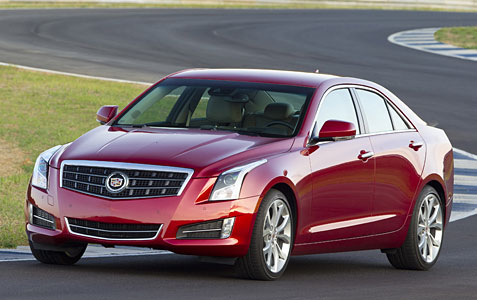
Car Review: 2013 Cadillac ATS 3.6L Premium

cadillac_ats_1

As the world at Cadillac continues to evolve, the expectations from buyers will also come to expect dynamic new products, which have to be the goal for any luxury car nameplate. The all-new Cadillac ATS 3.6L Premium was delivered to us at Bullz-Eye for a week of testing and admiration for what should be the new direction of Caddy and a shot across the bow at her competitors. Developed on an all-new, lightweight rear-drive architecture, the ATS reflects a new expression of Cadillac’s Art & Science execution philosophy, centered on a foundation of driving dynamics and mass efficiency. Germany ’s famed Nürburgring served as one of the key testing grounds, along with additional roads, race tracks and laboratories around the globe, where ATS engineers balanced performance with Cadillac’s trademark refinement.

EXTERIOR

The 2013 Cadillac ATS interprets Cadillac’s Art & Science design language in a new proportion, tailoring the signature styling and refinement cues for the most compact Cadillac while upholding and advancing the exemplary attention to detail and technological elements for which the brand is known. Although the 2013 Cadillac ATS 3.6L Premium skin doesn’t stand out all that much from the CTS, it’s clear that this new Cadillac was designed for performance over everything else. A long, 109.3-inch (2,775 mm) wheelbase and wide front/rear tracks are the cornerstones of the ATS’ firmly planted stance, which is enhanced by short overhangs and taut sheet metal that appears to wrap tightly around the tires. 17-inch wheels are standard and 18-inch wheels are available.

Bold, vertical lighting elements, including new LED front signature lighting detail and illuminating door handles and active grille shutters, lend technologically advanced style and function to the ATS. The luxury feel of the exterior is clearly enhanced with the lighting from all angles of the ATS, including the sleek door handles. The grille shutters close at certain highway speeds to reduce aerodynamic drag and enhance fuel economy. High-intensity discharge headlamps with Adaptive Forward Lighting made our driving experience that much better. Exterior colors include: Radiant Silver Metallic, Black Raven, Black Diamond Tricoat, Crystal Red Tintcoat, White Diamond Tricoat, Thunder Gray ChromaFlair, Opulent Blue Metallic, Glacier Blue Metallic, Silver Coast Metallic and Summer Gold Metallic. Our test model looked incredible in Black Diamond Tricoat that somehow looked as clean after a week as it did on day one.

INTERIOR

After taking in the striking good looks of the 2013 Cadillac ATS 3.6L Premium’s body, Cadillac really needed a top-notch cabin to keep the first impression strong, and they delivered with a morello red combined with a jet black hand-crafted cut and sewn interior seating that was off-the-charts good. A driver focused interior with integrated technology and crafted materials complements the exterior elements and supports the ATS’ driving experience. Everything from the placement of the pedals to the position of the shifter is designed for effortless and intuitive performance driving. Available performance seats have power-adjustable bolsters to optimize lateral support during high-load cornering. Contributing to the interior’s intuitive feel is an instrument panel that wraps into the doors and a center stack in the mid-instrument panel that flows into the center console.

Continue reading »

Classic Lamborghinis at Pebble Beach

1976-lamborghini-countach

We were back at Pebble Beach this year for the 2013 Concours D’Elegance at Pebble Beach, and again we had the opportunity to participate in the Dawn Patrol as the owners of the amazing classic cars drove them onto the 18th hole at Pebble Beach just as the sun was rising. We saw a stunning variety of beautiful vehicles as the drove past us during the dawn Patrol and then on the fairway at Pebble as they were on display for everyone to see.

The Best of Show award went to the owners of a 1934 Packard as cars from this time period often take the top prize. Those cars are beautiful, of course, but we’re usually most interested in the classic post-war sports cars.

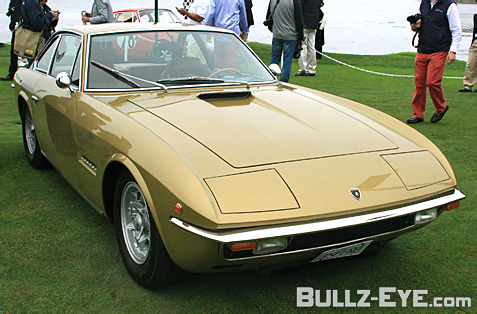
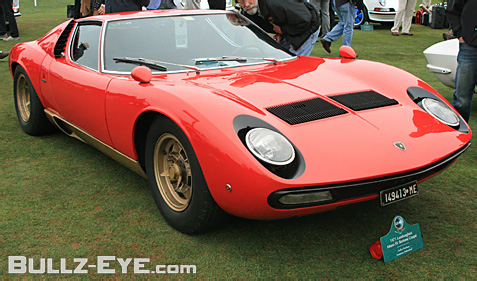
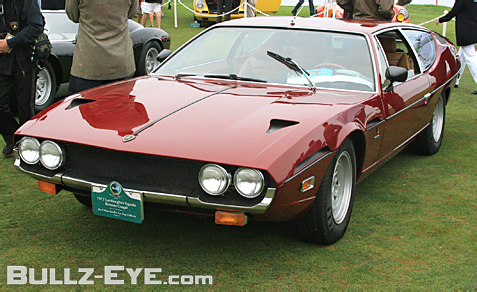
This year the Lamborghinis grabbed our attention as it was one of the featured brands as it celebrated its 50th anniversary. We certainly appreciate the modern Lambos as we’ve featured the new Aventador and drove the Gallardo on a track, so it was a treat to see some of the classic models up close.

The 1976 Lamborghini Countach LP400 in particular stood out with its bright blue paint job as you can see in the slideshow above. It’s hard to compete with the elegant sports cars from the 1960s, but the Countach offered up a radical design in the 1970s with its wedge-shaped, sharply angled look that had a huge impact on sports car design for a generation. You can also see how the cab-forward design of the Countach offered a dramatic contrast to the longer front hoods of the sports cars from the 60s. We made sure to get some photos with the iconic scissor doors opened up as well.

The Countach had some excellent company at Pebble with other iconic Lambos on hand:

1969 Lamborghini Islero S

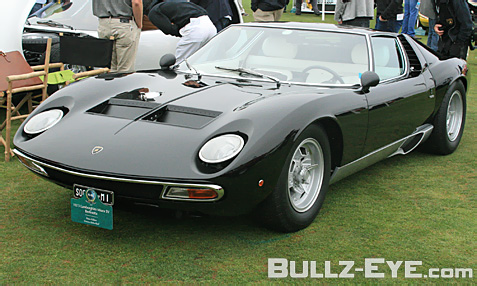
1971 Lamborghini Miura SV Bertone Coupe
1971 Lamborghini Miura SV Bertone Coupé

1972 Lamborghini Espada Bertone Coupe
1972 Lamborghini Espada Bertone Coupé

1973 Lamborghini Miura SV Berlinetta

You can see the evolution of the Lamborghini designs through the 60s into the 70s and also why these cars caught our eye. We’ll be posting more photos from Pebble Beach here and on our car site Dashboard News, but kicking things off with the Lamborghinis seemed like the obvious choice.

« Older posts Newer posts »

© 2026 Bullz-Eye Blog

Theme by Anders NorenUp ↑