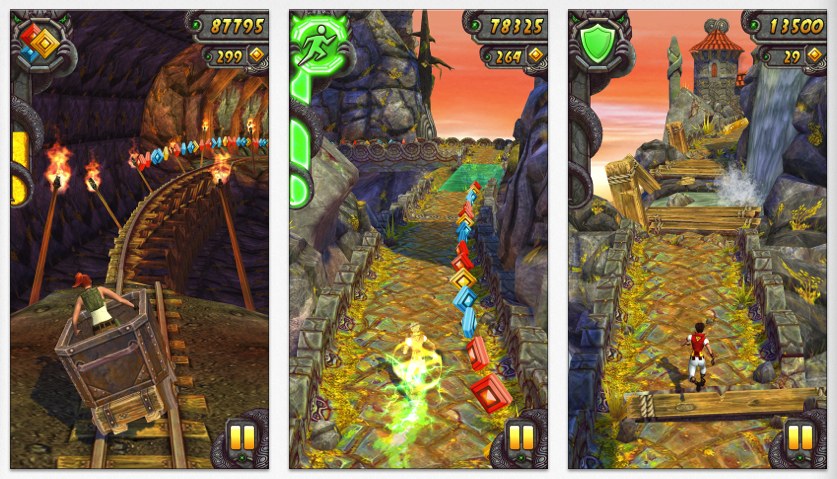
I tried to find a reason to not put “Temple Run 2” as the app of the week. I wanted to find some obscure, must have gem that was released in the same week as one of the biggest app sequels of all time instead, and hope to help it find some time to share in “Temple Run 2’s” considerable spotlight. Try as I might though, it was still “Temple Run 2” that came on top of the heap.
I probably don’t need to elaborate on the concept of “Temple Run” as with 170 million plus downloads, there’s a good chance you’ve played or heard about it. But just for forms sake, “Temple Run 2” has you playing as an adventurer in pursuit of the golden idol. The actual acquiring of it is never an issue, but the escape from the temple is the real challenge, and this is where the player comes in as they try to escape the temple, and it’s fervent defenders, via a series of course changes, jumps, and other simple (but rapid) interactions, all while trying to collect coins to unlock all kinds of goodies. You can’t survive, but the fun is in how long you last, and how much you can collect.
Since it’s a clearly successful formula, “Temple Run 2” doesn’t find much cause for altering it. Instead, this is a “more is better” type sequel, though that doesn’t mean there aren’t noteworthy additions. A particular highlight of “Temple Run 2” is the graphics, which are significantly improved from its predecessor. Everything is so colorful, varied, and detailed that it becomes impossible to look back at the first game without a scoff. It does cause some problems on older systems because of this, but the visual reward is worth the increased hardware recommendations.
Otherwise, it comes back to that more word to tell you what so great about the game. That would include more power ups (that goes along with more characters), more achievements, more collectibles, more environments, and best of all more obstacles like zip lines and mine carts that help make playing “Temple Run 2” in long sessions a much greater joy thanks to some genuine variety around every bend.
And of course it all works. “Temple Run” only came out in 2011, and while the novelty of it has long worn off, the fun never really did. “Temple Run 2” celebrates that fact by maintaining the simple joy of the gameplay, and sacrificing none of the addictiveness, but it also knows where to nip and tuck, and where to enhance, so that at least for the first few play-throughs, the game feels new again.
I think the reason that I was hesitant to write about “Temple Run 2” here is because it is such a big, bold, headline grabbing release, it seems almost lazy to join the masses of appraisers and admirers in covering it. Yet after spending some time with the game, I’m reminded that it’s not always about what’s new, what’s bold, and what’s unsung, but that rather sometimes it’s as simple as good is good. Well “Temple Run 2” is certainly good, and it’s also my app of the week.
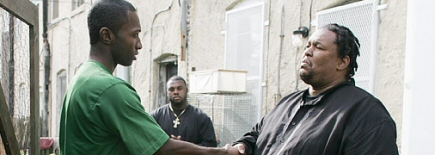
One of the best actors from the best television drama of all time has passed away. Robert F. Chew played Proposition Joe on “The Wire,” and in the scene above he gets a threatening visit from Omar.
Robert F. Chew, a 52-year-old Baltimore actor and teacher who portrayed one of television’s most unforgettable characters as Proposition Joe on HBO’s “The Wire,” died Thursday of apparent heart failure in his sleep at his home in Northeast Baltimore, according to Clarice Chews, his sister.
Mr. Chew, who appeared in “Homicide” and “the Corner,” as well as “The Wire,” also taught and mentored child and young adult actors at Baltimore’s Arena Players, a troupe he stayed with as his television career blossomed through his work with David Simon. Through the Areana Players Youth Theatre, he brought new talent to the attention of casting directors and coached the team of young actors who played students in the Baltimore City School system in Season 4 of “The Wire.”
“Robert was not only an exceptional actor, he was an essential part of the film and theater community in Baltimore,” David Simon, creator of ‘The Wire’ said in an email Friday. “He could have gone to New York or Los Angeles and commanded a lot more work, but he loved the city as his home and chose to remain here working. He understood so much about his craft that it was no surprise at all that we would go to him to coach our young actors in season four. He was the conduit through which they internalized their remarkable performances.”
Chew was an absolute master with dialogue and facial expressions, and it’s fascinating to learn in this article that many of the kids who starred in Season 4 of “The Wire” were his students. If you haven’t seen this show, get the DVD or download it now. You won’t regret it.
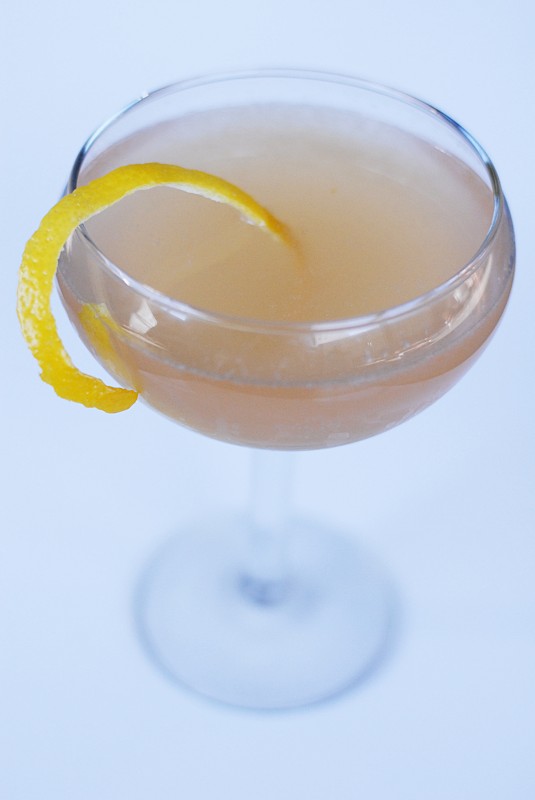
The French 75 does not refer to the number of pounds Gerard Depardieu could stand to lose. No, it refers to a really marvelous and relatively simple classic presumably imbibed in massive quantities by Ernest, F. Scott, Pablo, Gertrude and all those other people Woody Allen fantasizes about hanging out with.
The drink itself is named after a rapid firing cannon, the first truly modern piece of field artillery, say the Wikipedians. As for the cocktail, it “hits with remarkable precision” according to The Savoy Cocktail Book. I have to say I agree.
Reportedly created circa 1915 at Harry’s New York Bar in Paris by Harry himself, the French 75 rarely misfires. It’s delicate, friendly, and sophisticated all at the same time. The Lost Generation sure could find their way to a good mixed drink.
The French 75
1 ounce gin
1/2 ounce fresh squeezed lemon juice
2 teaspoons superfine sugar or 1/2 ounce simple syrup
Champagne/sparkling white wine
1 lemon twist (garnish)
Combine the gin, juice, and sugar or syrup in a cocktail shaker with plenty of ice. Shake vigorously and pour into a champagne glass. Top off with roughly 2-3 ounces of the dry sparkling white wine of your choice. Add your lemon twist and toast the early/mid 20th century author, poet, or painter of your choice.
****
First of all, I should add that this week’s drink represents a return engagement for the Yellow Tail Sparkling White Wine featured in last week’s beverage, the Capone. I am not a wasteful cocktail blogger and, as I still had half a bottle of not precisely champagne left and those little stoppers things actually work okay, I decided to try another sparkling white wine based cocktail. And, while I admit that Australia is a very long way from the Champagne region of France, any brut (dry) white fizzy wine should work okay here. The Yellow Tail worked pretty brilliantly, in fact, and I feel no need to rename this version of the drink after something Australian.
The French 75 is one of those drinks where there is a great deal of variation from recipe to recipe and experimentation is welcome. My favorite version of the drink was the one featured above, but I also enjoyed a couple of variations I tried out. One, maligned somewhat elsewhere, used Cointreau in place of sugar for a somewhat boozier, orangey-er concoction; it wasn’t quite as deliciously delicate as the version above, but was still a very nice drink of its own that many may prefer. I also experimented with dispensing with the sugar and using sweetened Hayman’s Old Tom Gin in place of my Beefeater. The result was drier but still very, very light and enjoyable.
The trick, for me, is keeping the lemon juice under control. Some recipes call for as much as a whole ounce of lemon juice and more sugar. To that, mates, I say “non.”
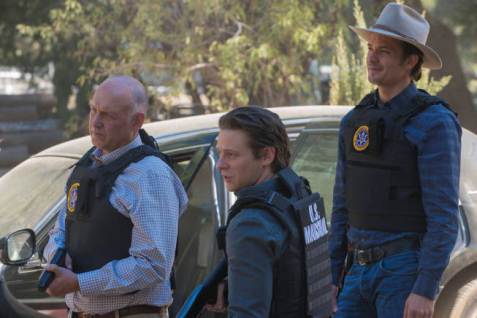
SPOILER WARNING: This post will appear following a new episode of “Justified.” It is intended to be read after seeing the show’s latest installment as a source of recap and analysis. As such, all aspects of the show up to and including the episode discussed are fair game.
The second episode of Justified’s fourth season didn’t offer much in the way of action. You probably could’ve watched it with a blindfold on and not missed out on much. That’s not to say it wasn’t entertaining, however. In fact, quite the opposite. There’s little on television more entertaining than a trademark Boyd Crowder speech, and his verbal battle with preacher Billy will likely be remembered as one of the best scenes in the series’ history. It was also a reminder that Walton Goggins is one of the past decade’s best character actors. While he’s finally getting rewarded with roles in big-time movies like Lincoln and Django Unchained, between Shane Vendrell and Boyd Crowder, how he hasn’t won a single Best Supporting Actor Emmy (and has only one nomination) remains a mystery to me.
Leading up to that confrontation, Billy and the Crowders poke and prod at each other from afar, mostly using Ellen May as a conduit. It starts when the easily convinced hooker shows up to tell Ava about her conversion, quoting “Palms number 62.” Ava is quick to ensure the fear of Crowder outweighs the fear of God by reminding Ellen Mae that she was the one who “saved her soul.” So Ellen Mae mopes back to the Last Chance Holiness, only to be converted yet again.
Up to that point, Boyd remained casually detached from the situation. He’s got more pressing concerns, namely finding someone to blame for the decline of his oxy sales. Cousin Johnny, determined to ensure that someone not be him, is quick to point the finger at Billy and his church. Boyd meets the idea with skepticism, however, noting that people in Harlan County “party Friday and Saturday and get saved on Sunday.” He doesn’t think one more church is going to change that, and declines Ava’s suggestion that they go see what all the hubbub’s about, stating that he “doesn’t like churches” (no doubt because of the way his own stint as an evangelist ended). But Billy gets Boyd’s attention by sending a group of hymn-singing children into his whorehouse, scaring away customers.
Though Sheriff Shelby insists Billy’s history of moving from one destitute small town to the next suggests he’s nothing more than your run-of-the-mill pulpiteer, Boyd reads a different story between the lines: The St. Cyrs (Billy and his sister, Cassie) keep their tent tied down just as long as it takes to bring enough addicts, whores, drunks, gamblers and other characters of ill repute into the fold. When the leaders of the local criminal element notice their revenue streams drying up, Billy and Cassie make a simple proposition: Pay up and we’ll be on our way. It remains to be seen what the St. Cyrs’ motivations really are. It seems more likely that a drop-off in oxy sales could have more to do with Dixie Mafia heroin dealers “accidentally” moving into Crowder turf, and that Boyd’s giving the St. Cyrs all that credit because that’s the way he would run that hustle. It’s just too early to tell, the possibilities are endless.
Anyway, all this leads to that ultimate showdown of the orators. The preacher vs. the ex-preacher, the sinner vs. the saint. The two trade bible verses, and Billy talks a lot about helping the wicked to see the light. Boyd turns that around though, pointing out the hubris inherent in the preacher’s willingness to pass judgment on those he does not know. Then he goes on the offensive, calling Billy a “false prophet” and begging the congregation to “test the spirits!” He says Billy goes from town to town, taking people’s hard-earned money and giving them nothing but empty promises in return. Billy’s counter is a surprising one, he says the church will no longer pass out collection plates, a smile never leaving his face. The same cannot be said for Cassie.
At first glance it appears Boyd has to chalk up a rare tally in the loss column. But, when Colton says, “that didn’t go so well,” Boyd responds, “Actually, Colton, I think we got exactly what we came here for.” See, Boyd’s always playing the game on a few different levels, using his bravado to mask his cunning. Boyd wasn’t in that tent on a search and destroy mission, but to gather intelligence. And not just about Billy, but the full extent of the problem, the individual members of the congregation, and everything he can exploit or use to his advantage. Most importantly, he learned that while Billy’s the one behind the pulpit, the charismatic face of Last Chance Holiness, Cassie’s running the show from behind the scenes.
Meanwhile, Raylan and company take the first steps towards unraveling the season’s big mystery, going in search of Waldo Truth, the name on the driver’s license found in the Panamanian diplomatic bag in Arlo’s wall. That included another fantastic scene in which Raylan, Tim, and Art get into a standoff with the Truths, an entire family of Dickie Bennetts. The Truths, of course, fail to see the irony in their gun-toting, “go ahead and shoot,” intensely anti-“gov’ment” attitude, all in an effort to protect the “draw” delivered to them from said “gov’ment.”
In contrast to the hotheaded younger Truths, however, is their matriarch, who calmly invites the Marshals in to sort things out. Eventually, “Waldo” returns home, but not really, as we soon discover. The man is an impostor, posing as Waldo Truth so that the family could continue to receive his benefit check. While Raylan’s ready to haul in every last one of them, Art decides to let them go once the information they offer helps him connect a few dots between their current predicament and an intriguing case from his early days as a Marshal. It’s now certain the man who fell out of the sky with all that cocaine was the real Waldo Truth, who disappeared with a pilot named Drew Thompson decades ago.
The episode brought some connection between the previously disparate Boyd and Raylan/Waldo Truth storylines with the return of Jere Burns as Wynn Duffy, who arrives in Harlan to deal with the dealer who wandered into Boyd’s turf. Duffy, who’s apparently been made a little colder by the time he spent with Robert Quarles, promptly shoots the dealer in the head. Boyd attempts to seize an opportunity by offering to partner up with Duffy in bringing heroin to Harlan County. Duffy turns him down saying, “I don’t even trust the way you just now said I could trust you.” But, before he leaving, he asks Boyd what he knows about Arlo offing a Dixie Mafia soldier, which, at the moment, is nothing. Boyd’s now a dog with a scent, he’d probably want to know what Arlo’s deal is just to know, but now he’s got the added incentive of proving he’d make a good partner to Duffy. Now we’ll get to watch as both Boyd and Raylan uncover the clues of the big mystery separately and on opposite sides of the law. That’s good news for us viewers, because we’ll get to see it all.
Check out the preview for next week’s episode below and follow the writer on Twitter @NateKreichman.
We’ve been fans of the beautiful Joy Bryant since she appeared in “Antwone Fisher” and we’ve enjoyed watching her have a successful career in Hollywood. Now she’s taking on a new project with “Across the Board,” a new web video series produced by Reserve Channel, an original YouTube channel. It’s an action talk show hosted by Joy where she dives deep into conversation with celebrity guests while they board around. In the episode featured below, Joy invites her “Parenthood” co-star, Erika Christensen, for a day of paddle boarding and girl talk. The duo discuss Christensen’s beginnings as a child actor, her role as a teenage drug addict in “Traffic,” being a curvy woman in a pencil-thin business, and her faith as a Scientologist.
We were sold on this as soon as we saw the two of them in bikinis, but the interview is excellent as well. We think Joy is onto something here. Check it out and look for new episodes as well.

 The French 75 does not refer to the number of pounds Gerard Depardieu could stand to lose. No, it refers to a really marvelous and relatively simple