Seriously, who doesn’t want a motorcycle with machine guns on it? Props to YouTube user pepelemacho for assembling this fun video. Merry Christmas, fuckers.
target=”_blank”
Seriously, who doesn’t want a motorcycle with machine guns on it? Props to YouTube user pepelemacho for assembling this fun video. Merry Christmas, fuckers.
target=”_blank”

We hit the LA Auto Show recently with our friends from Chrysler, and we’re happy to share some of our favorite sites from the event. The cars were amazing, but some of the eye candy next to the cars was even more impressive.
Chrysler deserves kudos for bring back beautiful models to help them show off their cars, and you can see that as our slideshow above kicks off with four photos of a stunning and elegant blonde showing off the new Ram trucks. Not to be outdone, Chevy made sure to have a fetching brunette on hand for the new Camaro convertible!
Fiat made a big splash at the LA Auto Show with the unveiling of the new Fiat 500 for the US market, and they had a red vintage Fiat 500 on hand to celebrate the event. We made sure to capture it in pictures, along with the tall blonde they selected to showcase the brand.
Check out the rest of the gallery for a tall, beautiful brunette in a green dress along with the shiny red pumps that looked like ruby slippers on the model covering the Range Rover vehicles.
Check out out Girls and Cars page for more!
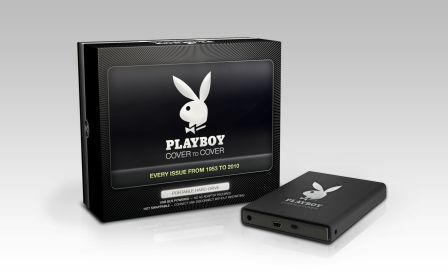
Practically every guy enjoys Playboy magazine whether they subscribe or not, and old issues are treated differently than those of other magazines. We don’t want to throw them out, particularly those with our favorite Playmates. So collectors and even casual fans have boxes of old issues in their closets and garages.
Now Bondi Digital Publishing has come out with a product that every Playboy fan will love – a USB portable device that gives users immediate access on their computer to every issue from that first iconic Playboy featuring Marilyn Monroe in December 1953, all the way to the December 2009 edition featuring Chelsea Handler– and every issue, award-winning article and advertisement in between. There are over 650 issues and more than 100,000 pages covering a span of 56 years. As for adding content after 2009, a decision hasn’t been made yet on whether that will be offered, though the device can be easily updated.
The Playboy Cover-to-Cover Hard Drive is pocket-sized and very easy to use, and it’s fun to browse through all the old magazines. Naturally the pictorials will be the most popular – some of our favorites include Cathy St. George from 1982 and Christina Leardini from 1991. But Playboy has always been an influential magazine as well as Hugh Hefner featured some of the best writers of the past 50 years from Norman Mailer to Tom Wolfe. The interviews are excellent as well with an incredible variety of subjects from Steve Jobs to Jimmy Carter to Brett Favre. The software makes it easy to find items through a robust search feature, and it’s easy to browse old issues as well. We found a couple of minor glitches, but representatives from Bondi explained that updates and fixes could be downloaded seamlessly.
Priced at $299.95 this isn’t an inexpensive item, but there’s a ton of value packed into this device. Collectors will love it, along with casual fans as well.
 John Lennon was killed 30 years ago today outside his apartment in New York City. Fans around the world are commemorating his tragic death, and we wanted to pay our respects as well. Lennon is one of the signature artists of the 20th century and he and The Beatles will be remembered forever. Lennon was also a powerful advocate for peace. Whatever one thinks about his views or tactics, Lennon was always brutally honest about his views.
We’re getting another glimpse of that honesty as Rolling Stone is publishing the full interview John Lennon gave just days before his death. The recording of the interview was recently discovered by writer Jonathan Cott in his closet. Here are some highlights:
On the tapes, Cott found a Lennon who was still angry at fans and critics who had taken him to task for a five-year musical hiatus, during which the singer devoted his time to raising his son Sean with wife Yoko Ono and decompressing from more than 15 years in the intense media spotlight. “These critics with the illusions they’ve created about artists — it’s like idol worship. They only like people when they’re on their way up,” he said. “I cannot be on the way up again. What they want is dead heroes, like Sid Vicious and James Dean,” he added in an eerily prescient screed. “I’m not interested in being a dead f—ing hero … so forget ’em, forget ’em.”
With Bruce Springsteen then the face of rock’s future, Lennon expressed fear that the Boss would fall victim to the same kind of pressures as he did. “And God help Bruce Springsteen when they decide he’s no longer God. … They’ll turn on him, and I hope he survives it.”
Our own Will Harris recently interviewed Yoko Ono for Bullz-Eye.com, and he had the opportunity to discuss the recent “Lennon NYC” documentary about John Lennon.
BE: Well, with the program that’s upcoming for PBS, the “NYC” program, putting that together, was it an emotional tightrope, going from “these are such wonderful memories” to “I still miss John.”
YO: (Wistfully) Yeah. It was very, very emotional for me. And I just never thought it was going to be that emotional, because I thought, “Okay, thirty years…” I’ve been doing John’s songs and dealing with it on a business level for thirty years, so it’s nothing, right? But it wasn’t.
BE: What do you think John’s fans will learn about him from watching the new special?
YO: Well, they’re going to learn a lot, actually. They might faint. (Laughs)
BE: Are there any particular moments in the special that really stand out for you?
YO: No, no. Well, the whole thing is very pretty, let’s put it that way. (Laughs) For me, it was, you know. “Is that my life? Did I have that kind of life? Oh, dear…” I mean, I can’t repeat it, I can’t do it over again, but it’s very pretty.
The best way to celebrate Lennon’s life, of course, is to enjoy his music. We like this live version of “Imagine” along with the “Imagine” video taken from the film of the same name. You can see how Lennon and One were ahead of their time, as this is a brilliant music video. We also liked this tribute to John Lennon by Paul McCartney in which he sings three Lennon songs.
Over the last decade, craft beer culture has exploded. There are now more than 1600 breweries operating in the US alone, a number that continues to grow year after year. Beer 101 is a guide to understanding the history of brewing, beer culture, and (my favorite part) the enjoyment of good beer.
Part 1 – History of Beer
As my first post in what will become a five part series about the science and art of beer, it seems appropriate to start with a little history. To consider yourself a scholar of any art, you have to know its roots and, with a history that spans several millenia and nearly every continent on the globe, there’s plenty to know about beer. I don’t pretend to know it all, but I can give you what I consider a ‘bartender’s history,’ basically enough that you should be able to chat up any local beer geek or the guy behind the bar at your favorite brewpub.
Though the numbers vary, most people agree that beer was first brewed sometime between 8,000 and 12,000 years ago. That’s a huge window, but there really isn’t a way to know exactly how long ago man first put yeast to malt and invited a few friends over to dream up the wheel. It suffices to say that beer is old and widespread and comes in all sorts of forms thanks to the cultures that brewed it and the different ways people have enjoyed it over the years.
As we know it today, beer is brewed with four main ingredients: water, yeast, hops, and some sort of grain. That formula holds true just about as far back as we can look, though hops are a fairly recent addition. Hops serve as a bittering agent in beer and so can be substituted with all sorts of crazy herbs. Ever heard of Bog Myrtle? The point is, beer is shaped by culture and geography and always has been. The grains used in beers around the world used to be directly related to what the landscape could sustain. Without modern agrarian technology, people couldn’t just grow barley where they pleased, despite its hardy disposition. Oats and rye thrive up North, while hops remain among the more fickle plants used to brew. If you traveled the world around 500 CE, you’d be hard pressed to find two beers that tasted even remotely alike.
Enough of this wishy-washy fablery, though. Let’s get down to specifics. Some time in the years 800-900 CE the world saw the first use of hops as a bittering agent, though it wouldn’t become widespread until the year 1500. That’s also about the time we started to see serious legislative efforts (Hammurabi’s Code aside) aimed at improving the quality of the world’s favorite libation. In 1516, Wilhelm IV and his Bavarian pals enacted the now infamous Reinheitsgebot, the standard of purity for all beer.
Fast forward a couple hundred years and the industrial revolution gives way to standardized brewing practices, giving brewers the ability to mass produce a consistent product. At the same time, 1842 to be precise, Czech brewers find a way to filter the pale lager they’d been brewing in the town of Pilsen (Plze). Thus, the Pilsner was born and would start making its way around the world. Across the pond, American breweries were sprouting up everywhere.
The boom peaked in 1873 with 4,131 breweries operating in the US. Most were short-lived. Thanks to refrigeration technology in railcars, regional brewers were able to expand rapidly, pushing their way onto the national scene. American drinkers flocked to the big name brands and their big, consistent products. By 1919, the year Prohibition began, there were just over 1500 breweries left. When the law was repealed in 1933 fewer than half that number would reopen their doors, and many of those that did failed shortly after. The American brewing scene grew ever dimmer. World War I suppressed German culture in the states to the point that many German-style beers disappeared. The invention of the beer can in 1934 gave big brewers a firmer grip on the American public and by 1980 there were fewer than 100 operating breweries in the United States.
A young enthusiast named Fritz Maytag had seen his local brewery, Anchor Brewing, struggle to make ends meet. He had purchased a majority of the company in 1965, but it still struggled. He became the sole owner in 1969 and two years later, started bottling Anchor Steam. Over the next three years, Maytag would lead Anchor to produce four additional varieties of beer, including its annual Christmas Ale. No one was calling it ‘micro-brewing’ but it was clear, at least in San Francisco, that a brewing revolution was on its way.
The 80’s and 90’s brought about a new boom in brewery openings. A lot of businessmen saw potential in the industry, opening new brewhouses and quickly thereafter closing them, leaving behind a glut of equipment and space for the enthusiasts that would start some of the craft breweries we know and love today. In 2009, the number of operating American breweries was the highest it had been in 100 years, as high as it had been just before Prohibition.
Check back next week for part two in our series on beer, Beer 101: A Crash Course in Zythology, when I’ll cover the brewing process as we know it today. In the meantime, be sure to check out our ‘iLoveBeer: Zythology App Tailgating Giveaway‘ for a chance to win tailgating gear like a new grill, an iPod speaker system, or party-to-go cooler.


© 2026 Bullz-Eye Blog
Theme by Anders Noren — Up ↑