Whether you’re shopping for someone that likes to kick back with a good book or graphic novel, or enjoys watching documentaries and other non-fiction films, you’ll find several great suggestions here.
Click on the image next to each item to purchase it online, and for more gift ideas, check out the other categories in our Holiday Gift Guide.
Before Watchmen Collections
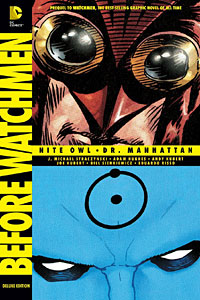
Have you ever wondered what happened before the events of “Watchmen”? Creator Alan Moore has been pretty outspoken about his thoughts on the matter, but that didn’t stop DC Comics from enlisting some of the industry’s best writers and artists to create eight new miniseries exploring the histories of characters like Nite Owl, Rorschach, The Comedian, Dr. Manhattan, Silk Spectre and Ozymandias. Serving as a prequel to the original 12-issue series, the “Before Watchmen” comics have since been collected in four hardcover editions, and the end result is a pretty mixed bag, especially since each collection features at least two characters per book. Though that’s good news for diehard fans, those that want to read J. Michael Straczynski’s Nite Owl series but couldn’t care less about his Dr. Manhattan story, for instance, are screwed. Additionally, some of the series are much better than others, with Darwyn Cooke’s Minutemen yarn the clear standout. Still, if you know someone who loves “Watchmen” that doesn’t mind that the property’s original creators aren’t involved, “Before Watchmen” makes for interesting supplemental reading.
American Experience: JFK
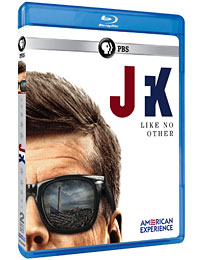
The story of John F. Kennedy is one of the most fascinating in American history. Regardless of your opinion of our 35th President, he will always be an iconic figure in American history, due to both the pivotal nature of his presidency and his tragic assassination. Debates will rage on about his performance in office and the circumstances surrounding his assassination, and his prolific adventures with the opposite sex have been fodder for the tabloids for decades. His story will captivate anyone who appreciates American history, so any documentary is likely to maintain the attention of viewers. But it’s hard to imagine anyone telling the story better than the folks at PBS who produce “American Experience.” They have consistently told the story of America through its presidents and other influential Americans in a series of compelling documentaries. “JFK” easily lives up to that legacy, and it’s a must-see, as this year we marked the 50th anniversary of that terrible day in Dallas. Like other “American Experience” documentaries, this is not just a story of the JFK presidency, but also the man.
The story of John F. Kennedy is one of the most fascinating in American history. Regardless of your opinion of our 35th President, he will always be an iconic figure in American history, due to both the pivotal nature of his presidency and his tragic assassination. Debates will rage on about his performance in office and the circumstances surrounding his assassination, and his prolific adventures with the opposite sex have been fodder for the tabloids for decades.
JFK had some spectacular failures like the Bay of Pigs and even greater triumphs such as the Cuban Missile Crisis and the space program. His story will captivate anyone who appreciates American history, so any documentary is likely to maintain the attention of viewers. But it’s hard to imagine anyone telling the story better than the folks at PBS who produce the American Experience. They have consistently told the story of America through its presidents and other influential Americans in a series of compelling documentaries. “JFK” easily lives up to that legacy and it’s a must-see as we mark the 50th anniversary of that terrible day in Dallas. Like other American Experience documentaries, this is not just a story of the JFK presidency but also a story of the man.
“JFK” premieres on Monday and Tuesday, November 11-12, 2013, 9:00-11:00 p.m. ET on PBS. Follow this link and you can also purchase the DVD.
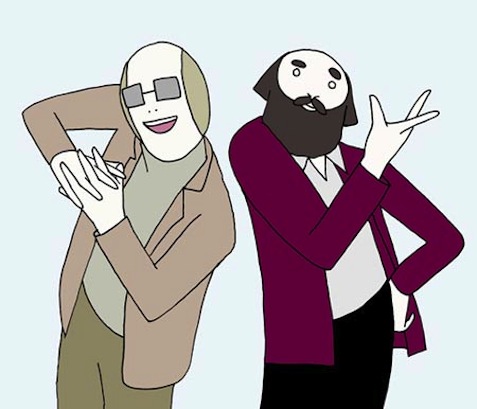
It is time now to return to the bizarre, frequently hilarious and occasionally disturbing fictional universe of China, Illinois, where Brad Neely‘s “The Professor Brothers” hold sway as the arbiters of knowledge and coolness. Steve and Frank Smith are brothers who both teach at a local community college whose mascot is a panda bear. Steve is the more laid back and presumably younger of the two, and his bald, sunglass-adorned appearance is vaguely reminiscent of Elton John. Frank, also mostly bald but bearded, is a connoisseur of drunken blackout experiences, as documented in the very funny two-part episode, “FliffNight.”
Together, the Professor Brothers reign supreme in their shared office at the college, surrounded by books with titles like “Owl Sex” and “Man Cave.” They sometimes join forces for songs like the wonderfully catchy “Prisoner Christmas,” or to essentially prank some poor, unsuspecting student, as in “The T.A. Interview,” but more often than not, it is Prof. Steve who pranks Prof. Frank. In “The Substitute,” for example, Prof. Frank hands his history class over to Prof. Steve (it is never made clear what Prof. Steve actually teaches), who proceeds to make up an extremely strange and offensive lecture that he then blames on Prof. Steve’s notes, which he ignores in favor of a comic book. In “The Late Date,” Prof. Steve actually joins forces with the college’s dean for the ultimate prank on Prof. Frank, whose day has already been going very poorly.
Unlike Prof. Steve, Prof. Frank does sometimes get around to teaching some history, though it is primarily of the irreverent biblical kind, like his lecture on Sodom (“named after sodomy”) and Gomorrah (“which was named after an even weirder move”) in “Bible History #1.” He also recounts the life of “Jesus F**king Christ,” of whom he says, “I know that Jesus is pretty played, but just like feces, he was very real, and some point you have to talk about it.” According to Prof. Frank, Jesus was betrayed by a conspiracy of his disciples in order to sell more copies of his teachings; they then blamed it all on Judas, “who was planning on killing himself anyway.”
The foul-mouthed, slang-inventing Professor Brothers are perhaps not as fascinating as his earlier creation, “Baby Cakes,” but their songs and misadventures make a very funny addition to the China, Illinois, universe. Baby Cakes can be seen in the audience of some of Prof. Frank’s lectures, and he even gets some insightful dialogue in “Future Thoughts”: “When the aliens come, they will be so great in so many different ways, that everything we ever thought was cool will then make us ashamed.” Get ready for a “so much cooler” future, everybody, because according to the Professor Brothers, the government has been lying to us all along.
Brad Neely, perhaps best known for his hilarious “George Washington” and “JFK” music videos, has built an empire of off animatics (still images edited together with dialogue and sound effects). The creator of “Creased Comics” also invented a fictional town called China, Illinois, in which several strange characters reside, including a huge, baby-faced man named Mark “Baby” Cakes. In the series “Baby Cakes,” Neely explores the unique life and philosophy of this probably autistic, mostly gentle giant, and the results are very funny, always absurd, and even sort of profound and sad a surprising amount of the time.
The first six episodes of “Baby Cakes” find Baby Cakes transcribing his thoughts on a variety of subjects into his diary. The very first episode sets up a few recurring themes of the series, such as Baby Cakes’ belief that his father and his father’s professor friends are wizards, and his love of fantasy role-playing games. When one of his friends asks him if he’s a virgin, Baby Cakes’ reply is a perfect example of his strangely limited understanding of the world: “I said no, because I can’t give birth to a Jesus.” The episode also sets up Baby Cakes’ recurring songwriting, and some of the later episodes are entirely made of these songs.
The second episode introduces Baby Cakes’ grandfather and explores the relationship between the three generations, and demands a few repeat viewings in order to decipher the ridiculous bathroom graffiti Baby Cakes encounters in a gas station bathroom on the way to his grandfather’s house. The third episode is among the series’ very best, as it is the first one that really captures the sweet, oddly sad philosophy and worldview of Baby Cakes, a self-described “peaceful, sleepy giant making zero a year.” As Baby Cakes walks through the park, reflecting on the world around him, as he sees it, in a unique parlance all his own: “I have a big coat, with big pockets. Sometimes, kittens get in there. It’s cool with me as long as they keep their hook-socks curled.” The episode ends with a wonderful encapsulation of Baby Cakes’ views about life: “Even if my days don’t mean anything, I just hope that I die while hugging, and not while in a wine-drinking contest.”
The sixth episode expands on this strange but surprisingly insightful worldview, and just might be the very best episode of the entire series. It finds Baby Cakes digging up a time capsule he buried as a child, in which he placed his favorite thing and a note to his future self, in which he explains sex: “Sex is a people-spaghetti. Hairy pee-pees clash. They yell, ‘Yes! Yes!’ but their grody faces say, ‘Ouch!’” The rest of the episodes (the non-diary ones) are something of a mixed bag, but there are definitelyhighlights, and the whole series is only about 32 minutes long, with more brilliance scattered throughout than most full-length television series.
Today it’s a milestone at Drink of the Week as we’re leaving behind our old friends whiskey, gin, and vodka for that tropical favorite, rum. Nevertheless, we’re holding on to our classical cocktail standards, so you may abandon all thoughts of blenders.
This is not the ultra-sweet ice-based monstrosity of a strawberry daiquiri that you’ll find at your local Bennigan’s/El Torito/Acapulco/TGIFriday or the devastatingly alcoholic quasi-Slurpees sold by hole-in-the-wall vendors on Bourbon Street in New Orleans. Nope, at the risk of sounding like a complete snob, this is the more civilized, yet refreshing — and vastly less fattening — beverage reportedly named either for a Cuban beach or an iron mine and favored by Ernest Hemingway and John F. Kennedy. The former personage is a lot more popular in post-revolutionary Cuba than the latter, but that’s another story.
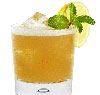
Here’s the drink:
The Daiquiri
2 ounces rum
1/2 ounce fresh squeezed lime juice
1/2 teaspoon superfine sugar
Lime or orange wedge (optional garnish)
Mix sugar with room temperature lime juice. Add rum and plentiful ice to your cocktail shaker. Shake very vigorously and strain into a chilled martini glass. It’s not really necessary, but you can garnish it with a lime wedge, or an orange slice if you’d like an extra touch of sweetness. You can add a little more sugar if you like, but remember that rum has, for a hard liquor, a lot of built-in sweetness. It will taste even better with Dizzy Gillespie and Chano Pozo’s Afro-Cuban classic, Manteca, playing in the background.
****
I’ve tried this a few ways, but I’m happy to say this is a rather indestructible drink if you don’t mess with it too much. Most recipes call very specifically for light rum, but it was only slightly less good when I tried it with gold rum. Cocktail historian David Wondrich says you can also use the even sweeter and more complex dark rums, but cut back some on the sugar. Since I ultimately determined that his recipe was better than those I found in several other places calling for more lime juice and sugar, I imagine he’s right about that, too.






 Today it’s a milestone at Drink of the Week as we’re leaving behind our old friends whiskey, gin, and vodka for that tropical favorite, rum. Nevertheless, we’re holding on to our