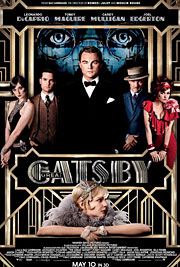
Leonardo DiCaprio, Carey Mulligan, Tobey Maguire, Joel Edgerton
Baz Luhrmann
Baz Luhrmann was born to make “The Great Gatsby.” Dazzling excess, star-crossed lovers, and tragedy are the cornerstones to nearly every movie he’s ever made, and F. Scott Fitzgerald’s novel has all three in abundance, wrapped in a searing indictment of the pursuit of wealth. All four of those elements of the story are on full display here, but there’s something missing in the execution. For a story with so much passion and longing and regret, it’s surprisingly bloodless. This is not to say that Luhrmann doesn’t hit the emotional buttons; he just doesn’t hit them hard enough. Then again, that may not be Luhrmann’s fault at all, but the source material. A bunch of clueless people ruining their lives by making bad decision after bad decision; it’s like a Mike Leigh movie, with money.
Nick Carraway (Tobey Maguire) is in a sanitarium for a laundry list of conditions (top of the list: morbid alcoholism), and soon begins telling his shrink about the summer of 1922. Nick had taken a job as a bond salesman during the Roaring Twenties, and found a small cottage in the village of West Egg, where he lived next to new-money millionaires. Nick’s cousin Daisy (Carey Mulligan) lives across the bay from her, and is (unhappily) married to old-money millionaire and unfaithful thug Tom Buchanan (Joel Edgerton). The man who lives next door to Nick is a mysterious fellow named Jay Gatsby (Leonardo DiCaprio). Jay would throw massive parties every weekend, but his reason for doing so was surprisingly sweet: he hoped that one day Daisy would attend one of them. Daisy was Gatsby’s girl five years earlier, and once Jay discovers that Nick and Daisy are related, he asks Nick to invite Daisy over for tea. This sets in motion a chain of events that would change the lives of all concerned.
Even though he just recently finished his sophomore season at the University of Wisconsin, Traevon Jackson comes across just like his game- confident, smooth and mature.
For being just 20 years old, he’s so calm and composed, you can’t help but think about where you were in life at 20….and then sheepishly quit punishing yourself.
Some of that confidence undoubtedly comes from his famous genetics and being the son of NBA star player Jim Jackson, but the greater part of it comes from his faith and approach to life, off the court.
After getting limited minutes in the beginning of the year, Jackson became a starter and was a key contributor during the Badgers’ NCAA Tournament run, being named to the Big Ten All-Tournament team and hitting multiple game winning shots. Jackson was 15th in the Big Ten in assists as a true sophomore, also leading the team in both steals and finishing second in free throw shooting.
You get the feeling that it isn’t about what Jackson has accomplished thus far, but what he is going to accomplish. And that gets Badger fans excited.
Bullz-Eye- What was your experience like playing in the NCAA Tournament?
Traevon Jackson- “Obviously, it didn’t end the way we wanted it to. Just the fact of me playing in the tournament was great because it’s the attitude of “loser goes home” and unfortunately we had to go home. But it really puts into perspective what you need to do to prepare for it going forward. And learning from that this year helps us next year.”
You just finished your sophomore year you were a big part of the rotation. What helped your development the most between freshman and sophomore year?
“Mainly going home and working with Anthony Rhodman (Who also trained National Player of the Year Trey Burke). This was my first full summer going back home and doing all the skill work that I needed to work on. Coming back in this year I was way more confident and better overall. It took a little while, had to go thru adversity. I didn’t achieve all the goals I wanted to, but the little bit of success I had is like a glimpse of the future.”
What is one area you’ve improved the most on the court and the most off of it?
“It goes for both- just my faith on and off the court. I’ve always been somewhat of a faithful guy but Ant really opened my heart to the lord and it really took hold of everything I do in life, I do it for the Lord. It’s a bigger purpose now. It really took hold for me on and off the court, doing it for the right reasons, bringing glory to god’s name, when it used to be “I want be the best just for me.” But now it’s not just for me but it’s for, Him, the Lord as well.”
What’s the experience been like at Wisconsin since you committed, versus what you thought it would be?
“Coming out of high school, just like any other freshman I’m sure, I thought I’d come in, play major minutes and be the man. And that wasn’t the case at all. Rarely played in my freshman year, and coming into my sophomore year I wasn’t expected to play either. But some injuries happened and I still didn’t start in the beginning of the year, but as season went on I became starter. That’s the biggest thing I’ve learned in my two years- overcoming adversity. And if you just stay in the fight because anything can happen if you put in the work.”
What’s the most annoying or creative heckling you have heard in any Big Ten arena?
“A lot of stuff about my dad, but I’ve heard that forever so it’s rare I hear anything new. Honestly, I don’t know. There was this one lady at Indiana after we beat them. It was after the game and I was walking off the court and she was just sitting there on the sidelines. I was walking off the court and apparently I was smiling and she said, “There’s nothing to be smiling at!” It caught me off guard and I thought, “Why are you so mad?” That’s one thing that comes to mind. Fans always say “Jimmy’s better!’ (laughing) but I’m so focused on the game I don’t even pay attention except at maybe at a dead ball.”
Is there added pressure based on who your dad is to succeed? What’s the dynamic of that like?
“Growing up, I felt it more than I do now, but now I don’t even think about it at all, actually. The pressure that I feel now the most is pleasing the Lord. That may sound cliché, but that’s an everyday type of task and the biggest thing for me. As long as I continue to grow in that aspect, there is no other question.”
Who would win a game of one on one right now?
“Oh, me of course (laughing). Easily. He can beat me in golf and all the other, cards, all that stuff, but he’s not beating me on the court.”
How did him moving, playing for 12 different NBA teams, impact you as you were growing up?
“It was great. I got to go to a lot of different cities and see a lot of places I wouldn’t have probably otherwise seen. But, just from watching him, I got to really go thru and experience his career. He started out as a top guy in the league and eventually became a productive role player. Just seeing how he handled it was awesome. It taught me no matter what, and I think about it now when I go through adversity, I never saw him put his head down, he always found a way, just like my mom- keep working hard and good things will come.”
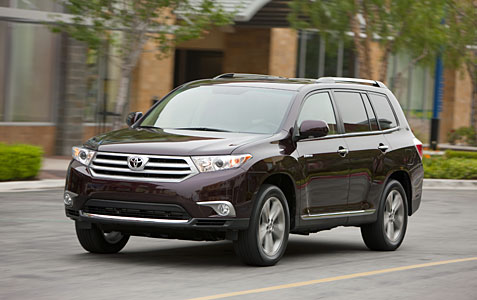
We drive a lot of cars, and sometimes, redesigned aren’t always much better than outgoing models, but that’s not the case with the 2013 Toyota Highlander Limited 4WD. The first-generation Highlander pioneered the midsize crossover utility vehicle segment, ushering in car-like performance, comfort and fuel efficiency with SUV-like roominess and versatility. The current, second-generation Highlander amplifies those attributes and is among the leaders in the segment in standard active and passive safety features. Toyota has really taken serious steps forward with the Highlander as this is one very impressive vehicle.
EXTERIOR
The Highlander now has that wow factor that you don’t regularly see in an SUV, but it’s real. Designed at Calty Design Research in Newport Beach, Calif., the second-generation Highlander conveys a contemporary, dynamic presence via clean, sculpted lines, a wide, stable stance and muscular contours. The Highlander grade could be mistaken for an upgrade model with its six-spoke, 17-inch alloy wheels, color-keyed power outside mirrors and silver-painted front grille.
The Highlander Limited as tested has a luxurious appearance with sporty 19-inch alloy wheels, chrome door handles and roof rails, puddle lamps and rear spoiler. The 2013 Highlander Hybrid is distinguished from the gasoline model by its own unique grille and bumper design, color-keyed rockers with chrome accents, plus vertically stacked fog lamps. The projector-beam headlights and taillights feature blue lens covers. Our classic silver metallic test model looked refined and upscale with an overall sleek look.
INTERIOR
Continuing with that upscale feel, the 2013 Toyota Highlander Limited really hit a homerun with the cabin quality, design and fit and finish. All Highlander models feature a standard 50/50 split third-row seat and rear climate control. Generous standard features on the Highlander grade include front and rear air conditioning; eight-way adjustable driver’s seat; power door locks and windows with driver’s window jam protection and auto-up/down feature; manual tilt and telescopic steering wheel; cruise control; multi-function keyless entry system; UV-reduction windshield and rear privacy glass; digital clock; conversation mirror; illuminated entry system; scheduled maintenance indicator light; full-size spare tire and more.
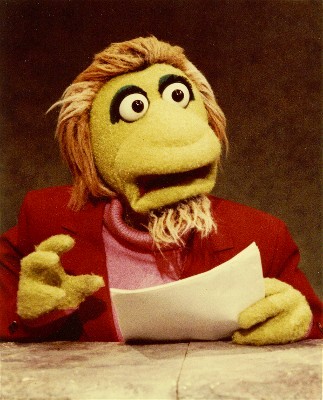
Last night on Twitter, I earned a few favorites and reTweets when I sent out the one-liner, “At last, my months of following “The Great Space Coaster” on Twitter have paid off: I just won an autographed photo of Gary Gnu.”
Funny thing is, though, I wasn’t joking: I really did get selected to receive a Gary Gnu photo which — unless I very much miss my guess — will bear the signature of puppeteer Jim Martin, who brought Gary to life on the show.
Reminiscing about that live-action kids show in turn got me to thinking about other such shows from my youth which, for the most part, tend to have been forgotten by just about everyone who didn’t experience them when they were originally on the air.
Here, for your reading enjoyment (and possible education) are a few that crossed my mind. Some were on broadcast networks, others were in syndication, but they all clearly left their mark on me in one way or the other, since it’s been at least 30 years since I’ve seen full episodes of most of them. Mind you, that’s not to say that they’d hold up for me now, but I’ll say this much for ’em: every damned one of the theme songs has a hook that’ll stick in your brain for the long haul…except maybe the one that leads off this list, but, damn, even that’s screaming to be sampled by an industrious DJ somewhere.
1. Curiosity Shop (1971-1973)
Chuck Jones, the man behind some of the most memorable Warner Brothers cartoons of all time, brought his unique sensibilities into a live-action setting for this educational program which, at least as far as ABC was concerned, seemed like a perfect opportunity to pull in some of the audience of this new PBS show called “Sesame Street” which was all the rage for the single-digit set. Thanks to Jones’s cartoon connections, he was able to pull such luminaries as Mel Blanc, June Foray, and Don Messick to give voice to the various characters, but there were also actual cartoons incorporated into the show, including animated adaptations of such comic strips as “Dennis the Menace,” “The Wizard of Id,” and “Miss Peach,” and trivia buffs may also be interested to know that the Schoolhouse Rock song “Three Is A Magic Number” made its debut on the show.
SPOILER WARNING: Whether you’ve read all five books or only watch the series this post is for you. I have read the books (multiple times) but I will not go beyond the scope of the TV series (save a wink or a nod every now and then that only my fellow readers will catch on to).All events that have occurred in the TV show up to and including yesterday’s episode are fair game. You’ve been warned.
Note: With the biggest cast in television it can be hard to keep all the names and faces straight. Thus the first mention of each character contains a link to a picture of them which will open in a new tab.
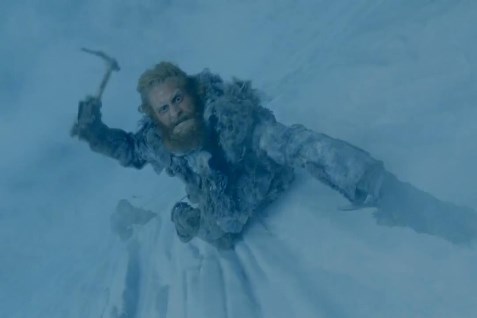
Sometimes, I have to work really hard to find a theme that unifies all (or most, or even just a couple) of the storylines in a given episode of Game of Thrones. Sometimes, I don’t bother, because the writers and directors make it clear that a particular episodes various plots have no cohesive theme, and are instead linked by, say, graceful editing. That was the case in the second episode of this season, “Dark Wings, Dark Words,” an onscreen character would bring up another, and we’d be whisked off to the named character’s far-away land and disparate plotline. But every once in a while there comes an episode which makes its theme quite explicit, and no hard work is required. “The Climb” is one of those episodes, as we got the title, a literal climb, and even a monologue from Littlefinger to fully explain the subtext for those that still hadn’t caught on.
Chaos isn’t a pit. Chaos is a ladder. Many who try to climb it fail, and never get to try again. The fall breaks them. And some are given a chance to climb, but they refuse. They cling to the realm, or the gods, or love. Illusions. Only the ladder is real. The climb is all there is.
In Game of Thrones, whether literally or figuratively, characters climb and fall, and if they survive, they get right back up and keep on climbing. Alternatively, they climb and reach the top, only to realize there’s still plenty of climbing to be done. As Lord Baelish so eloquently put it, “The climb is all there is.”