Category: Vices (Page 74 of 83)

Drink of the Week: Hot Buttered Rum

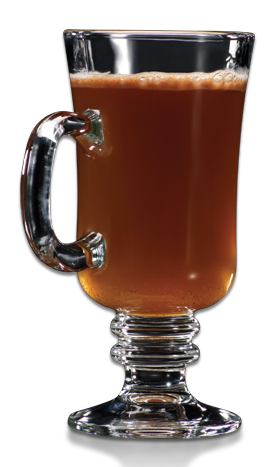
Hot Buttered RumButter…mmm…not the most common of classic cocktail ingredients but hot buttered rum is not your ordinary cocktail. A Christmastime favorite in many places, the history of today’s DOTW likely goes back as far as prior to the U.S. Revolutionary War, when New England was awash with rum due to the deeply unfestive Triangle Trade.

Now, I have to admit that, prior to this week, hot buttered rum existed to me only as an occasionally referenced warmer upper on 1970s sitcoms and 1950s rom-coms. The good news is that, I have to say, I’m sold on it. This version is simple and sweet and pretty surefire, though it’s definitely best if you can get it all down while it’s still hot.

One proviso: some ultra-purists may sniff at this recipe since it doesn’t call for you to heat this drink with, get this, a red hot poker removed directly from a fireplace. (I used a microwave.)

Hot Buttered Rum

2 ounces dark rum
2 teaspoons sugar, preferably dark brown or raw
5-7 ounces boiling water
1 pat of butter (unsalted or salted)
Ground cinnamon, nutmeg, allspice and/or cloves to taste

Put butter, sugar, and a dash or two of any or all of the suggested seasonings in mug, ideally pre-heated. Pour about 1-2 ounces of your boiling water in. Stir until the butter is melted and the sugar and spices have dissolved. Add two ounces of room temperature dark rum and top of with your remaining not-quite boiling but still extremely hot water.

Stir again and sip gingerly. It should be about the perfect temperature but better safe than sorry. Try not to spill any on your Snuggie.

****

A couple of quick notes. Most recipes call for unsalted butter, but I was too lazy, cheap and hateful of waste to run to the store for a product I would never use for any other purpose. Salted butter worked fine, though I would stay away from any other obvious substitutions. (“Hot margarined rum”?) Also, most recipes say to add the butter last, but I found it melted easier my way and I still got a nice buttery coating on top.

As usual, there are an enormous number of ways to make hot buttered rum. A lot of recipes substitute super-hot apple cider for water, which I’m sure is pretty tasty but adds a lot of calories. Some versions throw ice cream into the mix, which just kind of blows my mind. Seriously, though, if you use a nice dark rum and dark brown sugar or raw sugar — both of which include molasses, the stuff they make rum out of — this drink should be plenty sweet.

Speaking of dark rum, you may find that with all the light, amber, and spiced varieties available, regular dark rum might be a bit harder to find in your price range than you’d think. BevMo here in California’s OC offered only two varieties of true dark rum. Myer’s Rum which was about $19.00 for a fifth and Whaler’s Original Rum, which was about half that price and turned out to be perfect for getting all hot and buttered.
Drink of the Week: The Hot Toddy

The Hot ToddyHave you ever found yourself wondering exactly what a hot toddy is? I know I have. I’ve had them in bars maybe once or twice at most and occasionally messed around with heating up some whiskey and water with a little sugar or something else, but I’ve never quite had a handle on what makes a toddy a toddy. The funny part is that after working with them a bit more earnestly the last week or so, I’m still wondering what a hot toddy is.
The problem is that every recipe I’ve found seems to bear relatively little relation to every other recipe, to the point where I’ve determined that there is no baseline recipe for hot toddies there way there might be for other cocktails. Beyond involving hot water, sweetener, and some form of hard liquor that’s usually is whiskey but could also be brandy or rum, there’s nothing very much in common between any two recipes, though a lemon usually comes into play and some people, who may tend to be from the U.K. or British commonwealth countries, use tea instead of hot water. Figuring out the “classic” hot toddy seems to be a fool’s errand.

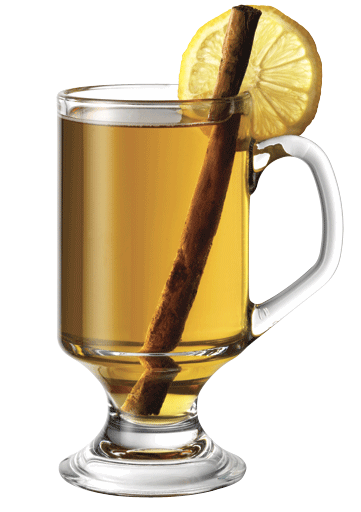
Therefore, I’m presenting, instead, my own personal hot toddy. Of the various combinations of boiling water, whiskey, and sugar that I’ve experimented with this week, this is the one that’s worked out the best for me.

The Hot Toddy

4 ounces boiling water
1.5 ounces bourbon or Scotch whiskey
2 teaspoons of sugar, preferably brown
1/4 ounce fresh lemon juice or lemon slice or peel
1 cinnamon stick as optional garnish.

Place sugar in a small coffee or tea cup. Pour in boiling water and stir to dissolve sugar. Add lemon juice — or don’t and substitute a very thin lemon slice garnish with your cinnamon stick. Based on personal preference feel free to increase or eschew the juice entirely. Add your booze, stir, and sip. (If you have a heat sensitive like me, don’t worry. The room temperature booze should cool the drink down to a reasonably drinkable temperature.)

****

Feel free to experiment with your favorite brandy, rum, or another type of whiskey. The sweetness of bourbon seems to appeal to me the most here, though using a decent single malt scotch was also very nice. You can boost the booze up to 2 ounces if you want or maybe reduce the water though it will get cold faster. I should add I was using Old Fitzgerald’s 100 proof bourbon, but I suspect 1.5 ounces of 80 proof Jim Beam or what have you would be good and potent enough for most people with 4 ounces of water.

Just watch the lemon juice and/or lemon slice as a little can go a long way. If you go the lemon slice route and want to warm up your drink, remove the lemon before nuking it in the microwave. On that road lies nastiness.

Toddies are nice. It’s actually fairly hard to mess up whiskey, a bit of sugar, and some water and wonderful for warming up on a cold night.  You might find you don’t need that sweater or sweatshirt after consuming one of these.

On the other hand, the docs tell us that, contrary to what some of us have been told, it’s really not the absolute best thing if you’re actually sick, especially with a fever. The dehydrating diuretic properties of alcohol makes momma’s chicken soup better for cold of flu sufferers, leaving aside the whole issue of drug interactions. (For starters, booze and anything containing Tylenol/Acetaminophen should not really mix in your body. It’s a liver thing.) On the other hand, if you’re simply sick from worry or stress on a cold winter evening, there is no simpler remedy.

Drink of the Week: Irish Coffee

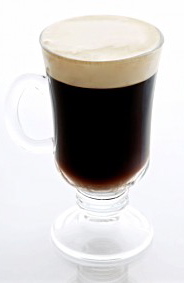
Give or take a few destructive and heat-increasing Santa Ana winds, relatively chilly weather is settling in, even here in Southern California. So, I suppose it’s finally time to take on what I consider to be the king of hot cocktails. Still, what a blow to my ego to discover that, not only have I had some difficulty pulling off this most delicious of drinks, but that I’ve mostly been drinking it wrong, too! I’ve finally learned that Irish coffee tastes even better if you don’t stir in that pretty layer of unsweetened cream floating on the top. And for all these years I thought floating the cream was just a presentation thing.

Irish CoffeeA true cocktail classic, Irish coffee might be hard for amateurs like me to pull off, but it’s also not so easy to provide a concise history. The most widely accepted version is that it was developed by chef Joseph Sheridan of Ireland’s Shannon Airport, who came up with the idea of adding whiskey to coffee to warm the cockles and other parts of travelers on bitter cold winter nights. Then, the story goes that Pulitzer Prize-winning travel journalist Stanton Delaplane brought the concept back home with him from an early 1950s trip to Ireland and reverse engineered the beverage with the help of the proprietors of San Francisco’s Buena Vista Cafe. Just to muddy the waters, though, L.A.’s temporarily closed Fairfax Blvd. landmark, Tom Bergin’s Tavern, also claims to be the American popularizer of the beverage.

No doubt people in San Francisco will hiss when they read the above, because that’s what they do in S.F. whenever you mention Los Angeles in any context. I can hardly blame San Franciscans, though, for wanting to claim credit. Irish coffee is an amazing beverage which I’ve greatly enjoyed in both Southern and Northern California, not to mention New Orleans and maybe I’ll have it in Ireland some day. There’s nothing like the combo of caffeine and alcohol and this tastes immensely better than vodka and Red Bull. So, enough vamping, here’s the wondrous but tricky (for me) to pull off recipe.

Irish Coffee

5-6 ounces very hot coffee
2 teaspoons sugar (preferably brown)
1.5 ounces Irish whiskey
Unsweetened, lightly whipped cream

Using a whisk or whatever device you have handy, lightly whip heavy cream until it is very frothy, which I admit is easier said than done. Set aside.

Get a glass coffee mug, but since you probably don’t have one, use a reasonably large wine glass, which also works beautifully. It’s best to heat the glass by putting in very hot water or holding it over steaming water if you’re afraid of breaking it. That may not be 100 percent essential if you do as I do and drip the coffee directly into the glass using a Melitta-style filter. Stir your sugar into the coffee thoroughly.

Then spoon — do not pour — the cream onto the top of the coffee. (You can also try pouring the whipped cream over the back of a spoon, but that didn’t work for me at all.) Sip the coffee through the layer of cream on top. And for James Joyce’s sake, don’t stir it!

*****

I’ve probably attempted this six times at home and I’ve managed to get this drink right precisely once. Getting that heavy cream whipped enough so that it sits atop the coffee and doesn’t simply combine with it has been tricky for me, to say the least. More than once I considered the coward’s way out — sugar-laden canned whipped cream. It would definitely be easier.

Some imply that if you simply pour heavy cream unwhipped over the back of a spoon it will somehow work. I’m here to tell you every time I tried the back of a spoon thing it failed to create the desired effect, whether or not I’d pre-whipped the cream. I’m not saying the results tasted bad, but they’re not nearly as heavenly as sipping the coffee through the cream. If you can manage to get it exactly the way I did that one time, it’s just the best warming pick-me-up/make-me-happy there is. If you’re really feeling lazy, though, a shot of Bushmills neat with a coffee chaser (or any chaser) isn’t so bad, either.

Spotlight on Booze: Gin

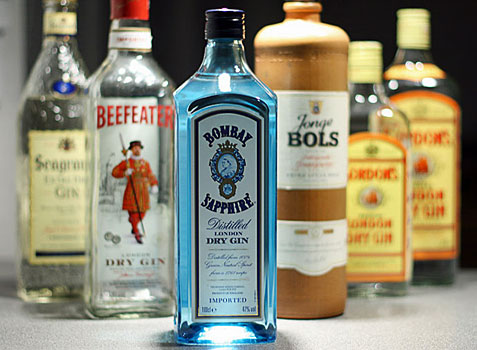
It’s lost some commercial ground to vodka over the decades, but the revival of interest in classic cocktails has given gin a boost lately. In any case, this venerable liquor remains the standard clear alcohol among serious cocktail aficionados, who strongly prefer its more complex flavor and swear it’s the only true main ingredient in a martini.

Gin is distilled from grain, usually wheat or rye, and starts out as a fairly plain spirit probably not so different from vodka. After that, “distilled gins” are then distilled a second time with various flavorings. The most prominent being juniper berries. That’s only for starters, as gin manufacturers use a pretty vast assortment of herbs and other botanicals ranging from licorice root to grapefruit peels to the perfumey bergamot we associate with Earl Grey tea. Some ultra-cheap brands are “compound gins.” These gins are not redistilled, but simply have tiny infusions added — they’re basically gin-flavored alcohol.
Most modern gins are “dry” and manufactured in England; these gins legally may not contain any added sugar and that aids in the liquor’s superb mixability. As far as we can tell, however, there isn’t much predictable difference between “London dry, “extra dry,” and other similar designations. “Plymouth” gins technically only have to come from the coastal town, but they tend to have a somewhat more complex, pungent, and slightly sweeter flavor profile. Largely produced in Holland and Belgium, genever is a less strong gin variant popular in central Europe. With plenty of added sugar, you can still find very sweet “old Tom” gin if you look hard. Speaking of sweet, you’ve likely had a slurp or two or of “sloe gin,” actually a liqueur made with gin or cheaper neutral spirits mixed with sloe berries. Most brands of gin are between 84 and 92 proof (42-46 percent alcohol), but a number of less upscale mass market brands are available at 80 proof or even less.

Like all types of booze, gin is available in a number of price levels, but there’s not really any such thing as a super premium gin. While you can easily spend $150.00 or much more on a bottle of small batch bourbon or single malt Scotch, if you find a bottle of regular size bottle of gin selling for more than $50.00, you’re probably paying mostly for ultra-fancy packaging. Some of the best and/or most popular premium gins include Tanqueray Ten, Plymouth (a brand as well as style of gin), and Bombay Sapphire. Just as good or better, in our opinion, are the mid-priced premiums, available in some states at discounters like Costco, Bev-Mo and Trader Joe’s. These include Tanqueray, Bombay Dry Gin (less heavy on the perfumey juniper berries than Sapphire), and Hendricks, an increasingly popular Scottish gin we like quite a bit. A bit cheaper, still quite good, and very rich in “Mad Men”-style classic street cred, is Beefeater.

Continue reading »

Drink of the Week: Spike Your Juice (Federweisser)

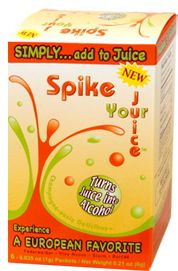
Spike Your JuiceToday we have something a bit different that feels kind of homey and appropriate for Thanksgiving weekend, even if it’s got a European pedigree. Home fermented grape juice, apparently known in Germany as Federweisser, isn’t exactly a cocktail, but then it’s U.S. cousin, Spike Your Juice, doesn’t exactly produce wine. The good news is that what it does produce is a tastier and much more fun alternative to a wine cooler or some ghastly “malt beverage.”

What I got in the mail from the Spike Your Juice people was a glass sealer that fits inside a plastic stopper and a number of thin tubey-envelopes which, in turn, contain primarily yeast, the friendly microorganism that turns fattening fructose into equally fattening, but somewhat more dangerously interesting, alcohol. All you do is empty the powdery contents of the tubes into a 64 ounce juice container — they suggest grape juice or other purplish/reddish beverages mentioned in a link at their faq. You don’t shake it or do anything else to it at all.

You then attach the aforementioned glass tubes (to which you have added some water) and plastic thingy to the top of the container, being careful to permanently discard the original bottle cap. That’s important because, apparently, from this point on, anything remotely airtight can result in a messy explosion that could leave you standing in the purple rain.

Next, you leave the unrefrigerated bottle alone for 48 hours; you’ll see a bit of foaming and an occasional bubble in the water in the glass tubing. When the time has passed, you are supposed to sample the result and, if it’s too sweet for you, reattach the apparatus. Once you’re happy with what what you’ve got, you then leave only the plastic portion in place, which means your drink is partially exposed and won’t be holding onto it’s fizz for long.

At the 48 hour point, what I had was a rather delightful but very sweet fizzy beverage that isn’t at all like the bad sparkling wine you might expect, but is like a really very nice slightly alcoholic lightly carbonated grape juice. Still, it was very sweet and packed little punch so I let the fermentation continue. Although I like the drier version just fine over ice, I’m slightly embarrassed to admit that I wish I had stopped at maybe 55 or 60 hours, rather than 72. That’s my old sweet tooth again.

It’s not one of the suggested juices and I’m curious why, but, I’m going to try this with apple juice. I love hard apple cider, the original Euro-American booze beloved of our pilgrim predecessors…and I guess that covers the need for a Thanksgiving weekend reference to wrap this post up.

« Older posts Newer posts »

© 2026 Bullz-Eye Blog

Theme by Anders NorenUp ↑