Category: Food & Drink (Page 62 of 82)

Drink of the Week: The Dry Manhattan

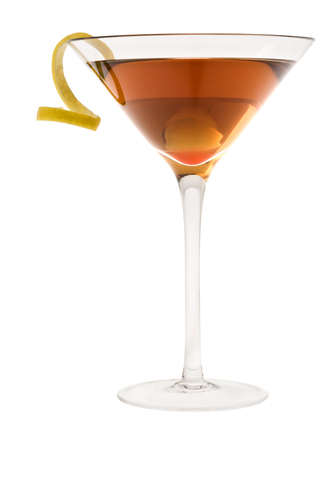
the Dry Manhattan It is time to correct an old oversight this Friday the 13th. It seems that way back on the second DOTW, in which I dealt with that sturdiest of classic cocktails, the Manhattan, I failed to mention one of the most important of the classic variations. The Dry Manhattan eschews the usual sweet vermouth in favor of dry vermouth for what amounts to a very sophisticated drink that is essentially a whiskey martini for true cocktail snobs sophisticates. As far as I’m concerned, it’s nothing but good luck for whoever drinks it.

The occasion for me revisiting this drink at this time is bottle of the very hard to find 100 proof version of Canadian Club that was very kindly sent to me by my personal good whisky fairy employed by Hiram Walker. It’s good stuff, maybe the best base I’ve found yet for this particular drink. We’ll get back to that later. First, the drink itself.

The Dry Manhattan

1.5 ounces whiskey (Canadian, rye, or bourbon)
3/4 ounce dry vermouth
1 dash Fee’s Old Fashioned Aromatic Bitters or Angostura
Lemon twist (garnish)

Pour your whiskey, dry vermouth (as always, Noilly Pratt is my personal default choice here), and bitters over ice cubes into a shaker. Shake or, if you simply can’t abide clouding, stir very vigorously for as long as you can stand it and pour into a chilled martini or wide-mouthed champagne glass. Rim the glass with a lemon twist and toss it into the drink. Best enjoyed with Dinah Washington’s rendition of Rodgers and Hart’s “Manhattan.”

****

Okay, let’s talk ingredients. First of all, I haven’t tried it this way lately, but I’m pretty sure this would also work with Scotch, though that would actually be a dry Rob Roy. Still, I’m of the opinion that Canadian whiskey in general and Canadian Club in particular might be better than bourbon and possibly even rye.

I will say that the stronger, slightly more complicated and oaky flavor of the 100 proof version of Canadian Club might possibly work best of all. I’m really liking this stuff in general and I can’t wait to try it in a sweeter type of Manhattan. However, you should be aware that, at least here in the States, this stuff isn’t easy to come by even at your local big box beverage retailer. You can, however, purchase it online from select vendors, and I was able to find it just now for an extremely reasonable price at the website of Denver-based Argonaut Liquor.

Of course, this drink will also work with the 80 proof stuff just fine. Especially if you’re going that route, you might well want to round up the portions to 2 ounces of whiskey and 1 ounce of dry vermouth. In that instance a second dash of bitters might not be the worst thing if you’re a bitters sort of person.

Speaking of bitters, you’ll note that instead of suggesting the traditional Angostura brand of aromatic brew, I’ve given preference to the lesser known Fee Brothers brand. I recently picked up a bottle of this on a whim when I was visiting an unfamiliar liquor emporium far away from my usual digs and have kind of fallen in love in love with it. For my money, it’s flavor, though still apparently dominated by angostura bark, is a bit more subtle than its venerable competitor. It’s definitely tailor made for a drink like this which can’t stand up to too much straight bitterness, though regular Angostura will still work. I found using Regan’s Orange Bitters, however, to be a somewhat overpowering citrus experience when combined with the lemon peel.

One final variation, if you’re as mad for olives as I am, you can really go the whiskey martini route here and using an olive or two or three as your garnish in place of the lemon twist. It won’t be anywhere near as good as this drink in terms of sophisticated complexity, but it will be olive laden. Sometimes, that’s all I need.
Drink of the Week: The Cognac Sazerac

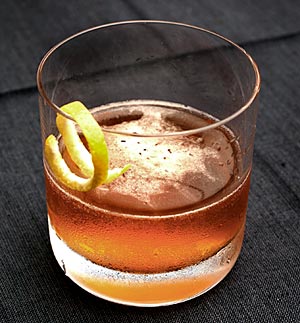
the Cognac SazeracThere was a time when calling a drink a cognac sazerac would have been close to calling a certain sandwich a “beef hamburger.” However, New Orleans’s magnificent contribution to classic cocktails has changed over the years. Today, it is almost always prepared with rye whiskey but, as I pointed out in my prior post on this great beverage, it was originally a cognac-based drink.
The occasion for my welcoming in 2012 with a reconsideration of an old favorite was the kind and savvy decision of the Hennessy company to send me a bottle of their relatively young, but still very drinkable, Hennessy VS Cognac. I’m not a huge cognac or brandy connoisseur at this point, but I’m starting to see what all those rappers and the late Kim Il Sung saw in the stuff. In fact, I sort of accidentally mostly polished off the bottle sooner than I meant this last Christmas Hanukkah when I got overenthusiastic making Sidecars — with Cointreau, at last — for family. I also tried one of their recipes, the Hennessy citrus, which wasn’t bad but was kind of sour for my taste. I think the addition of a bit of egg white. as in this variation, might have helped.

Nevertheless, I had enough Hennessy VS left to revisit what I might actually argue is the more readily enjoyable version of this great cocktail. Harder edged drinkers may prefer the whiskey based drink, but I’m here to tell you this one may well be preferable for those with softer taste buds.

The Cognac Sazerac

2 ounces cognac
1 teaspoon superfine sugar or 1 sugar cube
1/2 ounce of water
2-3 dashes of Peychaud’s bitters
1 teaspoon Herbsaint
Lemon twist

Start by chilling a rocks glass, either by filling it with ice or leaving it in the freezer or, ideally, both. Dissolve a teaspoon of superfine sugar by stirring it in a cocktail shaker or room temperature rocks glass with unchilled water, whiskey, and bitters. (If you want to go super traditional, leave out the superfine sugar and muddle a sugar cube into the same mixture instead.) Once the sugar is dissolved, add plentiful ice. If you want to conserve water, and you should, you can use the same ice you’ve been using to chill your rocks glass.

Take your now well-chilled glass and add a teaspoonful of Herbsaint, a very sweet but strongly anise flavored liqueur. Swirl the liquid carefully, holding the glass sideways. The idea is to coat it with the Herbsaint. Then, turn the glass upside down over a sink, dumping out any remaining liquid.  Now it’s time to grab your cognac and fixings filled shaker and shake it very vigorously. Strain the result into the chilled and Herbsainted glass.

Then, take your lemon twist and run it along the edge of the glass. Twist the lemon peel over the beverage to magically deliver lemon oil to the drink. Drop it in. Sip while listening to the New Orleans music of your choice.

***

A few notes about ingredients and practices. For starters, It’s actually more traditional to use absinthe but, having just purchased my first bottle of the once illegal stuff, I wasn’t wowed. Both liqueurs are heavy on the anise, but absinthe has a bitter edge that I was not too thrilled by. So far, at least, I personally prefer the kinder, gentler, and cheaper sweetness of Herbsaint in a sazerac. There is also a shaking vs. stirring debate here to some degree, but I don’t get why you’d want to stir it. Froth is your friend in a sazerac, I say.

Also, though I really did enjoy the Hennessy VS Cognac, feel free to use your favorite straight-up brandy. Most regular brandy is to cognac as champagne is to sparkling white wine. It’s basically the same, just made from grapes grown in a different part of the world.

Whiskey review: Canadian Club Classic 12

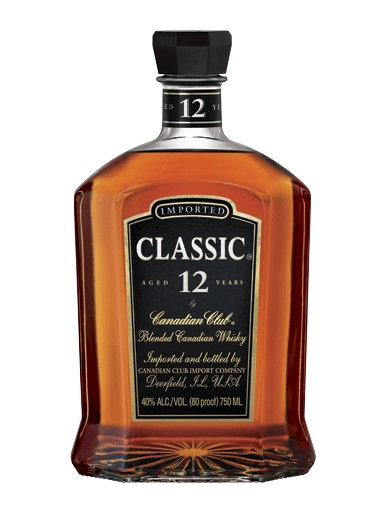
Canadian Club Classic 12 Year-Old

This variation on the very popular brand of Canadian whisky has been around for years, but I’ve never seen it on a single store shelf. In fact, at first I assumed it was a brand new product. It’s not, but it fits right in with the trend towards attempting more complex variations on the traditionally light and smooth Canadian whisky discussed in our “Spotlight on Booze” piece several weeks back.

As the name Canadian Club Classic 12 indicates, this expression is aged 12 years rather than six years as with standard Canadian Club.  It is actually one of a few spin-off lines from Hiram Walker’s best-known brand. The venerable whisky line also includes the more commonly available 10-year-old Canadian Club Reserve, which I’ve enjoyed, and a 100 proof version I would truly love to try at some point — now that I know it exists.

I’ve been sampling this whisky — the Canadians dispense with the “e” — for a while now and have featured it in a couple of “Drink of the Week” posts, but I haven’t really discussed it on its own. Like a lot of things, it took some getting used to but has grown on me.  I found it pretty outstanding in the slightly counterintuitive Bloody Caesar recipe that I ran. Its more smokey flavor may also work better in a Canadian Cocktail than ordinary CC.

Though I rarely drink booze straight except when I’m doing these reviews, it definitely tastes better neat than it’s more inexpensive but supremely mixable brethren. CC 12 has some Scotch-like astringency, but the flavor also has maybe a tiny bit more of a noticeable sweetness with a rye tang. It’s fine on the rocks and extremely drinkable with soda.

All in all, I’m coming around to the view that I’m pretty favorable to this expression, perhaps because it actually predates recent attempts to appeal to connoisseurs. In the case of the acclaimed Forty Creek, those efforts may have lead to a whiskey I personally found excessively difficult for all its greater complexity. I prefer the lightness and smoothness of regular Canadian whisky in general, and standard (and very inexpensive) Canadian Club in particular, which causes some to sniff that it’s the vodka of whiskey. I still like vodka, too.

Drink of the Week: The Champagne Cocktail

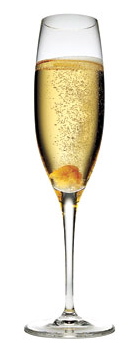
the Champagne CocktailI’ve never made any bones about the fact that I’m a lazy bartender who, for reasons of taste and well as convenience, likes to keep my cocktails simple. Still, for this New Year’s weekend edition of DOTW I’m hitting a new high in simplicity and also using the official beverage of the coming holiday as our key ingredient. Make no mistake, however, as simple as it is, this week’s drink is an entirely legitimate and very classic cocktail. It’s also, in my opinion, delicious.
How classic? Well, a variation of it was featured in what appears to be the first cocktail guide published in 1862 and authored by bartender Jerry Thomas, who defined cocktails as containing spirits, sugar, water, and bitters. (This drink lacks only the additional water.)

I first became aware of this particular concoction, I imagine, the first time I saw Claude Rains order one for himself and one for a displeased Paul Henreid in “Casablanca.” I’ve been curious about it ever since, but I only bothered to look up what was in it this year. I only tried it, well, just a couple of nights ago but I immediately fell in love with it. Yes, some might call making a cocktail out of fine champagne gilding the lily, but who can afford fine champagne these days?

The Champagne Cocktail

Champagne or other Brut (dry) sparkling white wine
1 sugar cube
Aromatic bitters
Lemon twist (optional garnish)

Soak a sugar cube in your bitters — Angostura is traditional but I had equally good luck using Fee Brothers Old Fashioned aromatic, which has a slightly gentler flavor — and then place it at the bottom of a champagne flute, if you’ve got one, or a regular wine glass if you don’t. Pour in your champagne, chilled of course. Do not attempt to mix the sugar cube with the champagne as the gradual decay of your sugar cube will actually be adding extra fizz and visual interest to your beverage along with a very, very slight dash of sweetness. If you want, rim the glass with your lemon twist and toss it in. Toast which ever year, old or new, you prefer.

****
Classic though it be, I gather from David Wondrich that the Champagne Cocktail has long had detractors who argue that good champagne should be left alone. They probably have a point if you’re drinking a $150.00 bottle of Dom Perignon. I however, was drinking a really not so bad $7.99 sparkling white from Spain — which I dare not call Champagne for fear of offending the French — and I greatly enjoyed the extra flavor, subtle though it be, and the additional fizz.

On that last point, Rachel Maddow informs us that making Champagne cocktails is the perfect way to revive somewhat flat, left-over bubbly. If that doesn’t justify the existence of this fine beverage, I don’t know what would, and it certainly makes it a fine way to keep your News Year’s festivities going for as long as you can manage.

Drink of the Week: Eggnog

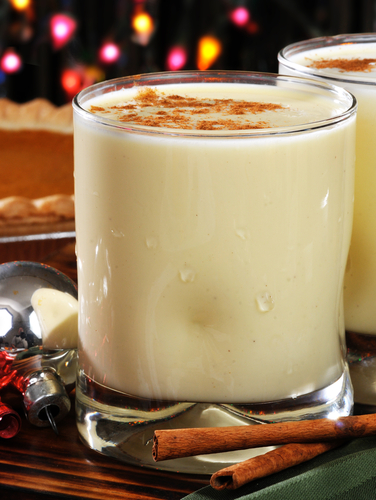
eggnogI have a confession to make.  Despite my enormous love of all things sweet and milk fatty, I was fully prepared to bale on what has to be the ultimate seasonal drink. I have to admit there were concerns for my waistline — you guys have no idea how much weight I gained as a child knocking back the carton based non-alcoholic stuff. Also, as I grew older, I usually was disappointed by the spiked nog I’d had at parties. Somehow, the booze always seemed to destroy the cheap and creamy charm of the store bought nog. It was like putting vodka in chocolate milk. (I’d rather have a shot and choco-moo chaser, thank you.)

Still, the real reason I was going to go AWOL on eggnog was that I was simply intimidated. I imagined fresh eggnog to be a very complicated drink to make; a drink that might even force me to break my no-blenders rule, classic drink though it be. The online recipes telling me that I had to start with a 6 or more eggs, separate the yolks from the whites and perform various operations on them only reinforced that assumption.

Then, however, I started Googling “eggnog for one” and a great revelation came to me. Really, all this drink is a raw egg — provisos and disclaimers to come — milk, sugar, vanilla flavor, and booze. I have to say that, even if I have a sentimental attachment for the gooey store bought stuff, this shockingly easy, if slightly messy, home made version beats that all to heck.

So, here goes, the drink recipe I never thought I’d post.

Eggnog

1.5 ounces of your choice of cognac/brandy, bourbon, Canadian whiskey, or rum
1 large egg
1/4 teaspoon vanilla extract
1/2 ounce heavy cream (optional)
2 ounces full fat milk if not using heavy cream; with cream use 1.5 ounces
4-5 teaspoons superfine or powdered sugar
Ground nutmeg (garnish)
1 cinnamon stick (optional garnish)

Continue reading »

« Older posts Newer posts »

© 2026 Bullz-Eye Blog

Theme by Anders NorenUp ↑