Category: Beer (Page 9 of 11)

Beer 101: Beer Styles

beer_styles

Part 3 – Beer Styles

When I set out to write this section of our Beer 101 series, I knew I was in for some work. There are nearly infinite styles of beer, and as the popularity of craft brewing has grown, we’ve seen a resurgence of near dead styles, the creation of new styles, and the advent of ‘imperial’ beer. That said, I want to give an overview of some of the most common styles and highlight a few of the more exotic beers so you can understand the scope of variety among beer styles.

Lager – This is the style we learned in high school, courtesy of the big American breweries and the most popular style of beer in the world. While some would call beer like Budweiser a pilsner, a pilsner is typically defined by a slight hoppy bitterness that cuts a portion of the malt character typical to lager-style beer. The distinction is very slight – after all, pilsner is a type of lager. The cold fermentation process used to create lager beer yields a nice, crisp flavor with a slight aftertaste.

Ale – This is going to be a more substantial subheading than lager because there are so many varieties of ‘ales’ in the world. Ale is widely defined as a malted barley beer, brewed with top-fermenting, fast-acting yeast that yields a sweet and fruity character, a bright, floral aroma and full-bodied mouthfeel. There are virtually endless varieties of ale, so we’ll only discuss a few.

Pale Ale – This is the beer known as a ‘bitter’ or ‘English bitter.’ It’s brewed with pale barley malt, typically a low- to mid-gravity brew with a highly complex finish. The flavor in pale ale is often heavily defined by the malt, and the best pale ales use the very best English or European malts. American malts are fine for lighter lager beers that are less about flavor and more about mouthfeel, but if you want some real character, you need better malt. Pale ales also have a bright aroma, thanks to the low-alpha hops added at the end of the brewing process. Low-alpha hops can be added in large quantities to impart some flavor on the beer without adding too much bitterness to your brew. I realize almost everything I’ve said here has been contradictory, so I’ll just say this: pale ales are all about balance.

Abbey/Trappist Ale – I group abbey ale and Trappist ale together because the brewing process and end product is nearly identical, the difference being that Trappist beers are brewed in Trappist monasteries by Trappist monks. This style of beer is top-fermented and often sweet and high in alcohol content. Some of the sweetness comes from the spices or candy sugar you can typically find in this style, and the rest comes from the alcohol. Perhaps the most prominent abbey ale is AB In-Bev’s Leffe, an amber-colored ale with a supersweet finish. Among the Trappist ales are Orval, Koningshoeven, Westvleteren, and of course, Chimay.

India Pale Ale (IPA) – The IPA has seen serious growth in popularity in America over the past decade. Brewers seem to be constantly releasing some epic IPA or another every month or two. The IPA style was invented so that beer could sustain long, oceanic voyages. The high hop content essentially safeguarded the beer against contaminants and also imparted delightful complexity with prolonged cellaring. IPAs are bitter to the max, though many also have a smooth, citrusy finish that pairs well with a wide variety of food.

Lambic – Lambics are a beer all their own. This brew is made using wild yeasts instead of cultivated ones, which can yield some interesting differences from batch to batch. Many lambics are also brewed with a portion of unmalted barley, which gives off a sour aftertaste not unlike a dry white wine. Lambics have been popularized in recent years by adding fruit sugar to cut the sour, funky taste of the beer. If you know anyone who drinks ‘Framboise,’ they’re really a Lambic drinker, though the Lindeman’s version is pretty far from the traditional style.

Wheat Beer – Wheat beer technically belongs to the ale category, but it has its own subset of special rules, and there are enough differences for it to stand alone. Wheat beers are, as you might have guessed, brewed with wheat malt, though they still contain malted barley. These beers are typically top-fermented and often appear hazy as the yeast settles during bottling and kegging. The most common styles of wheat beer are Belgian witbier (Belgian white ale) and German-style wheat. A witbier often employs unmalted wheat and spices – coriander, organe peel, and lemon zest are all popular – while a German-style white follows stricter guidelines: no spices, top fermentation only, and tightly controlled malt combinations.

That does it for our Beer 101: Beer Styles section. I could go on and on about styles I didn’t have space to mention. If you’re interested, dig around the web. There is a ton of information out there. If you’re just joining, be sure to head back through the past couple weeks for posts on the history of brewing and an overview of the brewing process. Next week we’re on to pouring and appreciation and in two weeks we’ll cover some guidelines for pairing beer with food.

Beer 101: The brewing process and ingredients

brewing

Over the last decade, craft beer culture has exploded. There are now more than 1600 breweries operating in the US alone, a number that continues to grow year after year. Beer 101 is a guide to understanding the history of brewing, beer culture, and (my favorite part) the enjoyment of good beer.

Part 2 – Brewing Process and Ingredients

Last weekend I put together a brief history of beer, bringing you through thousands of years of history in just a few hundred words. Sorry for the delay this weekend – I ended up flying to LA for the Spike Video Game Awards. For this week’s post, I’ll be walking you through the basics of the brewing process, a process every enthusiast should know since it informs so much about the way a beer looks, feels, and tastes.

As I mentioned in last week’s post, beer is essentially brewed with four ingredients: water, yeast, hops, and malted grain. There are all sorts of ways to modify the process, but for our purposes, this ingredient list will do just fine. Of those four ingredients, yeast is the really important one. If your yeast goes bad, everything goes bad. Yeast is the miracle ingredient that makes the entire process possible.

First, you steep your malt. Steeping is just what it sounds like – soaking your grain in water, which prepares it for germination. Soaking the grain activates the growth process. Little rootlets start to sprout from the grain and the starches in the grain begin to break down. Once the germination process is complete, you have what is known as ‘green malt.’

Next, the grain goes to the kiln to dry. The kiln process, along with the type of grain used, is what gives the malt its character. Pale malts are dried and lower temperatures than, say, ale malts, which will also produce deeper color in the final product. Once dry, the grain has to be cracked in order to better absorb water during mashing. This cracking is called milling.

The milled grain is now mixed with warm water in what is known as the mash tun. The warm water helps convert the starches from the malting phase into sugars, which the yeast will then be able to consume, creating the alcohol and carbonation in the beer. The sugar-rich water gets strained through the mash and becomes wort.

We’ve finally reached the part of the process we know as brewing. The wort is boiled, causing a lot of different chemical changes to take place. This is where a craft brewer develops most of the flavor in a beer. Hops are added at different stages to produce varied results. Bitterness, aroma, and acidity are all determined, in part, by the moment the different hops are added to the brew kettle.

From brewing, the wort gets cooled as quickly as possible. Rapid cooling preserves the character of the wort and makes it temperate enough for yeast to live and work. Once cooled, the wort heads to a fermentation tank, where the brewer selects the yeast and adds it to the wort. Different yeast strains produce different results, again altering the flavor profile and character of the beer. Also, certain yeasts can live in higher alcohol concentrations than others, allowing higher ABV beers. The next step of the process is known as racking. The beer is transferred from the fermentation tank to a conditioning tank to allow the beer to age. Finally, the beer is ready to be filtered and carbonated, a process known as finishing. Once finished, the beer goes to a holding tank until it can be bottled or kegged.

That’s brewing in a small, tightly compressed nutshell. There are all sorts of ways to embellish this process, and while some of my descriptions are short, several of these processes can get complicated, especially on a large scale. It’s a difficult thing to produce the exact same beer time and time again, but with careful monitoring and the latest brewing technology, it can be done.

Come back next week for a discussion of the many different styles of beer, and in the meantime, check out A-B InBev’s iLoveBeer iPhone app (iTunes Link) – it’s a surprisingly solid look at several different beer styles. I won’t be able to cover them all, but I promise to give you a look at brews both strange and exotic.

Beer 101: The history of beer

history_of_beer

Over the last decade, craft beer culture has exploded. There are now more than 1600 breweries operating in the US alone, a number that continues to grow year after year. Beer 101 is a guide to understanding the history of brewing, beer culture, and (my favorite part) the enjoyment of good beer.

Part 1 – History of Beer

As my first post in what will become a five part series about the science and art of beer, it seems appropriate to start with a little history. To consider yourself a scholar of any art, you have to know its roots and, with a history that spans several millenia and nearly every continent on the globe, there’s plenty to know about beer. I don’t pretend to know it all, but I can give you what I consider a ‘bartender’s history,’ basically enough that you should be able to chat up any local beer geek or the guy behind the bar at your favorite brewpub.

Though the numbers vary, most people agree that beer was first brewed sometime between 8,000 and 12,000 years ago. That’s a huge window, but there really isn’t a way to know exactly how long ago man first put yeast to malt and invited a few friends over to dream up the wheel. It suffices to say that beer is old and widespread and comes in all sorts of forms thanks to the cultures that brewed it and the different ways people have enjoyed it over the years.

As we know it today, beer is brewed with four main ingredients: water, yeast, hops, and some sort of grain. That formula holds true just about as far back as we can look, though hops are a fairly recent addition. Hops serve as a bittering agent in beer and so can be substituted with all sorts of crazy herbs. Ever heard of Bog Myrtle? The point is, beer is shaped by culture and geography and always has been. The grains used in beers around the world used to be directly related to what the landscape could sustain. Without modern agrarian technology, people couldn’t just grow barley where they pleased, despite its hardy disposition. Oats and rye thrive up North, while hops remain among the more fickle plants used to brew. If you traveled the world around 500 CE, you’d be hard pressed to find two beers that tasted even remotely alike.

Enough of this wishy-washy fablery, though. Let’s get down to specifics. Some time in the years 800-900 CE the world saw the first use of hops as a bittering agent, though it wouldn’t become widespread until the year 1500. That’s also about the time we started to see serious legislative efforts (Hammurabi’s Code aside) aimed at improving the quality of the world’s favorite libation. In 1516, Wilhelm IV and his Bavarian pals enacted the now infamous Reinheitsgebot, the standard of purity for all beer.

Fast forward a couple hundred years and the industrial revolution gives way to standardized brewing practices, giving brewers the ability to mass produce a consistent product. At the same time, 1842 to be precise, Czech brewers find a way to filter the pale lager they’d been brewing in the town of Pilsen (Plze). Thus, the Pilsner was born and would start making its way around the world. Across the pond, American breweries were sprouting up everywhere.

The boom peaked in 1873 with 4,131 breweries operating in the US. Most were short-lived. Thanks to refrigeration technology in railcars, regional brewers were able to expand rapidly, pushing their way onto the national scene. American drinkers flocked to the big name brands and their big, consistent products. By 1919, the year Prohibition began, there were just over 1500 breweries left. When the law was repealed in 1933 fewer than half that number would reopen their doors, and many of those that did failed shortly after. The American brewing scene grew ever dimmer. World War I suppressed German culture in the states to the point that many German-style beers disappeared. The invention of the beer can in 1934 gave big brewers a firmer grip on the American public and by 1980 there were fewer than 100 operating breweries in the United States.

A young enthusiast named Fritz Maytag had seen his local brewery, Anchor Brewing, struggle to make ends meet. He had purchased a majority of the company in 1965, but it still struggled. He became the sole owner in 1969 and two years later, started bottling Anchor Steam. Over the next three years, Maytag would lead Anchor to produce four additional varieties of beer, including its annual Christmas Ale. No one was calling it ‘micro-brewing’ but it was clear, at least in San Francisco, that a brewing revolution was on its way.

The 80’s and 90’s brought about a new boom in brewery openings. A lot of businessmen saw potential in the industry, opening new brewhouses and quickly thereafter closing them, leaving behind a glut of equipment and space for the enthusiasts that would start some of the craft breweries we know and love today. In 2009, the number of operating American breweries was the highest it had been in 100 years, as high as it had been just before Prohibition.

Check back next week for part two in our series on beer, Beer 101: A Crash Course in Zythology, when I’ll cover the brewing process as we know it today. In the meantime, be sure to check out our ‘iLoveBeer: Zythology App Tailgating Giveaway‘ for a chance to win tailgating gear like a new grill, an iPod speaker system, or party-to-go cooler.

A-B InBev releases iLoveBeer iPhone app for free

A-B InBev is straddling the fence in the current beer market. Anheuser-Busch has long been the dominant American brewer in the domestic market, but when it joined the InBev group, the Budweisers were suddenly in the same family with traditionally highbrow beers like Leffe, Stella Artois, and Boddingtons. Even though your average beer geek will start wailing and gnashing his teeth at the mere mention of Anheuser-Busch or any of its products, most of America still drinks domestic, lager-style beer.

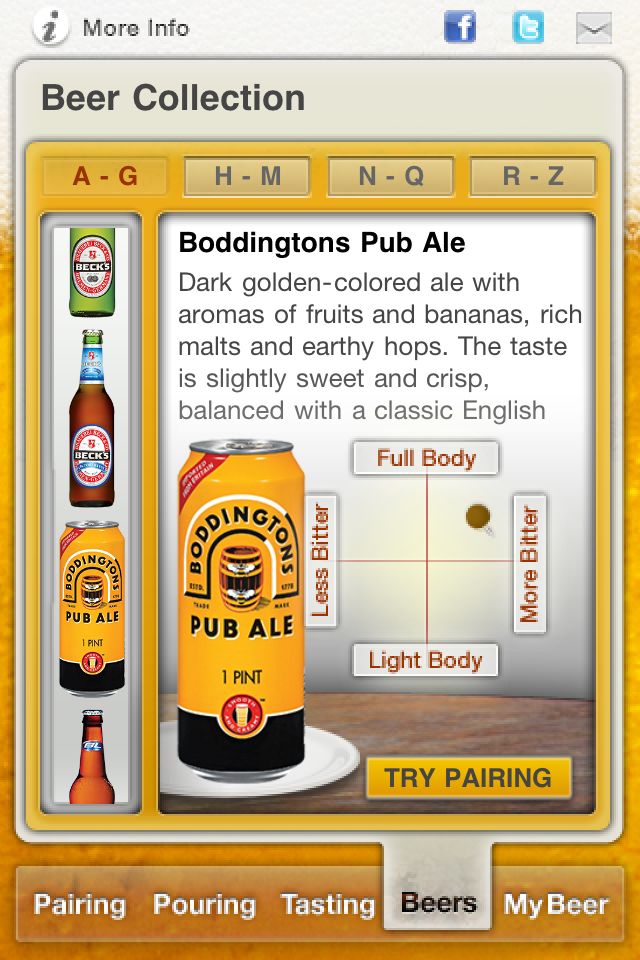
In order to help its customers branch out a bit, A-B InBev put together a free iPhone app called iLoveBeer (iTunes Link). The app is supposed to promote zythology, the study and appreciation of beer, by helping consumers find new beers to try, offering meal pairings, and providing detailed descriptions of proper pouring procedure for several of the brands. While none of these features – with the exception of the pouring instructions – are particularly detailed, I think getting these ideas into the hands of American consumers can only help improve the national beer experience. Most beer drinkers still think their decision is simply between Bud or Bud Light and MGD or Miller Lite. iLoveBeer aims to put more options in front of the consumer and to remind people that beer can provide a sophisticated dining experience that would turn up the noses of the wine snobs in our lives. Also, who’s to say that the guy who tries a Michelob Porter won’t love the style and start to branch out and try a Fuller’s London Porter or a Bell’s Expedition Stout.

Though iLoveBeer is simple, I think A-B InBev is doing both a smart thing and a good thing for the consumer market with the app. It raises awareness of the wide selection of InBev beers and encourages beer drinkers to branch out. What so evil about that?

Kim Kardashian and Paris Hilton invade Oktoberfest

Kim Kardashian and Paris Hilton invade Oktoberfest

Oktoberfest is one of the great parties that every guy should experience. Huge beers and drunken ladies showing off their cleavage in authentic Bavarian costumes come to mind. Oktoberfest is a two-week festival held each year in Munich during late September and early October. With six million people attending every year, it’s the world largest fair and one of the most famous events in the world.

This year, Kim Kardashian and Paris Hilton jetted out to Munich to join in the fun. Naturally, they put on the appropriate costumes to show off their assets. We collected some great photos from this year’s party, including the two celebs along with some of the local ladies as well

It’s not too late to get out there and join in the fun, so go ahead and grab your own Oktoberfest tickets.

« Older posts Newer posts »

© 2026 Bullz-Eye Blog

Theme by Anders NorenUp ↑