Month: August 2013 (Page 3 of 12)

Frankland Estate proves that Australia is much more than Shiraz

It’s possible — perhaps even likely — that the first thing you ever tasted from Australia was Shiraz. In fact, it wouldn’t shock me if Shiraz is the only grape you’ve tasted from down under. Lots of Australian Shiraz, at bargain prices, filled lots of U.S. store shelves for a number of years. Some of it was interesting and tasty, but a lot of it was anonymous or worse. The thing is that Australia is a huge country with many distinct wine growing regions, and while they do make lots of delicious Shiraz, they also produce many other grapes quite well too. I recently sampled the wines of Frankland Estate at a portfolio tasting and was impressed enough that I needed to retaste them in a sit-down setting. There are quite a few distinct selections in their lineup, but three in particular really stood out to me above the others.
frankland_1

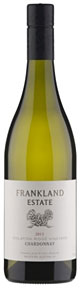
The Frankland Estate 2011 Isolation Ridge Chardonnay was produced using organic fruit. All of the grapes were harvested from a trio of different locations within the winery’s estate vineyards. This offering is 100 percent Chardonnay. After being pressed into stainless steel, the wine is fermented utilizing wild yeast in French oak barrels for a period of nine months. About 1,000 cases of this offering were produced in the 2011 vintage and it has a suggested retail price of $39.99. Aromas of limestone and citrus are joined by an undercurrent of nutmeg on the nose of this Chardonnay. Apple, pear and lemon zest flavors lead an absolutely intense blast of pure and unadulterated fresh fruit flavors. The finish is clean and crisp, showing off minerals, spice and a bit of crème fraiche. The depth and clarity of the fruit here is striking, as is the persistence and length of the finish. Frankland Estate’s 2011 Chardonnay is an extremely impressive example of this wonderful grape.

The Frankland Estate 2012 Isolation Ridge Riesling was produced using fruit that has been dry farmed with organic methodology. This wine is 100 percent Riesling. All of the fruit was hand harvested and then immediately pressed into tank. Fermentation took place in a combination of tank and neutral oak at low temperatures. About 1,200 cases of this Riesling were produced and it has a suggested retail price of $39.99.The nose is fresh and vibrant with bits of citrus alongside mineral aromas. Lemon zest flavors overlay stone fruit characteristics throughout a gently layered palate. Grapefruit, lime, white pepper and minerals galore are all part of the impressively long finish. This wine is refreshing with lively acidity and a crisp finish. It begs you back to the glass for sip after sip until the bottle stands empty.
Continue reading »

App of the Week: HabitRPG

Developer: OCDevel

Compatible with: Android Devices

Requires: Android 3.0

Price: Free

Available: here

When it comes to self-improvement apps and myself, I have to reference the classic movie “Office Space” and say that it’s all a question of motivation, in that it’s not that I’m lazy, it’s that I don’t care.

Most self-improvement apps show you a lot of graphs and statistics, but don’t exactly do much to motivate you besides the desire to see a series of graphs and statistics that reflect the new, and better you. Sure they may help keep you in line, but that’s about the extent of their involvement.

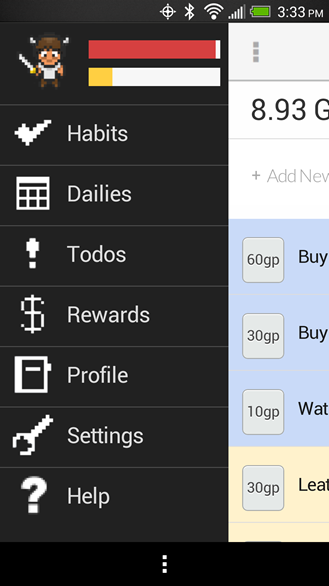
“HabitRPG” is a website, and now Android app, funded by Kickstarter that takes a gamification approach to the subject, by turning your self-improvement into a role playing game. Basically what you do is create a virtual 8-Bit avatar, and set a series of goals. If you accomplish those goals (for instance “Do 50 push-ups”), then you get to award yourself points. Fail to accomplish those goals however, and you have to take away hit points from your character. Gaining enough points, allows you to reach new levels, buy new equipment, or put them towards any number of custom rewards you set (Like “Watch 2 hours of Netflix”), however lose enough points and your character can “die” resetting all of your progress.

nexusae0_Habit17_thumb

While it’s a system that is more dependent than others on you being honest with yourself (especially when it comes to removing points for missteps), and there are some interface issues that could use some ironing out, the basic idea this app is built around is generally inspired, and a great overall use of the gamification idea to inspire you to be more productive.

Turning you into a virtual RPG character, and your life into a quest, is certainly an effective tool for those looking to make some serious lifestyle improvements, but honestly for most this will serve as the absolute coolest to do list available. A big part of that has to do with the expansive system of tasks and rewards the app allows you to enter, all of which can be tied into game elements that may be simplified, but provide a rewarding experience all the same.

In fact, it’s easy to imagine the intended use for this app is for the user to start using it as a simple checklist for their life, and gradually add more and more to that list as you go along until you find yourself becoming better and better and finally reaching your ultimate goal at a progressive pace. Kind of like…well…an RPG.

Not quite a game, but much more than the usual planner, “HabitRPG” is a hybrid app that gets it right, and at the very least deserves a spot on the Android device of every gamer with a to do list. For making your routine anything but, “HabitRPG” levels up to my app of the week.

Game Review: “The Bureau: XCOM Declassified”

Available for
Xbox 360, PlayStation 3 and PC
Publisher
2K Games

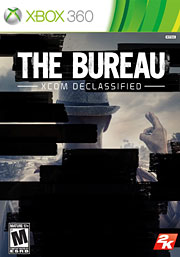
The year is 1962, and in the midst of the Cold War, a new enemy has emerged in the form of alien invaders called the Zujari. With a covert military organization already in place to defend against an attack from the Russians, CIA special agent William Carter is recruited by the Bureau of Strategic Emergency Command and tasked with neutralizing the extraterrestrial threat without creating mass panic across the country. But while aliens and the 1960s seemingly go hand in hand, whether or not it makes for a great gaming experience is another question. Though “The Bureau: XCOM Declassified” looks pretty good for a title that’s been in development since 2006, it lacks the polish and quality that you’d expect from a studio like 2K Games.

Most of your time in the game is spent doing one of two things: going on field missions and running errands around Bureau HQ, the latter of which is mostly comprised of boring dialogue sequences that might not feel so laborious if any of it actually mattered. But despite a deceptively intricate storyline, most of the information you receive over the course of the campaign is supplemental at best, but generally just a big waste of time. Thankfully, the missions themselves are fun, although not incredibly difficult once you get a hang of things. Though there’s a bit of a learning curve at first (especially in regards to keeping your fellow agents alive), as your squad mates level up and receive increased health and new abilities, they become even more powerful than your enemies. Case in point: One of the big boss fights was practically over before I even had the chance to pull the trigger on my sweet alien grenade launcher.

Continue reading »

Drink of the Week: The Clover Club (The Rasp-Wiki Take)

The Clover Club (again). If you have a deep aversion to déjà vu, I advise you to take a break from today’s and, yes, next week’s posts. (I haven’t decided yet about the week after that!)


You see, I’ve always been fascinated by how seemingly very small changes in cocktails can make very big differences. I also was, to be honest, fairly embarrassed to find out at close to the last minute last week that the Clover Club recipes I got from two bonafide cocktail book classics, Harry Craddock’s prohibition era Savoy Cocktail Book and Robert Hess’s vastly more recent The Essential Cocktail Guide, could be seen as  minority takes on the drink.

It turned out that most of the presumably classic recipes I found online, such as the one featured on Wikipedia, suggested rather strongly that raspberry syrup, not grenadine, was the default sweetener/pinker-upper for this refreshing, too little known cocktail treat. I basically had to try this version out, and so we have today’s pinker, tangier take on the Clover Club.

What’s the difference between a little grenadine or a little raspberry syrup? I’ll tell you on the flip side.

The Clover Club (the Rasp-Wiki Take)

1 1/2 ounces gin
1/2-3/4 ounces fresh lemon juice
1 egg white
1/4 ounce raspberry syrup

Once again, we combine all the ingredients in a cocktail shaker, sans ice. Once again, we shake the luke-cool concoction to properly emulsify the egg. Once that’s done, we add some ice and shake again, very vigorously, to add much needed ice water to the mix. Then, it’s naturally time to strain the drink into a chilled cocktail glass. Our toast? How about to second (and third) chances?

******

So, which is better, the grenadine or the raspberry syrup iteration? If I had to choose, I think I’d go with last week’s grenadine. This raspberry adds a delightful tang I really enjoyed, but it was less sturdy in the sense it doesn’t really stand up to as much variation. Last week, I found my favorite version employed 3/4 of an ounce of lime juice although (a bit less) lemon juice was just fine. This time around, I’m counseling readers to skip the lime completely. For me at least, it just didn’t work. Lime juice has some additional flavors that just don’t blend with the raspberry.

My favorite version of this drink, however, did use the entire 3/4 ounce of lemon juice, which I suppose is odd given my tart-phobia. I’m guessing there’s something about the dryness of the lemon juice blending with the tangier raspberry-derived flavor. Ultimately, it’s a mystery.

And, speaking of mysteries, yes, will be trying another ever-so-slight variation of this week’s beverage next week. Next time around, we introduce something entirely new…a garnish! Stay tuned.

Movie Review: “You’re Next”

Starring
Sharni Vinson, AJ Bowen, Nicholas Tucci, Wendy Glenn, Joe Swanberg
Director
Adam Wingard

When a movie has been stuck on the proverbial shelf for as long as “You’re Next” has, it usually doesn’t speak well of the film’s quality. But in the case of Adam Wingard’s home invasion thriller, it’s actually quite the opposite. After debuting to rave reviews in 2011 at the Toronto International Film Festival, “You’re Next” was quickly scooped up by Lionsgate, only to be placed on the back burner for two years while the studio completed its merger with Summit Entertainment. During that time, the movie gained even more buzz on the festival circuit, and for the most part, the hype is justified. It’s not exactly an instant classic, but “You’re Next” is a horror movie lover’s treat that embraces as many genre tropes as it subverts.

The Davison clan has gathered at an isolated vacation home in the country for the weekend to celebrate the 35th anniversary of their waspy parents (Rob Moran and Barbara Crampton), and they’ve all brought along their significant others for support. It’s been a long time since the entire family has been together under the same roof, and it immediately becomes clear that Crispin (AJ Bowen) and his siblings don’t get along. But when they’re suddenly attacked one night in the middle of dinner, the family learns that they’ve been targeted by a gang of deadly intruders wearing creepy animal masks. As the houseguests are murdered one by one, Crispin’s girlfriend Erin (Sharni Vinson) surprises everyone – including the intruders – when she begins to fight back, proving that she’s the most dangerous of them all.

Continue reading »

« Older posts Newer posts »

© 2026 Bullz-Eye Blog

Theme by Anders NorenUp ↑