I remember back in the 1980s, I purchased my first used Volkswagen Eurovan. I was in my 20s without as much as a care in the world. I always considered myself a hippie at heart, and the Eurovan just added to my laid back, carefree lifestyle. I took that van everywhere. I gallivanted all around the US exploring and creating memories with friends and family.
I’d take a camping trip every year with a group of my friends. We’d load up the VW with mountain bikes, food and luggage, and head off on the trails. We’d jam out to some of the best tunes of the ’80s, ready to explore uncharted territory.
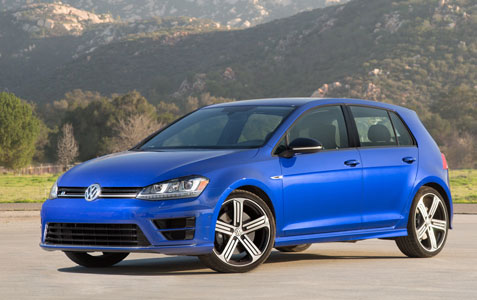
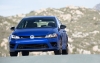
SAN DIEGO – The high-powered, low-volume 2015 Volkswagen Golf R could play a big role in getting the German automaker’s U.S. sales back on the good foot. That would mean more VWs rolling out of showroom doors.
Here’s the deal: the VW Golf recently was named Car of the Year by two very prestigious organizations. Now, the Volkswagen Golf R helps to fill out a lineup that includes the regular Golf, a performance version of that compact car, a diesel powered Golf and an electric Golf. A station wagon is on the way, but we came here to test drive the Golf R. It is the high-powered version of this car.
By the numbers, this Golf R has a 2.0 liter turbocharged four-cylinder engine under the hood that makes292 horsepower and 280 pound feet of torque. It’s mated to a direct sequential gearing, read six-speed dual clutch, automatic transmission branded (DSG). This version goes on sale in the spring. It will be joined by a six-speed manual Golf R this summer that will be sold as a 2016 model; it will about $1,000 less than the automatic.
With the fast-shifting DSG, the Golf R can get to 60 mph from a standing start in a blistering 4.9 seconds and it has a top track speed of 155 mph. Because of low sales for the two-door Golf R in the past, the 2015 version will only be sold in this market as a four-door. Mileage is expected to be 23 mpg in the city, more than 30 mpg on the highway and 26 mpg combined.
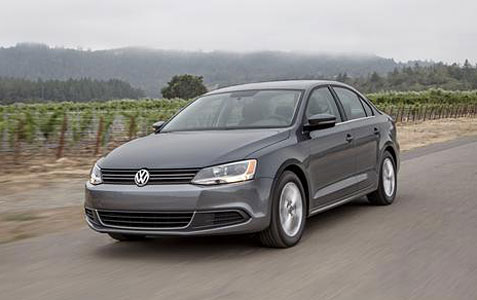
The Jetta is Volkswagen’s number one selling car in North America, so there is always pressure on the Jetta to rack up sales for VW. The 2014 VW Jetta SE we tested sported a reflex silver metallic paint that was as clean as any paint we’ve seen. First impressions are important and the Jetta came out of the gate strong.
EXTERIOR
Volkswagens in general have a distinct look, and the Jetta is no different with a sleek design that looks smart and sporty. At the front, the coupe-like incline of the windscreen and the consistent use of horizontal lines define the Jetta’s design. The horizontal blades in the grille, together with the blades in the lower intake, are designed to make the Jetta appear wider and more dynamic. Volkswagen completely redesigned the Jetta a few years back and crafted a bigger car, with a longer wheelbase and 2.9 inches added to the overall length. The increased dimensions allowed designers to incorporate clear, precise lines and muscular surfaces to impart a timeless elegance, giving the impression that this is a car from a higher class. The 16-inch alloy wheels looked sweet and also came with all-season tires.
INTERIOR
The Jetta gets right to the point inside and out, and the cabin space is no nonsense. A key benefit of the Jetta’s extended wheelbase—it stretches an incredible 104.4 inches—is a truly spacious interior, with impressive rear-seat legroom of 38.1 inches. Long legs can rejoice. The gently arcing roofline also means more than ample headroom of 37.1 inches for rear-seat passengers. And stretch-out legroom in the back isn’t achieved by a cramped front seat either. Being tailored for an American audience, there is no shortage of legroom and headroom up front.
Just open any of the Jetta’s wide-angled doors and the quality of materials – the fit and finish, and the clean, simple, refined elegance of the cabin – is clearly visible. And in true German tradition, the layout of the fascia, the positioning of the switches and controls, and the clarity of the oversized, round instruments is designed to be ergonomic and intuitive. Trunk space also borders on the cavernous. The Jetta offers a class-leading 15.5 cubic feet of usable trunk space, and can be increased significantly by folding forward the 60/40-split rear seatback. The rear seatback is also offered with a pass-through to accommodate longer items, like skis. Move up to the SE (as tested) and additional standard features include: heatable front seats; cruise control; standard V-Tex leatherette seating surfaces; an adjustable center armrest with storage compartment; a six-speaker sound system; and a Media Device Interface (MDI) with iPod adapter.
Premium features that are available on the Jetta include: a six-way power driver’s seat; a leather-wrapped multifunction steering wheel; a soft-touch dashboard; two-tone V-Tex leatherette sport seats; the RNS 315 navigation system; the acclaimed Fender Premium Audio System; keyless access with push-button start; VW Car-Net connected services; Bluetooth connectivity; and a rearview camera. Exterior enhancements include a chrome radiator grille and chrome window trim.
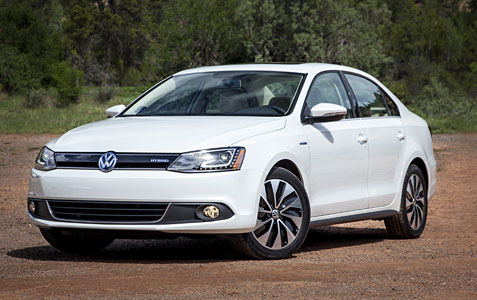
There is no question that Volkswagen has been on a sales tear in North America, and with new offerings like the Jetta TDI, one can see a bright future indeed. We had the opportunity to spend a week behind the wheel of a 2014 VW Jetta TDI to see just how far clean diesel has come in the past few years.
EXTERIOR
The Jetta remains Volkswagen’s best-selling car three years after the sixth-generation car was introduced to the U.S. market as a 2011 model. When you take a look at this Volkswagen, it’s clear that they never rest on success and are continuously striving to make its vehicles even better. The platinum gray metallic with 17-inch alloy wheels on the 2014 VW Jetta TDI we tested looks very modern with a clean and upscale look. Marketing experts call it “class-up appeal.” It’s the offering of more, for less. Which is why, when Volkswagen completely redesigned the Jetta, it crafted a bigger car, with a longer wheelbase and 2.9 inches added to the overall length.
The increased dimensions allowed designers to incorporate clear, precise lines and muscular surfaces to impart a timeless elegance, giving the impression that this is a car from a higher class. At the front, the coupe-like incline of the windscreen and the consistent use of horizontal lines define the Jetta’s design. The horizontal blades in the grille, together with the blades in the lower intake, are designed to make the Jetta appear wider and more dynamic. To give visual weight to the lower part of the Jetta and impart a sense of the car being ‘planted’ to the road, the base of the doors is eased outwards. The pronounced wheel arches also add visual width and weight to the car.
INTERIOR
The overall theme of a clean and modern design carries over into the cabin of the 2014 VW Jetta TDI appearance. Just open any of the Jetta’s wide-angled doors and the quality of materials, the fit and finish, and the clean, simple, refined elegance of the cabin is clearly visible. And in true German tradition, the layout of the fascia, the positioning of the switches and controls, and the clarity of the oversized, round instruments is designed to be ergonomic and intuitive.
Trunk space also borders on the cavernous. The Jetta offers a class-leading 15.5 cubic feet of usable trunk space, and can be increased significantly by folding forward the 60/40-split rear seatback. The rear seatback is also offered with a pass-through to accommodate longer items, like golf clubs and skis.
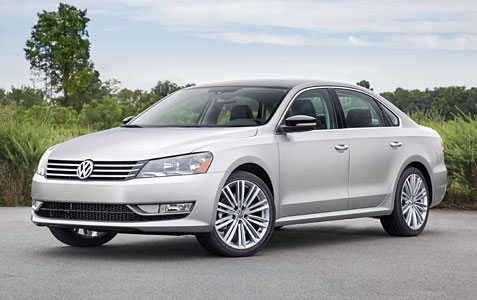
The built-in-America 2014 Volkswagen Passat is pushing her way into the heart of U.S. auto sales with striking good looks and top-of-the-line quality. We drove one for a week and now understand why there is so much momentum behind the 2014 Volkswagen Passat Sport.
EXTERIOR
Volkswagen knows how to design and build cars, so it comes as no surprise that the 2014 Passat is one of the best looking cars on the road regardless of price. The Passat’s balanced proportions give it elegant and timeless styling, reflecting the new Volkswagen Design DNA. The clean design, with a predominance of horizontal body elements, reinforces the Passat’s position as the sophisticated choice in the mid-size segment. The key identifying feature of a strong brand is the styling of its front end. Here, the Passat displays the horizontal brand face, with the three-blade grille and headlights forming a single unit. The Passat’s grille is sculpted in a three-dimensional shape and makes a distinctive and elegant impression because of its strict geometry. Beneath the front bumper is a large, lower intake with a striking honeycomb surface and available fog lights housed at each end.
From the side profile, the muscular ridge in the sill area creates a lively interplay of light reflections. Powerfully sculpted wheel arches emphasize the dynamic properties of the Passat. To emphasize the aerodynamic styling of the Passat, the roof lines flow toward the back with a nearly coupe-like cut of the rear window. Three side windows create luxury-class style with a long, extended glass surface. The rear section is also dominated by horizontal lines. The lines of the large taillights rise toward the sides, underscoring the dynamics of the elegant rear styling. Another unique feature here is the design of the two-part taillights that are integrated in the rear fender and trunk lid. This is a generously proportioned four-door sedan and the largest Passat ever. Nose to tail it measures 191.6 inches and features a stretched 110.4-inch wheelbase and 72.2-inch width, which allows such exceptional rear seat space.
INTERIOR
The first thing that stands out when entering the cabin of the 2014 VW Passat Sport is the extraordinary amount of space available. There’s room for five adults to really stretch out in comfort, and with four large, wide-opening doors, getting in and out is a breeze. There’s also a true elegance and simplicity about the layout. Nothing here is trendy or over-done. The lines flow in a style that’s easy on the eye, complimented by high-quality materials applied with attention to detail. Available chrome-trimmed gauges surround a digital multifunction display. A high-end chrome look is also applied to the air vents in the cockpit, and to the surrounds of the radio, navigation system and the climate control panels. The rotary light switch and parking brake handle button are also treated in chrome.