Tag: Drink of the Week (Page 55 of 59)

Drink of the Week: The Caipirinha

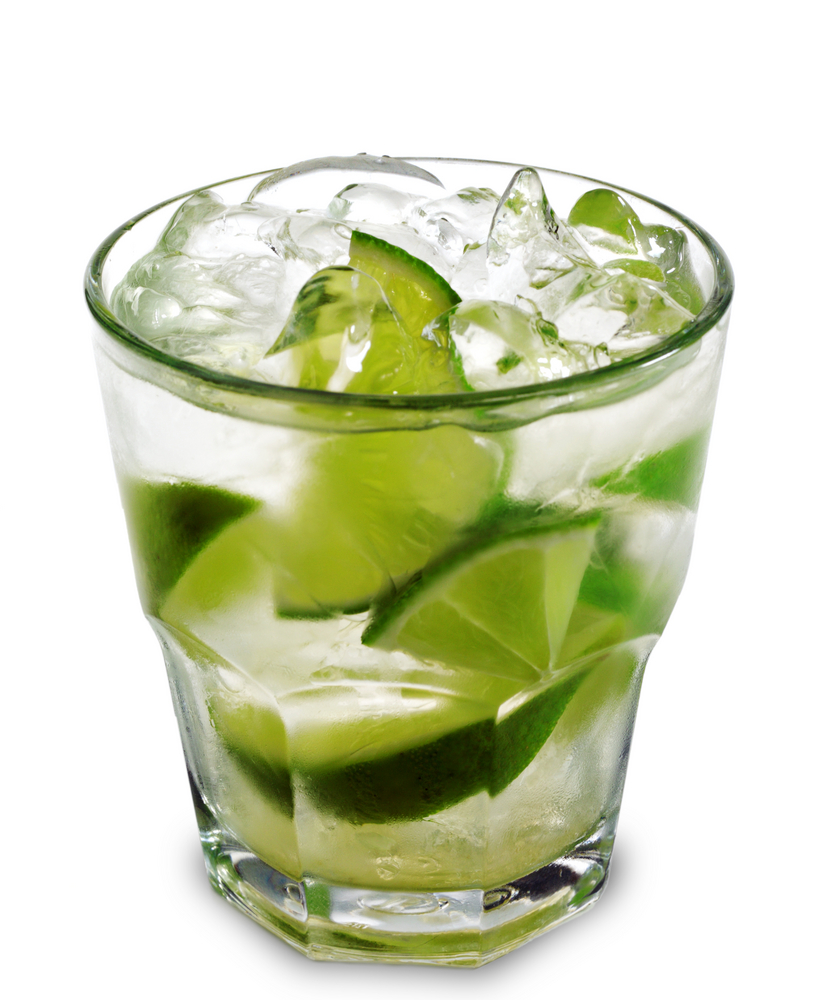
CaipirinhaAs of right now, the national drink of Brazil isn’t that well known stateside. If the PR savvy makers of Leblon Cachaça have their way, however, the cachaça-based caipirinha will soon be doing battle with the mojito (which I promise we’ll be covering here shortly) for the title of most chic Latin American beverage in North America.

Because of U.S. labeling regulations, cachaça is frequently confused with rum. While rum is made from molasses, cachaça is made from sugar cane juice which makes them relatives, but anything but identical twins when it comes to flavor. As I understand it, most brands of the drink consumed in Brazil are also first-cousins to lighter fluid, but Leblon — the only brand I’ve tried so far — is of a far finer stripe and sells here for between $20-$30. The reason I know the brand is that it is buying influencing writers like me with bounteous alcoholic swag. Not a bad start, to be honest.

I’ve experimenting with the stuff for over a week and what I can tell you is that, like all really interesting booze, it’s a somewhat acquired taste, but I’m enjoying doing the acquiring. It has a complex flavor that is less sweet than rum or whiskey and is closer to dry gin or vodka, but with more than a hint of olives about it and some other odd flavors I can’t quite identify and am still getting used to. It makes an okay martini, but it’s terrific with a few splashes of ginger ale and a lot of ice. I’m sure there are lots of other classic drinks using gin or vodka it could be easily worked into.

So far, the Caipirinha, which is somewhere between and old fashioned and a mojito in terms of preparation, is the most intriguing way to go with cachaça that I’ve found, and it’s about as refreshing on a hot August night as any drink I’ve had. And, no, I have no idea how to pronounce the name of the cocktail, either.

The Caipirinha

2 ounces cachaça
2 teaspoons superfine sugar
1 lime

Cut a good sized lime into wedges. Add sugar and muddle vigorously in a rocks/old fashioned glass. The backside of a spoon won’t do here; you’ll want a proper muddler or a blunt instrument of some sort because you’ve really got to smash the lime wedges and sugar but good to form a sort of juicy paste. Add lots of crushed ice and pour the cachaça over it. Stir with a bar spoon or swizzle stick for maybe 30 seconds or longer to allow a lot of the ice to melt. Sip away.

****

The recipe the Leblon people provided me called for the drink to be shaken with vigor for about 10-30 seconds, and you can do so either in a cocktail shaker or by shaking the concoction in the glass itself using a professional-type shaker. My personal opinion is that’s only necessary if you don’t have crushed ice, because you’ll need a way to extract some water out of that ice fairly quickly. If you’ve got crushed ice handy, my way is easier, tidier and, I think, tastier.

Not surprisingly, there are endless variations on the caipirinha theme, many of them involving smashed fruits of various sorts. I haven’t tried any of them yet, but a lot of them sound delicious and you can definitely check out more recipes at the Leblon website. Personally, I’m just thinking about raiding my fridge for whatever fruits are there and seeing what happens.

Drink of the Week: The White Russian

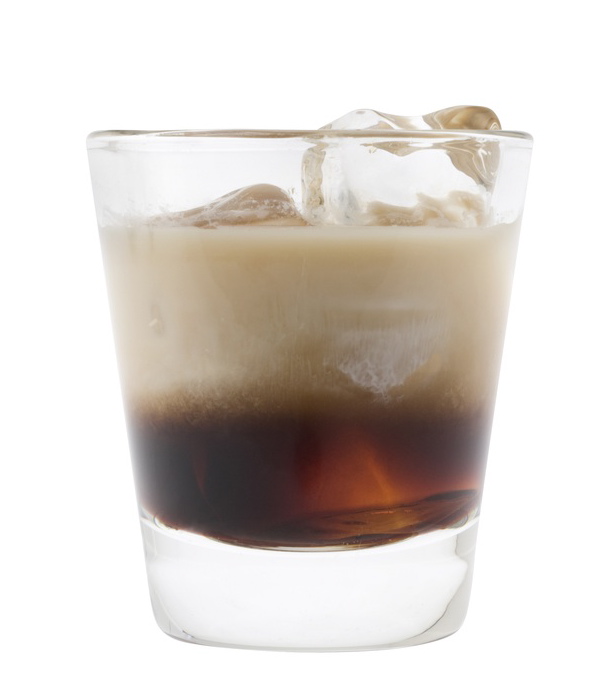
The White Russian.Cocktail classicists beware, because this week we’re saluting the immanent blu-ray release of the Coen Brothers’ comedy classic, “The Big Lebowski,” as well as the historic Lebowski Fest cast reunion with a drink that not only contains vodka but which usually requires no shaking and perhaps not even a great deal of stirring. That’s not all, the White Russian is extremely sweet and seems to derive not from the cocktail heights of the early 20th century but closer to the mixological nadir of the 1970s. The fact that it was a drink simple enough for a stoner to love led to it being immortalized on celluloid in the aforementioned 1998 film with Jeff Bridges, easily the greatest example of the pot-driven comedy genre yet made. Next to James Bond’s shaken vodka martini, the Dude’s Caucasian — same drink, different name — is easily the most legendary of all movie cocktails.

Still, no movie can make a drink popular all on its own, and the White Russian’s appeal is obvious; it tastes like a frozen candy bar. Moreover, the fact that it contains a bit of caffeine and even some rudimentary nutrition also makes it a highly appropriate beverage, not only for achievers but for caffeine heads like me. No wonder that it was one of the first cocktails I gravitated to in my ignorant youth and no wonder I still enjoy it when the time is right. Sometimes there’s no time for a martini and a very sweet cappuccino to follow it up. Impact-wise, the white Russian gives you a bit of both.

The White Russian

1.5 ounces vodka
3/4 ounces Kahlua or other coffee liqueur
3/4 ounces of heavy cream (or somewhat larger portions of half-and-half, whole milk, or even 2% milk)

Pour vodka and Kahlua over ice in rocks glass. Add heavy cream, which should “float” over the top, or other dairy topping. Stir and proceed to get into endless arguments with your friends about whether or not urinating on a rug constitutes a Saddam Hussein-like act of imperial aggression.

***
There are a number of variations on the above, of course. You can eschew the diary product and go for a black Russian. I understand that if you use 2% or lower fat content film it’s called a Skinny Russian, which isn’t awful. On the other hand, I can tell you first hand that going past half-and-half and into the land of heavy cream will make the drink all the more tasty, though perhaps not tasty enough to warrant the eventual heart attack if you drink these things on too regular a basis. On the other hand, if you’re drinking as many Caucasians as the Dude seems to do during the course of a single day, wear and tear on your heart may not be your primary concern.

Also, I have to note cocktail historian David Wondrich‘s recipe actually calls for the drink to be made in a shaker and strained into a chilled rocks glass. It’s not bad that way, though it’s hard to imagine the Dude putting in all that work. As Wondrich points out, this is a drink beloved both by very occasional drinkers like my former self for its sweet-as-ice-cream taste and for the most down and out of out-and-out alcoholics, for whom it’s often the closest thing they’ll get to a balanced meal. Yes, a White Russian is for all, but really it belongs to just one man.

Drink of the Week: The Pimm’s Cup

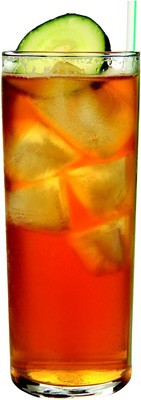
Pimm's CupLike Campari, Sambuca, and the like, Pimm’s Cup #1 is a bottle you’ll see at a lot of bars but which, at least here in the States, no bartender ever seems to open and which most barfolk will tend to discourage you from trying. They have their reasons because, on its own, it’s definitely not for everyone. It’s a concoction of gin and various herbs that has a nicely sweet but also fairly bitter flavor. It’s somewhere between a liqueur and Angostura.
It may be a little harsh straight, but it can mix very accessibly. A popular cocktail classic in the UK that has been referenced on both “Mad Men” and “Boardwalk Empire,” Pimm’s Cup, the cocktail, combines this relatively low alcohol (50 proof) base spirit with various types of soda and fruit and vegetable garnishes.

In my experiments, I avoided some of the very elaborate recipes which are more like very large and very wet fruit salads and eventually settled on the simple recipe below, adapted freely from the method used by Minneapolis mixologist D.J. Kukielka. It’s a winner — a tasty refreshment for lightweights with discerning palettes.

The Pimm’s Cup

2 ounces Pimm’s Cup #1
4 ounces (approximately) ginger beer or ginger ale
Cut-up cucumber (to taste)
Cucumber slice (garnish)
Lemon slice (garnish)

Place cucumbers in cocktail shaker and muddle. (Having an actual muddler on hand is a real help here, and essential if you want a truly well-stocked bar.) Add Pimm’s Cup #1 and ice. Shake very vigorously and strain into a Tom Collins glass over ice (preferably crushed). Top off with ginger ale and garnishes. Stir with swizzle stick or barspoon.

****
I’m barely exaggerating when I say that there are a million recipes for this beverage on line, and they’re all pretty different from each other, which I suppose befits a drink that is something like the British equivalent of sangria. I get the impression that you could pretty much throw any fruit you can think of in, if you want. Still, I had by far the best luck with the recipe above and, though it’s more expensive, ginger beer does work slightly better than good old Canada Dry.

If you want to be really authentic, however, be aware that the original recipes often call for lemonade. The confusion here is that what the British call lemonade and what we Yanks call it are two different things. UK lemonade is a lemon soda which some compare to 7-Up — and many online recipes specially call for American-style lemon-lime soda — but Brits inform us that true British lemon soda tastes fairly different than our uncolas. If you’re lucky enough to live in a city like Los Angeles with a large British ex-pat population and specialty stores to go with it, or want to go online and don’t mind spending a little extra cash, I bet you can find some and go full Brit.

Drink of the Week: The Whiskey Sour

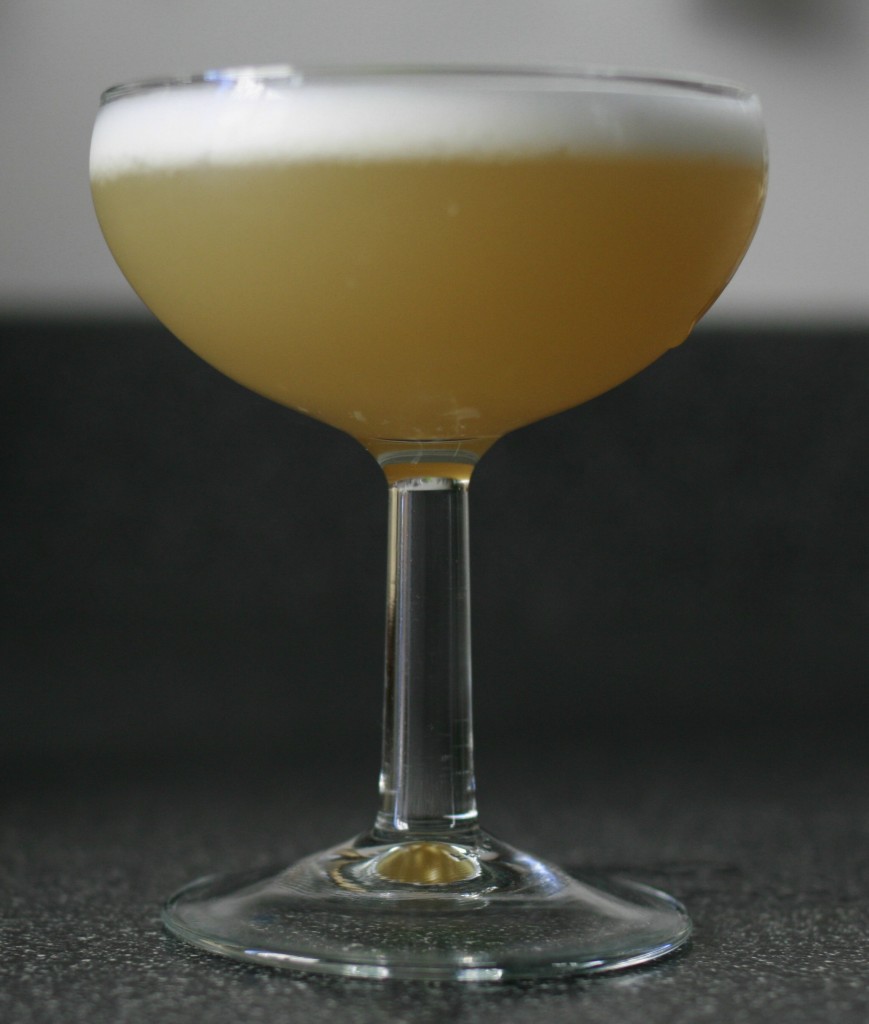
whiskey sourSours are an entire family of cocktail which mostly utilize some combination of lemon juice and sugar. (The sour mix used by many bartenders is, in my experience, slightly revolting.). The Latin American favorite, the pisco sour, is probably a better known drink in many quarters these days, but the whiskey sour has been one of the standard cocktails since cocktails have become popular. Oddly enough, it’s possible that both of these cocktail favorites actually began in Peru.
The Whiskey Sour

2 ounces whiskey (bourbon, rye, Canadian, etc.)
1/2-1 ounce fresh lemon juice
1 teaspoon superfine sugar
About 1/2 of an egg white  (semi-optional)
Maraschino cherry or orange slice (optional garnishes)

Dissolve sugar in whiskey and lemon juice and add egg white.  Shake vigorously. You should see a light froth on top of the liquid.

Note that I haven’t mentioned ice at this point. It is important to keep the whiskey, lemon juice and egg white at near room temperature in order for the egg to properly emulsify. Once you’ve shaken the liquid thoroughly, however, it is time to add ice and shake again very vigorously. Strain into a chilled martini, rocks or, if you’re really serious about it, a sour glass.  Add garnishes if you’ve got them.

****

Two provisos. One — the “sour” in “whiskey sour” is a serious kind of sour and thus, this drink is not for tartphobes.  Even as an increasingly hardy beverage connoisseur, I found the pucker factor on my whiskey sours to be a bit much, especially without the egg white.

Which brings us to the second proviso. I’m sure some reading this will react strongly against the use of raw egg whites, which can be a bit controversial because of the very small but not quite nonexistent risk of salmonella poisoning. If you’re especially concerned for whatever reason — and if your immune system is compromised or your health is generally shaky, I would be somewhat concerned — you might consider using pasteurized or powdered egg whites or just making the drink without it.

However, be aware that the risk of contaminated egg whites, especially if they are reasonably fresh and kept refrigerated, is actually fairly infinitesimal; whites are less vulnerable than yolks to bacteria and the overall incidence of salmonella has been going down. Also, though I can’t speak to the science of the point, bartenders argue that the alcohol and lemon juice will tend to kill any dangerous microscopic critters. In any case, I’ve been drinking this stuff all week and, aside from being extremely tired of the flavor of lemon juice, I’m doing just fine.

Drink of the Week: The Negroni

It is with some shame that your humble writer admits that, until a few days ago, he had never tasted Campari. In case you don’t know, Campari is theoretically a very popular Italian apéritif — that’s “before dinner drink” to us English speaking barbarians — that’s essentially a drinkable variety of bitters. You see it consumed with soda in European films and every bar in the world seems to stock it but, classic spirit or not, nobody we know seems to drink it or anything made with it.

So it was with great curiousity that yours truly brought home a bottle of the stuff and broke the lifelong Campari drought. First, a surprising and delicious burst of orangey sweetness reminiscent of a really tasty Italian vermouth, then, a bracing bitterness. A bit strong and not 100% pleasant in the usual sense, but fascinating. Time for had another sip.

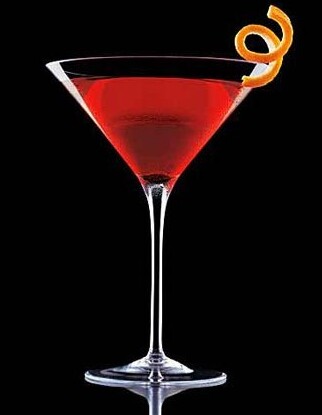
the NegroniYep, it was good to take the bitter with the sweet. It was better to try the most famous cocktail made using Campari.

The Negroni

1 ounce Campari
1 ounce sweet vermouth
1 ounce dry gin
Twist of orange peel (garnish)

Shake like the dickens and serve in a chilled martini glass. Semi-optional final step: swirl the orange twist around the rim of the glass and “express” it (twist it) over the drink. Drop it in.

If the above seems a bit too sweet for you, feel free to increase the gin slightly and decrease the Campari and vermouth. (David Wondrich‘s version is 1.5 ounces gin to 3/4 ounce Campari and vermouth, and it works beautifully.)

*****

Folks, I’m going to drop the “royal we” I’ve been using and say in the first person that I really love the Negroni. It appeals to my sweet tooth while also being plenty refreshing on a warm summer day and offering a delicious complexity thanks to the one-two sweet-bitter punch of the Campari, softened by the sweet vermouth and with a terrific tang coming from the gin. For some reason, bartenders I’ve met are skittish about this drink and it has a somewhat “difficult” reputation. My take is that, if you can enjoy a Manhattan, you’re probably more than definitely ready for a Negroni and it’s a lot more accessible than a martini. I love this drink and think you will, too.

The Negroni is often served on the rocks, particularly in Europe, but I tried it that way and, like most “up” drinks served on the rocks, the results were not exciting, almost sickly sweet. It’s also often served anti-James Bond style, stirred and not shaken, on account of the bar worker’s lore that gin should only be shaken when non-alcoholic ingredients are present. I tried that too and decided that worrying about the gin here was complete balderdash. Negronis demand a good shaking.

Oh, and if you’re wondering where the name comes from, it’s simple enough. It seems that a turn-of-the-20th-century Italian count named Negroni was drinking another Campari-based cocktail, an Americano, (we’ll cover that some other time) and wanted a stronger version with some gin in it. That’s the whole story.

« Older posts Newer posts »

© 2026 Bullz-Eye Blog

Theme by Anders NorenUp ↑