Category: Sports (Page 42 of 51)

Training for Marathon #1: Race weekend

Ah, the curveball. The dreaded “bolt from the blue.” With just over a week to go before the Chicago Marathon, I was lounging in bed on a lazy Saturday morning, watching TV and delaying the start of my day as long as possible. I had to knock out an easy 10 miler later that afternoon — my last long run prior to the race — before coasting through the final week with two short runs on Tuesday and Thursday. I felt great about my training, confident that I’d worked hard to put myself in position to run my best race possible on October 9, and also fortunate that I’d avoided any sort of serious injury that would interrupt my training or affect me on race day.

Then, I felt a twinge in my shoulder.

I had been sitting with my right arm slung over my head, an odd yet comfortable position I often find myself in while watching TV. Only this time, when I stood up, my right shoulder felt a little sore. Nothing alarming at first, just something I figured would pass within a few minutes. Instead, it got worse…and worse…and still worse. The pain got so bad — so sharp and so deep, right behind my shoulder blade — that I was convinced I must have pinched a nerve or something. Knowing the race was approaching and growing increasingly concerned as the pain swelled to an almost unbearable level, I headed for the ER, wondering how the heck I hurt my shoulder so badly while watching TV, and just a week before my first marathon. Fantastic.

The ER doctor gave me a quick examination, ruled out any nerve issues or muscle tears, then gave me prescriptions for a muscle relaxer and pain killer to help treat a strained shoulder. Monday afternoon, still in considerable pain, I headed to my sports medicine doctor, who took one look at my swollen shoulder, noting how far my shoulder blade was “winging out” (his term), and diagnosed me with subscapular bursitis, or inflammation of the fluid-filled sac that sits between my shoulder blade and rib cage. The good news, he said, was because my injury wasn’t muscular in nature, I’d still be able to race Sunday, which was obviously my biggest concern. He gave me a cortisone shot to reduce the pain and inflammation, and my range of motion almost immediately improved. The bad news, though, was that my shoulder would most likely bother me to some degree during the race and, in my doctor’s words, my arm was going to be “extremely sore” afterward. Hey, something to look forward to, right?!

Of course, I’m just relieved I got the green light for Sunday. Then again, the only way I would have even considered skipping the race entirely would be if the doctor told me trying to run through the injury would cause further damage. With that not being the case, I’m ready to gut this out and deal with the pain on race day, to whatever degree. What choice do I have? Sure, the circumstances could be better, but it is what it is. I refuse to let something so random detract from this experience, a moment I’ve been training for since February, a moment I’ve envisioned for years. Crossing the finish line Sunday is going to be an unbelievable experience, even if my shoulder is on fire when it happens. To quote Forrest Gump: Shit happens. I need to manage the situation and adjust my expectations.

When I first started training, my pie-in-the-sky goal was to run better than 3:10 in Chicago to qualify for the Boston Marathon. As the race has gotten closer and I’ve piled up more mileage, I’ve pulled my expectations back a bit. My main priority now is to start comfortably with a reasonable pace that will allow me to cruise through the first half of the race. That may seem obvious or simplistic, but it’s easy to get caught up in the energy and excitement on race day and find yourself coming through the first mile much faster than planned. Strategy goes out the window at that point. Considering the Chicago Marathon ranks as the third largest race in the world, with more than 45,000 participants and a course filled with raucous and supportive spectators, sticking to my plan early and putting myself in position to run a strong second half will be even more challenging.

Assuming things go as scripted, however, my baseline goal is to run 3:30, an 8-minute-mile pace I handily topped on my longest training run of 21.5 miles. Setting a reasonable goal will make it easier to ignore my watch in the early stages and settle into a comfortable pace while also giving me some wiggle room in case my shoulder gives me more trouble than I’m anticipating. If, however, things break my way during the race and I feel better than I’d hoped, I could realistically break 3:20. The chances of that happening may have taken a hit with this freak shoulder injury, but I’m not abandoning my best case scenario days before the race.

Ironically, I had been fighting a cold for the past couple weeks, eating more fruits and veggies while loading up on vitamin C to stave off anything that could sap my energy and complicate things on race day. I even skipped a cold and rainy training run two weeks ago to ensure I didn’t get sick. Fortunately, those actions paid off, but while I may not have been able to avoid injury, at least my legs are healthy heading into my first marathon. For that, I’m grateful.

I expected to encounter one or two hurdles in my training, but I didn’t expect something so random to happen so close to race day. I’m hoping to get at least one run in before Sunday, but my shoulder isn’t quite ready yet. On the plus side, I have a few more days to recover, and while I could have done without the monkey wrench, I won’t be the only one on the course dealing with an injury, nor am I the only runner whose training was interrupted along the way. Rather than worrying about factors beyond my control, I’m determined to make the best of a less-than-ideal situation. It’s race weekend, a weekend I’ve had circled on my calendar all year, and I’m as ready as I can be.

When life gives you lemons, sometimes you’ve got to figure out how to make lemon-lime Gatorade.

Jamey has tracked his training for the 2011 Chicago Marathon — his first full marathon — in his Runner’s Journal. Assuming he survives, Jamey will return a week or so after the race to recap the event as he looks forward to running the Tough Mudder next March. Email jcodding@bullz-eye.com with comments, questions or your own thoughts on running, and see why Jamey runs.

Training for Marathon #1: The homestretch

You’d think the hardest part about running a marathon would be…well, running a marathon. Turns out the hardest part is just getting to race day.

When I signed up for the Chicago Marathon last winter, I wasn’t entirely convinced that I’d ever be able to run 26 miles, let alone by October. Wait, I realized, forget about the race. I had a whole lot of running to do before I even set foot in Chicago. I needed to get my body ready for 26 miles, but to do that, I first had to conquer 14, 15, 16, 19 and, this past weekend, 21 miles. That’s a lot of hard miles just to get to the point where I could run a lot of hard miles. There also were a lot of internal pep talks on days when motivation was lacking, and a lot of sacrifices made by my family to accommodate my training schedule.

But as I hit the homestretch with just over two weeks before the marathon, I’ve reached the calm before the storm. After increasing mileage consistently for the past several months, my training runs only get shorter from here as I taper my miles to keep me fresh for race day. Of course, I’m looking forward to a bit of a break but, more significantly, just getting to this point in my training has given me a nice confidence boost at a time when I can use all the help I can get.

It’s important to identify and then move past mental hurdles during your training so that, when you hit the course, you have faith that you can actually accomplish your goal…or at least finish. That doesn’t mean you have to put in a 13-mile training run if you want to run a half marathon, but you better get up to at least 10. After last weekend’s 21-mile run, I now know that I can handle another five on race day. With that mental hurdle cleared, it feels like the hardest part is over. In fact, the race is now more like a reward for all the work I’ve put in than the looming menace it first appeared to be when I started training. Yeah, some reward, right?

None of this is to say that I’m taking the race lightly. In fact, running those 26.2 miles on October 9 — and, ideally, running them well — will no doubt be the most challenging singular moment of this eight-month endeavor. But now that I’ve put in more nearly 800 training miles, I’m much better prepared for the race, both physically and mentally, than I ever thought I’d be when I was slogging through the February snow and melting under the July sun. Finishing the marathon will be a monumental personal achievement, something to finally cross off the ol’ bucket list years after convincing myself that I’d never be up to the task, but I’ve already seen the benefits from all the training. This isn’t about running the race; it’s about being able to run the race, and what it takes to get there.

Training for your first marathon is a memorable and rewarding experience filled with tiny, incremental victories along the way. Each time I completed a distance I’d never before run, my confidence grew a little more. I learned that this weekend’s good run can erase the memory of last weekend’s bad run, and that 10 miles actually qualifies as an easy run when you start putting in 15- and 20-milers. It’s all relative.

I also learned that marathon training is about the journey and not so much the destination. My journey is almost over, and the destination awaits!

Jamey will be updating his Runner’s Journal a couple times a month as he trains for the 2011 Chicago Marathon – his first full marathon – on October 9. Only 17 days to go…but who’s counting, right?! Email jcodding@bullz-eye.com with comments, questions or your own thoughts on running, and see why Jamey runs.

Runner’s Journal: The Virginia Beach tune-up with Dodge

Dodge Durango

Parents with young children rarely experience the freedom of a weekend getaway. Weekend errands and weekend soccer games and weekend family functions, sure, but not weekend getaways. For my family, there also are the weekend long runs, which we’ve learned will chew up an entire Sunday morning as you work your way up to 20 miles in your marathon training schedule. My most recent weekend long run, however, doubled as a long weekend getaway for my wife and me when Dodge, sponsor of the hugely popular Rock ‘n’ Roll Marathon series, invited me to the Virginia Beach Half Marathon and gave us a sleek 2011 Dodge Durango Citadel to drive to and from the race. A chance to break up my training routine while staying at an oceanside hotel and spending several lazy hours next to a pool? Sign us up. A fully loaded Durango and a break from the kids too? Shoot, now you’re just spoiling us, Dodge.

Fortunately, the race itself didn’t go as well as I had hoped. Wait…fortunately? Yep. I’ll admit that finishing four minutes slower than my goal wasn’t really how I wanted to cap off the weekend, and as my wife can attest to, I was pretty disappointed when I crossed the line with a time of 1:34:20, a full minute and a half slower than my PR and significantly slower than my goal of 1:30. Still, a runner can learn something from almost every race, no matter their time — in fact, slower times often yield the most significant lessons — and just as I learned a few things from my first three half marathons, I came back from Virginia Beach on Labor Day better prepared to run my first marathon in Chicago next month. So what did I learn?

I need to run my race. I went out too fast last weekend, and it cost me. I had a plan heading into the race, looking to run the first 8 miles in 56 minutes (7:00 per mile) before picking up the pace over the final 5 miles and finishing under 1:30. Instead, I got caught up in the moment and came through the first mile at 6:40. I settled into a 7:00-per-mile pace after that before falling off a bit around mile 6, coming through the 8-mile marker at about 56:30 and finding little left in the tank when it came time for the strong finish. My fast start alone didn’t cost me four minutes off my finishing time (more on that below), but it certainly didn’t help. No matter what my strategy ends up being for Chicago, I’ll need to stay under control early and stick to the plan. If anything, I’d rather start out too slow than too fast, since I’ll have plenty of time to make up for a sluggish first couple of miles. Whatever race you’re running, spend some time thinking about how you want to run based on what you’ve learned during your training, and do your best to stick to that plan, at least early on. You can always adjust mid-race if needed, but a fast start could spell trouble later in the race.

I’ve been training hard. It sounds a little silly, but it’s true. I felt tight and worn out Sunday, almost from the start, whereas I felt loose and fresh when I set my PR in Cleveland last May. The difference? I tapered my training down the week leading up to the Cleveland Half Marathon whereas the Virginia Beach race capped a challenging week of training, including a tough speed workout Wednesday morning. Tired legs combined with a fast start depleted my reserves pretty quick and I never really recovered. Be sure to take some time off during your training, especially leading into any big races. Fresh legs are vitally important to a quality race, as I learned again last weekend. In fact, I elected to take Tuesday off this week as well, feeling like my body could use an extra day of rest. Don’t be afraid to cut yourself some slack if your body’s telling you it needs a break.

Continue reading »

Marathon tune-up: The Virginia Beach Half Marathon

Training for a marathon can be grueling. Most weeks, my training consists of four runs: speed-based workouts on Tuesday and Thursday, a shorter easy run on Saturday and a long run on Sunday. At the moment, I’m putting in just over 30 miles a week, and by the end of my Sunday long run, I’m worn out with only a day to recover before it starts all over on Tuesday. It’s a schedule that’s served me well for the past year — I followed a similar routine with modified mileage while training for each of my first three half marathons — but, as you can imagine, things tend to get a little repetitive and stale, especially in the heat and humidity of an Ohio summer when the race you’re training for is still months away. But this weekend, I get a break.

Granted, running the Virginia Beach Rock ‘n’ Roll Half Marathon Sunday morning doesn’t seem like much of a break, but our friends at Dodge, one of the sponsors of the excellent Rock ‘n’ Roll series, are giving me a much needed and appreciated mental break from my training routine. After dropping our kids off with the grandparents Friday afternoon, my wife and I will load up a fully loaded 2011 Dodge Durango Citadel and head for Virginia Beach. It’s a long drive from Ohio — about nine hours, give or take — but we’ll be riding in style in the blackberry-colored Durango (pictured below) and, with no kids clamoring for snack stops and bathroom breaks, it’ll be the most peaceful nine-hour drive we have had in quite some time.

The unique circumstances of this particular trip aside, the race will serve as an excellent training barometer with the Chicago Marathon just over a month away (Oct. 9). I set my half marathon PR (personal record) of 1:32:51 in Cleveland a couple months ago while I was dealing with some knee pain and IT band tightness, but my body feels better now than it did in May and I’m in even better shape. My ultimate goal for Chicago is to qualify for the Boston Marathon with a time of 3:15 or better. A bit of a longshot, perhaps, particularly for my first marathon, but there’s nothing wrong with aiming high. And as I head into my final month of training, the race this weekend will give me a clearer idea of where I am in my training, with a time under 1:30 meaning that a 3:15 marathon may in fact be within reach.

If you’re training for a marathon, half marathon or any other longer race, don’t shy away from competition in the weeks and months leading up to the big day. Of course, races are much more taxing on your body than a standard training run, so don’t sign up for anything too close to your big race, but because you’ll likely run a race faster than any of your training runs, adding one or two shorter races to your schedule can serve as a useful warmup while giving you a mental break from the training grind to boot. So thanks again to Dodge for the opportunity to test my training in Virginia Beach this weekend and, after driving the 2011 Dodge Durango home Monday and picking the kids back up, I’ll check in next week to see if I broke that 1:30 mark.

Jamey, the editor-in-chief at Bullz-Eye.com, will be updating his Runner’s Journal a couple times a month as he trains for his next race. Currently, Jamey is training for the 2011 Chicago Marathon – his first full marathon – on October 9, and he plans on running the Tough Mudder next March. Email jcodding@bullz-eye.com with comments, questions or your own thoughts on running.

Training for Marathon #1: Hydration and nutrition

It’s no secret that you need plenty of water before and after a run, but what about during? And while most runners know all about carbo-loading with a big plate of pasta the night before a race, trying to figure out whether you need GU energy gels (pronounced “Goo”) or some other form of in-race nutrition to keep you chugging through the finish line can lead to some tricky trial-and-error experimentation during your training. To GU or not to GU? That is the question.

I’ve put in a fair number of miles over the years, but prior to competing in my first half marathon, the farthest I’d ever run was 11 miles. In fact, during my heaviest volume days in high school, most training runs topped out around six miles and races were anywhere from a half mile to a 5K, or 3.1 miles. Because of that, I never had to worry about in-race hydration and nutrition – by eating well the night before and taking in plenty of fluids prior to a race, my body was prepared for the moderate mileage it had grown accustomed to. Running 26.2 miles? Well, that’s a different story.

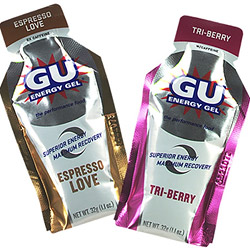
I first started looking into energy gels while training for the half last year. Also referred to as endurance or sports gels, these single-serving plastic packets of goopy carbohydrates typically contain some form of simple sugars like sucrose or fructose, and supply the body with calories and nutrients to help delay muscle fatigue while raising blood sugar levels and enhancing performance. The first and perhaps the most popular energy gel – the one you’ll likely see in sporting goods stores or during most longer races – is the previously mentioned GU. I didn’t know if I would need energy gel during the race, but since this would be my longest run ever, I figured I at least should consider it. The first thing I learned was that I needed a test run. Literally. No matter the brand, energy gels in general can cause gastrointestinal discomfort for some runners – most commonly cramping, bloating and/or diarrhea – so you’ll want to introduce them to your system during a long training run instead of a race setting, just to see how your body reacts.
I picked up a berry-flavored GU on the way to my final 10 miler and planned to take it about six miles in. Unfortunately, I didn’t notice the note on the package about taking the gel with some water. I tore off the top of the packet and squeezed the thick, sticky, berry-flavored gel into my mouth. Instant cottonmouth. It was like trying to swallow the world’s thickest, sweetest cough syrup. A mile or so later, I felt slightly and briefly nauseous, but it was smooth sailing once that passed as I finished the final three miles strong despite my sticky lips and dry mouth. However, while my stomach handled the gel fine during the run, I had some problems afterwards and elected to pass on GU during the race a couple weeks later.

Two months after that, I had some stomach issues during another half marathon. In hindsight, several factors likely contributed to the problem, but my main suspect at the time was the GU I took at mile 7. I didn’t run very well in general that day so the GU may not have been to blame, but I certainly didn’t feel any better at the end of that race than I felt without any gel at the end of my first half. Frustrated and disappointed after my poor finish, I swore off energy gels for good. Then I signed up for the Chicago Marathon.

All runners are different, and all runners have different needs. Some have to stop at every water station to stay hydrated and healthy, while others blow through the stations without taking a drop. I’d always been in the second group, but I’ve also never run for three or four hours straight. One day, it dawned on me: I am going to need some kind of nutrition for the marathon. GU again?

Well, I recently gave GU another try but after mixed results, I turned to apple-cinnamon flavored Hammer Gel for a 14-mile training run last weekend. The Hammer Gel, which contains real fruit juice and no added simple sugars, wasn’t nearly as thick or sweet, making it much easier to swallow while cutting down on the cottonmouth, and it tasted pretty good to boot. I took a few sips of water from one of the bottles in my new hydration belt (more on that below) and, after another slight but brief bout of queasiness, I finished the second half of my run rather well. Once it was clear later that day that my stomach had no problem with the Hammer Gel, I had officially found my in-race nutrition.

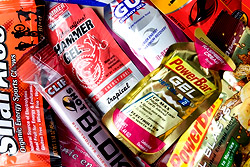
There are, of course, dozens of other options available to the running public, from Clif Shots and Accel Gel to PowerBar Gel and Carb Boom. You can also try chewable products like GU Chomps, Clif Shot Bloks, Sport Beans and even regular ol’ gummy bears. I’ve had Sport Beans and GU Chomps, but only before runs because I find that chewing while I’m running disrupts my breathing and rhythm. Some runners use Honey Stinger gel or simply grab single-serve packets of honey for their long runs, while others create their own homemade portable energy sources (a quick Google search will yield plenty of options for you DIYers). Most casual runners probably don’t need to consider energy gels or other forms of nutrition– they’re typically recommended for people running for 45 minutes or longer – but if you’re thinking about signing up for a big race (think 10K, half marathon or more), you probably will have to spend some time experimenting like I have to find a nutrition option that works for you, and don’t be afraid of a little homework. Different runners prefer different products – I have friends who swear by GU, some who love the Sport Beans and others who don’t like any of them. The web is littered with comparisons of these products, tips on how to take them, and a host of other issues you should consider while doing your research.

Hydration, on the other hand, is a little simpler. Every runner needs fluids, some just more frequently and in greater quantities than others. I don’t like holding anything when I run so water bottles aren’t an option, and I’ve never been particularly adept at drinking from the little cups they hand out at water stations – I usually end up spilling 97% down the front of my shirt and another 2% dribbles down my chin, allowing the remaining 1% to actually reach its intended destination. For those who choose to walk intermittently during a race, however, the stations are a perfect place to take a breather, rehydrate and maybe wash down some energy gel.

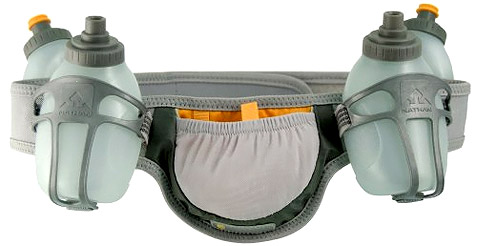
If, like me, you need an on-the-go solution to your hydration needs, there are plenty of options. You could go with a handheld water bottle for shorter runs, but that seems like the least effective option. I recently bought a Nathan Speed Waistpack with two 10oz bottles, knowing I’d need some help getting through my upcoming 16-, 18- and 20-mile training runs. I admit that it took a bit of time getting used to those two bottles sloshing around on my waist, but by my second long run, I barely noticed them. And when it came time to take my Hammer Gel, I had the water I needed to wash it all down. It may look and feel a little goofy at first, but if it gets the job done, who cares? There are an endless number of hydration belt choices out there with all sorts of various factors to consider, including comfort of fit, number of bottles and waist size.

If you need more water than a hydration belt offers, consider one of the Camelbak Hydration backpacks. I’ve never used one but have seen plenty of other runners with them, and customer feedback on sites like Amazon is overwhelmingly positive. An added bonus is the ability to stash essentials like keys, wallet and/or phone in your Camelbak. My recommendation would be to try on several of these packs and belts at your nearest running or sporting goods store to see how they feel, but you won’t know what works for you until you hit the road with one strapped to your hips or back.

So what about pre-race hydration and nutrition? Well, that’s a much bigger can of worms. I drink plenty of water and some Gatorade before a run, and will also have some coconut water between runs to help keep me hydrated consistently. On the morning of a race, I add Gatorade Prime to the water and standard Gatorade regimen. Food, of course, is much trickier and, like so many other factors, varies wildly from runner to runner. I recommend doing your own research on this subject and, as always, experimenting to find what works for you and what doesn’t because, as you’ll discover when you start increasing the length of your races and training runs, your needs are going to change along with the mileage. What worked for you on a two-mile jog or 5K race probably won’t be enough for a 10K or half marathon. And, I think it goes without saying, what works for a half marathon most certainly won’t work for a full.

Bullz-Eye.com editor in chief Jamey Codding ran competitively in high school, took a brief 15-year breather, and then came back to run his first half marathon last year. He’s currently training for his first full marathon, in Chicago on October 9. Only 44 days to go…but who’s counting, right?!

« Older posts Newer posts »

© 2026 Bullz-Eye Blog

Theme by Anders NorenUp ↑