Category: Movies (Page 112 of 191)

Drink of the Week: The Nutty Professor (TCM Fest Salute #2)

The Nutty Professor.And so we continue from last week, making drinks inspired by some of the most interesting films I saw at this year’s TCM Classic Film Festival.

Today’s drink is inspired by the best regarded film starring, cowritten, and directed by Mr. Jerry Lewis, a man whose legacy and contribution to the movies and show business is so complicated I don’t dare to try and contain it in my little cocktail blog. Remade in 1996 with Eddy Murphy, the 1963 version of “The Nutty Professor” is a fairly boozy film, stylistically influenced by director Frank Tashlin, with whom Lewis worked on a number of earlier movies and whose output includes two candy-colored and alcohol-soaked 1950s must sees, “The Girl Can’t Help It” and “Will Success Spoil Rock Hunter?” (The latter, a spoof of the advertising business staring Tony Randall and Jayne Mansfield, is especially recommended for “Mad Men” fans.)

For those of you who’ve never seen it, Lewis’s film is a silly yet oddly bittersweet twist on “Dr. Jekyll and Mr. Hyde.” He plays Julius Kelp, an ultra-nerdy, ultra-lonely college professor with horrendous teeth and a worse haircut who is smitten with young Stella Purdy (Stella Stevens). In pursuit of Purdy, and some kind of a life, he concocts a potion and transforms himself into Buddy Love, a handsome, ultra-hep playboy blessed with massive confidence and a complete lack of kindness or humility.

Now, as I was looking for a cocktail inspired by “The Nutty Professor,” I could have gone with the Alaskan Polar Bear Heater, a cocktail Mr. Love orders during the film in James Bond-style detail. However, people have actually dared to make the drink not once but twice and, well, comparisons to the hindquarters of the late Ernest Borgnine were made. Like the obnoxious Mr. Love, that drink was clearly not intended to be endured by any actual, living human being.

I, however, have come up with a beverage that I think Julius Kelp, but not so much Buddy Love, would have approved of. It’s a bit literal on the matter of being “nutty” but it’s both kind of wholesome and professorial, while it’s also boozy enough to make you feel like a more charming version of yourself. Perfect for sharing with the delightful Miss Purdy. It’s also got enough ingredients to qualify as a chemistry experiment.

The Nutty Professor

2 ounces French brandy
1 ounce almond milk
1/2 ounce orgeat (almond syrup)
1 large egg white
1/4 ounce falernum
1 teaspoon absinthe
1 chopped or sliced almond (garnish)

First, combine all the liquid ingredients in a cocktail shaker without ice and shake. This is to properly emulsify the egg white; I’m sure Prof. Kelp would agree it’s the best way. Next, add ice. Shake very vigorously and strain into a good size cocktail glass. (You’ll have leftovers if you use the glasses of the sized pictured above). Sprinkle your almonds on top. Then, toast…yourself, I suppose. As Prof. Kelp says, “You might as well like yourself. Just think about all the time you’re going to have to spend with you.”

***
Let’s start with the brands. I didn’t specify them above because I wasn’t really using anything too special and I suspect other brands would work just fine, though it’s hard to be sure.

I didn’t have my usual brandy fall back, Reynal, on hand and instead used St. Remy, but I suspect any reasonably decent but understated brandy or cognac will be fine here. John D. Taylor’s Velvet Falernum is pretty much the only brand of that very sweet tiki standby you’re likely to find without breaking a serious sweat. (Some people actually make their own.)

My absinthe is one that absinthe fanciers look down upon, the possibly accurately named Absinthe Ordinare. (I bought because it’s also Abinsthe Reasonably Priced.) The orgeat is Torani, but I’m sure Monin’s syrup would probably be fine, too.

I’d tell you the brand of almond milk I was using if I thought that was important in any way, shape, or form. The egg whites, however, were brown, on sale, and cage free. Julius Kelp would want us to be kind to chickens.

Speaking of Prof. Kelp’s alter-ego, I was fortunate enough to see the 88 year-old Lewis, looking better than I’ve seen him look in a very long time , at Disney’s historic El Capitan theater before the screening of a beautifully restored “The Nutty Professor,” which I understand will be out in a deluxe Blu-Ray package this June. (Excerpts are on You Tube.) To be perfectly honest, I’ve had mixed feeling about Lewis for a long time and I have mixed feelings about the film, “The Nutty Professor,” which only becomes truly a film you actually need to see with the arrival of its Mr. Hyde, the vile but utterly gripping Buddy Love.

It was, therefore, definitely nice to see the man clearly enjoying himself and not really exhibiting any of the traits that have made him one of show business’s most openly prickly characters for as long as I can remember. (Was he acting at all during “The King of Comedy”?)

This Jerry Lewis, I would like to make a Nutty Professor for. It’s kind of tasty. I know it’s more drinkable than, say, an Alaskan Polar Bear Heater.

Blu Tuesday: Big Bad Wolves and Sorcerer

Every Tuesday, I review the newest Blu-ray releases and let you know whether they’re worth buying, renting or skipping, along with a breakdown of the included extras. If you see something you like, click on the cover art to purchase the Blu-ray from Amazon, and be sure to share each week’s column on Facebook and Twitter with your friends.

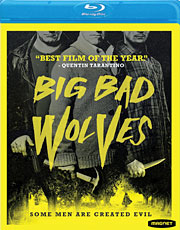
“Big Bad Wolves”

WHAT: When a lawless police detective (Lior Ashkenazi) botches his investigation into a series of brutal child murders that he believes was committed by religious studies teacher Dror (Rotem Keinan), he teams up with the vengeful father (Tzahi Grad) of the latest victim to kidnap and torture the suspected killer into revealing the location of the girl’s severed head.

WHY: “Big Bad Wolves” is one of those movies where all the hype may have hurt the film more than it helps it, because while writer/directors Aharon Keshales and Navot Papushado have produced a well-made Israeli thriller, it’s not nearly as amazing as many people (including Quentin Tarantino, who named it his best film of 2013) would lead you to believe. Between the many plot holes that defy logic and twists so predictable that it makes the police characters seem incompetent by comparison, “Big Bad Wolves” is unable to stick the landing, resulting in a movie that’s good, but not as great as it could have been. What makes the whole thing work at all are the performances from the three leads. Even when you’re 99% certain that you know the truth, a character will say or do something that forces you to rethink your position. And that’s where the film’s true genius is revealed, because it never allows you to feel comfortable about what these brutish men are doing to their captive, even if he may be guilty. It’s a smarter, more socially conscious form of torture porn – one that places morality over shock and awe.

EXTRAS: There’s a pretty decent making-of featurette and a fluff piece produced for AXS TV, but that’s the extent of the bonus material.

FINAL VERDICT: RENT

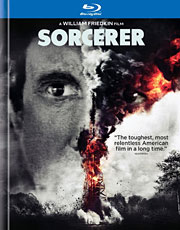
“Sorcerer”

WHAT: A group of outcasts from different backgrounds find themselves working for a drilling company in South America. When an oil well explodes several hundred miles away, four of the men (including Roy Scheider) are given a lucrative opportunity to transport six crates of unstable dynamite across the jungle so that the nitroglycerin can be used to extinguish the flames.

WHY: William Friedkin’s 1977 thriller has experienced a bit of a revival lately, but it’s hard to understand why. The movie was critically panned when it was first released, and rightfully so, because it’s an often boring and uneven mess, beginning with its horribly misleading title. Named after one of the trucks that the characters drive in the film, it tells you absolutely nothing about the story, nor does anything of much interest happen in the first hour. It takes 30 minutes just to introduce the four main characters, and another 30 minutes to send them on their journey. Once they embark on the suicide mission, however, the movie finally shifts out of first gear and delivers a handful of truly suspenseful moments as the quartet is forced to battle the elements, dangerous rebels and shoddy terrain. Many people have singled out the bridge crossing as the standout sequence in the film, but there’s a pair of set pieces that come just before and after that are equally as good, even if they’re dragged out a little longer than necessary. With better pacing and more likable characters, “Sorcerer” could have been an American classic, but instead, it’s a disappointing exercise in wasted potential.

EXTRAS: Nothing, zilch, nada.

FINAL VERDICT: RENT

007 One by One: Live and Let Die

Live and Let Die

Bullz-Eye continues its look back at every James Bond film, 007 One by One, as part of our James Bond Fan Hub that we’ve created to celebrate the 50th anniversary of the first Bond film.

Pimpmobiles. Alligators. A trip through Harlem. Voodoo. Cigars. Blaxploitation. George Martin. Bourbon and water. Tarot Cards. Snakes. The City of New Orleans. Paul McCartney and Wings.

“That’s just as bad as listening to the Beatles without earmuffs.” – 007 in “Goldfinger”

Somebody’s out to prove Roger Moore ain’t your daddy’s James Bond.

On the calendar, 007 entered the ‘70s with Sean Connery’s last official entry, “Diamonds are Forever”, but it wasn’t until two years later in 1973 that the shift of the decade really affected cinema’s most popular secret agent.

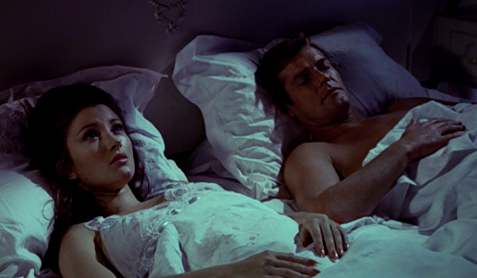
The Plot: Three MI6 agents are killed – one each in New York, New Orleans, and the fictitious Caribbean island of San Monique. M (Bernard Lee) assigns Bond (Moore) to the case. He follows the trail of bodies, only to discover an elaborate heroin producing, smuggling and selling operation, masterminded by the ruthless San Monique dictator Kananga (Yaphet Kotto), who operates under heavy makeup stateside as Mr. Big, where the goods are dispersed through a chain of soul food restaurant/bars called Fillet of Soul. But faux voodoo and mysticism surround Bond from the word go, as does the hypnotic spell cast over him by Kananga’s delicately beautiful reader of cards and seer of visions, Solitaire (Jane Seymour).

The Girls: Nabbing the role of lead Bond girl must seem exciting for an unknown actress, but as has been proven repeatedly, it rarely leads to a big time career. Seymour is one of a handful of actresses to buck that trend and with good reason: Solitaire ranks high on the list of Bond’s classiest ladies, and her story is arguably the heart of the picture. The character isn’t necessarily written with a huge amount of depth, yet that very simplicity makes her complex. In a movie full of charlatanistic voodoo, she stands out as the lone figure possessing the psychic ability to see into the future. Additionally, she differs from the Bond girl flock by sporting ornate, body-covering costumes that contrast with the oft-expected “Bond girl in a bikini” mold. And she’s a virgin, until James enters her, um, life.

Content - Jane Seymour as Solitaire with James Bond in Live and Let Die

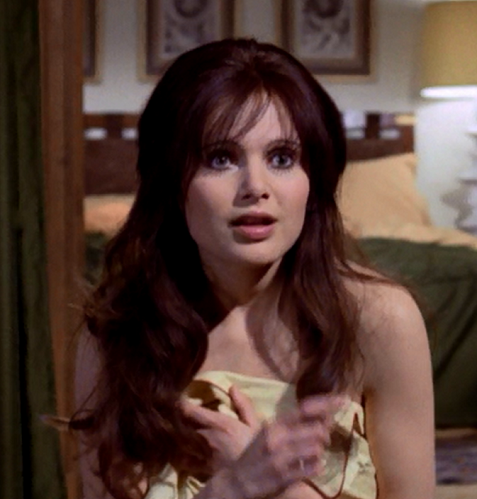
Also on hand is Gloria Hendry’s Rosie Carver (see photo above), marking Bond’s first filmic foray into the wilds of jungle fever. Unfortunately for double-agent Carver, that’s about all she was good for, as she not only betrays James, but also does little more than scream until somebody shuts her up. At the start of the movie, there’s the adorable Miss Caruso (Madeline Smith), an Italian agent James worked with in an offscreen adventure, and is now bedding back home in his flat.

Content - Madeline Smith as Miss Caruso in Live and Let Die

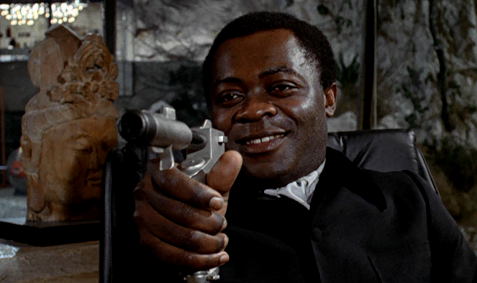
The Nemeses: If a Bond movie is only as strong as its villains, then “Live and Let Die” is one of the strongest, with a half a dozen characters worthy of mention. Yaphet Kotto’s double act of Kananga & Mr. Big was quite a departure for a Bond baddie — after a decade of destruction by SMERSH, SPECTRE and Blofeld, here’s a guy who isn’t out to take over the world, only to keep his vast opium operation afloat whilst continuing his duties as dictator of San Monique. His fatal flaw is his mistaken belief in Solitaire’s ultimate devotion, and when the issue sidetracks his attention, it costs him his life.

Content - Kananga Live and Let Die

Drink of the Week: Make Way for Amaro (TCM Fest Salute #1)

Make Way for Amaro. For the last four years or so I’ve had the privilege of attending the annual TCM Classic Film Festival. It’s been great and I’ve been able to cover it from a few different angles, both as a classic film loving cinephile and, last year especially, as a cinema-addled boozer.

This year, however, I’ve come up with a slightly different approach and will be covering the festival right from DOTW. For the next few weeks, rather than simply stealing drinks from elsewhere and trying them out myself as per usual, I’m going to be whipping up my own creations, all inspired by some of the amazing films I was lucky enough to see projected on the big screen in my native Hollywood. I’m not promising they’re all going to be cocktail classics. I’m not even necessarily promising they’ll be any good. I’m definitely not promising that they’ll be terribly original or unique. I am, however, reasonably certain that it’s a great excuse for me talk a little bit about a few remarkable movies.

I’m happy to say, the first drink of our series surprised me by turning out to be very drinkable indeed. In fact, I think I’ll have an easier time persuading many of you to try the drink that than to watch the film. That’s because, our selection is a tragicomic masterpiece about an elderly couple who are forced to separate by the behavior of their selfish, but all too understandable, adult children.

I know nothing I’m going to say that will persuade you that watching  Leo McCarey’s sneaky, awe-inspiring 15 hankie tragicomedy, “Make Way for Tomorrow,” goes down nearly as easily as this rather lively variation on the oldest of popular classic cocktails, but it’s that good a movie. The drink isn’t too terrible either.

Make Way for Amaro

2 ounces Rittenhouse Rye (100 proof)
1/2 ounce Amaro CioCiaro
2 teaspoons soda water or club soda
1 sugar cube
1 orange or grapefruit slice
Garnish with an additional slice of citrus twist

Muddle the sugar cube and citrus slice with the soda water in the bottom of a cocktail shaker. Add the Rittenhouse Rye and Amaro CioCiaro – one of a number of bittersweet Italian after-dinner liqueurs – and plenty of ice. Shake vigorously and strain into the smallest Tom Collins or Old Fashioned glass you can find. (The one in the picture is too big, but it did okay for me.) Toast your mom and your dad. In fact, if they’re alive, give them a call – before you have a second drink.

****
Unless you’re a member of the Cinephile American community, you’ve probably never heard of Leo McCarey’s 1937 masterpiece. Though “Make Way for Tomorrow” has nearly as many well-earned laughs as tears – McCarey is legendary as a director of comedies like “The Awful Truth” and “Duck Soup” – it was a failure at the box-office. It could hardly have been a surpise. With subject matter like this, it would be a tough enough sell on today’s arthouse circuit.

Even so, the film takes a surprising and, at least temporarily, more upbeat turn at what might have been its most maudlin moment as the aged parents break free of their offspring and find themselves in the hotel where they enjoyed their honeymoon 50 years prior. A kindly manager suggests a cocktail and, despite that the fact that the Beulah Bondi character comes from an era when “nice” females never drank in public, they decide on “two Old Fashioneds, for two old-fashioned people.”

Aside from being the height of bittersweet comedic drama, the scene is interesting for cocktail geeks. The Old Fashioneds the couple enjoys actually look nothing like Old Fashioneds you’d get today. They are served in the kind of teeny-tiny glass that was once standard for cocktails – in this case a sort of mini-Tom Collins – and it’s not on the rocks. It’s presumably served up and with a long, spiral orange peel like you’d get in a classic Horse’s Neck.

Even so, I started out making this drink in the usual Old Fashioned fashion by building it in the glass and serving it on the rocks, but the results just didn’t come together. The amaro, which I’m using largely, though not entirely, in the place of the bitters, just kind of held the drink down. Shaking it and serving it in a chilled glass, however, added the kind of lightness to the drink that brought the whole thing together. It’s a bit glib to compare shaking a cocktail to the ample humor in an essentially tragic film, but it really did kind of feel and taste that way.

Finally, though I usually try to make my drinks as non brand-specific as I can, it’s hard enough to come up with a new cocktail in three days if you’re not an absolute souse and have a day job. I will say that I leaned towards the oldest school brands I could.  I went with rye instead of bourbon, and the wondrous Rittenhouse Bottled in Bond over a fancier newer brand because it’s just possible that that’s what Beulah Bondi and Victor Moore might have been served way back in 1937. Like the movie, you might be surprised but it packs at least as much of a punch today as it must have 77 years back.

Don’t believe me? See for yourself and watch the whole movie right here. I guess modern ways aren’t entirely for the birds.

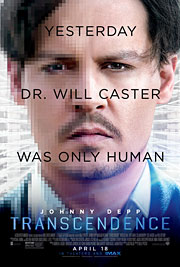
Movie Review: “Transcendence”

Starring
Johnny Depp, Rebecca Hall, Paul Bettany, Morgan Freeman, Cillian Murphy, Kate Mara, Cole Hauser
Director
Wally Pfister

With Easter just around the corner, it’s probably no coincidence that just as the furor over “Noah,” a man who had visions from God, has died down, we are treated to Johnny Depp taking the futuristic steps in becoming a god in “Transcendence.” A cautionary tale about the evils of technology by way of artificial intelligence gets the visual treatment by acclaimed cinematographer Wally Pfister (“Inception,” the Dark Knight trilogy) in his directorial debut, but this is more than just a big budget version of “Siri Goes Wild.”

Johnny Depp plays Will Caster, the leading scientist in the field of Artificial Intelligence. He’s brilliant to the point of being a bit bored with the non-scientific world, not that his flock of geek groupies seems to mind. (Eat your heart out, Reed Richards). Keeping him tethered to people, places and things is his loving wife, Evelyn (Rebecca Hall). She’s more than Will’s diplomatic arm candy, though. She’s arguably his intellectual equal.

While Will charges down the road towards creating sentient machines, his best friend and part-time conscience, Max (Paul Bettany), reminds him that just because you can play god doesn’t mean you should. Apparently, he’s not the only one who thinks society should pump the brakes on giving Cortina cyber synapses to work with. The anti-tech terrorist organization R.I.F.T (Revolutionary Independence from Technology) – led be Kate Mara’s Bree – subtly voices its opposition with a coordinated attack targeting the Casters’ former mentor, Joseph Tagger (Morgan Freeman), and killing his entire staff in the process. But Will isn’t spared when the group attempts to kill him as well, and they pull it off… somewhat.

After he’s poisoned by R.I.F.T. and given only days to live, Evelyn does the unthinkable and transfers Will’s mind into his living computer P.I.N.N. (You can’t have science without a couple good acronyms), the Physically Independent Neural Network. As Will tells a crowd before he’s shot, “Once online, a sentient machine will quickly overcome the limits of biology.” And he does just that, initially to the delight of his grieving wife Evelyn and the shock of his pal Max. Will is more than just a ghost in the machine, however, using his near-infinite knowledge to help change the world, effectively becoming a god. Yes, connecting to the internet can make you a god, but the Casters come to find that being a diety power couple comes at a price.

Continue reading »

« Older posts Newer posts »

© 2026 Bullz-Eye Blog

Theme by Anders NorenUp ↑