Month: December 2011 (Page 9 of 11)

A Roundtable Chat with Colin Firth (“Tinker, Tailor, Soldier, Spy”)

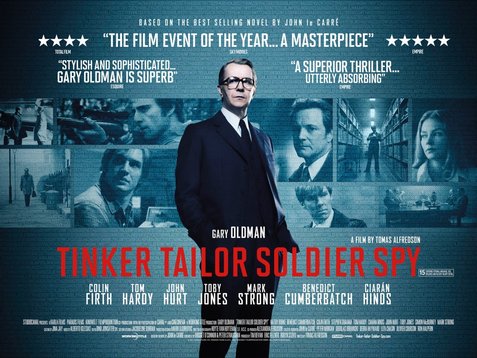
When Focus Features drops you a line and asks you if you’d like to head to New York City for an overnight stay at the Waldorf Astoria in order to attend a screening and press junket for “Tinker Tailor Soldier Spy,” based on the novel by John le Carré, you don’t think about it. You just say, “Yes.” And so I did. After catching a screening of the film on a Friday night, I got up on Saturday morning to begin the interviews of the day. After a roundtable with director Tomas Alfredson and screenwriter Peter Straughan, the two gentlemen left the room, to be replaced a few minutes later by one of the stars of the film, Colin Firth.

One word of warning: the potential for spoilers exists within the piece…like, to the point where Firth asks during one of his answers “not to turn this into spoilers when you write about it.” But, look, if you don’t want to know, then don’t read it. But given that the original novel was published in 1974, followed by the TV miniseries in 1979, it’s not as if you haven’t had plenty of time to absorb this information already…
Journalist: Are you a fan of the espionage and spy films?

Colin Firth: I like the good ones, yeah.

J: Do you have any favorites?

CF: No, not really. [Gesturing toward the journalist sitting next to him.] We talked about this, actually, him and I. He had to help me out. [Laughs.] No, I’m one of those people where, if you say, “Tell me what your favorite music is,” I can’t think of any music in the world. So that’s a difficult question. You throw something at me, I’ll tell you whether I like it or not. But, yeah, I’m a fan.

J: Well, we’re all like that. You ask me, and I’d do the same thing.

CF: Yeah, I know. Nothing is more guaranteed to draw a blank, I’m afraid.

J: In the film, we were trying to figure out exactly who the people up in that big office were.

CF: [Uncertainly] Oh, I hope I can help…

Continue reading »

A Roundtable Chat with Peter Straughan and Tomas Alfredson (“Tinker, Tailor, Soldier, Spy”)

When Focus Features drops you a line and asks you if you’d like to head to New York City for an overnight stay at the Waldorf Astoria in order to attend a screening and press junket for “Tinker Tailor Soldier Spy,” based on the novel by John le Carré, you don’t think about it. You just say, “Yes.” And so I did. After catching a screening of the film on a Friday night, I got up on Saturday morning to begin the interviews of the day. First up: director Tomas Alfredson and one of the film’s screenwriters, Peter Straughan. (Alas, Straughan’s co-writer, Bridget O’Connor, who was also his wife, died of cancer in September 2010.)

One word of warning: the potential for spoilers exists within the piece. But, look, given that the original novel was published in 1974, followed by the TV miniseries in 1979, it’s not as if you haven’t had plenty of time to absorb this information already…

Journalist: How liberating was it for you to be told (by John le Carré), “Don’t reshoot the book?”

Peter Straughan: Very. [Laughs.]

Tomas Alfredson: Yes, very. I was much more so, I think. Peter wasn’t too worried, but I was very reverential about the book and was very nervous about taking a foot off the path. So it was just very good that John le Carré was there to push us off the path and tell us to do something different.

J: Can you each tell us about your first encounter with the book, if you had read it a long time ago? Did either of you?

PS: I’d read it, yeah. And Bridget had read it years earlier and loved it. In the UK, it’s considered one of the greatest novels of the 20th century, let alone spy novels. And then we read it again when we were asked to come in to discuss adapting it. Which made us quite nervous. [Laughs.] You read it, and…it’s quite a difficult book to adapt!

J: Because it’s so well known, or because of the complexity…?

PS: Because of the complexity. Because it’s quite an interior story. So much of it takes place in Smiley’s mind and Smiley’s memory. And also because, in the UK, it’s a holy cow. As is the TV series. So there was a sense of…I think we were maybe the only writers who rushed in and said, “Okay, we’ll do it!” Everyone else would say, “No, we don’t want to do it!” [Laughs.] Fools rushing in where angels fear to tread.

TA: I think it’s…very much about not deciding, “Okay, I want to do this,” but it’s about, “I want to start working on this, to start the process.” And early on, it was…I remembered the old TV series and the reading of the book, but also meeting with the actual persons, with Peter and Bridget and le Carré and the producers, who are very nice people. To do a scary thing like this, you need to be encouraged, and if you’re surrounded by encouraging people who you trust, it’s much easier.

Continue reading »

They Were Spies: Famous Folks Who Played the Espionage Game

Spy /spī/ noun: A person who secretly collects and reports information about an enemy or competitor.

Artists, in my experience, have very little centre. They fake. They are not the real thing. They are spies. I am no exception. – John le Carré, aka David Cornwell

If you should learn one thing from watching the Oscar-touted new film version of John le Carré’s classic of realistic Cold War-era cloak and dagger, “Tinker, Tailor, Soldier, Spy,” it’s that people in the espionage business should not be show-offs. If everyone knows you’re a spy, you’re not doing it right.

Nevertheless, documents get released over time, old stories get told, and the end result is that we now know of a surprisingly large number of world-renowned writers, actor, and others who have worked pretty high up, and sometimes rather low down, in the field of intelligence. On the other hand, whether or not some of them were actual spies is a matter of how you define spying. That’s why we like the rather inclusive definition we’ve placed up top. On his website, John le Carré, who worked for several years at England’s MI-6 and whose real name is David Cornwell, at first tells us he was not a spy at all, but then jauntily describes himself as a “spook” four paragraphs later. By any name, spies are cagey.

While a lot of these people were probably mainly bureaucrats, we’d add that the same thing could be said for le Carré’s most famed protagonist. Whether portrayed by Alec Guinness in the 1979 television adaptation or newly embodied for the big screen by Gary Oldman, the seemingly gentle and harmless George Smiley is a man one underestimates at one’s extreme peril.

In any case, some of the notables below were pretty deep in the trenches of the spy game, and some probably even killed people. Some may not really have been involved with intelligence at all, we can’t be sure. That’s one thing about dealing with espionage – it’s like it’s all supposed to be a big secret or something.

Continue reading »

Sons of Anarchy 4.14 – To Be, Act 2

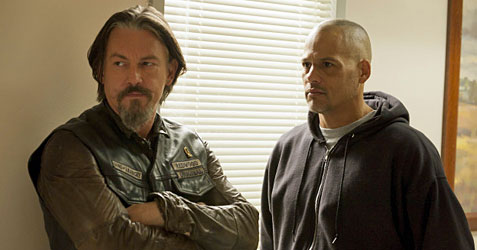
In last week’s recap, I proposed that the only reason Romeo could have for telling Jax that Otto didn’t sell out the club was that he knew something SAMCRO didn’t, and as it just so happens, that something turned out to be pretty big. Shortly after Lincoln and his men set up surveillance on the Sons, Romeo and Luis roll into camp to announce that they’ve been working with the CIA and are shutting down the RICO investigation. I had a feeling this might be the case back when Lincoln was discussing Luis’ history with the Mexican military, but I had completely forgotten about it since then, mainly because it seemed a bit far-fetched at the time. And it still does, to be honest, even if this wouldn’t be the first time that the government has sided with the bad guys for the greater good. They’re essentially bankrolling the Galindo cartel so that they come out on top, because “whoever controls the drugs controls the politics,” and in order for that to happen, they need SAMCRO’s deal with the IRA to go through unimpeded.

Of course, nothing is ever that easy in the world of “Sons of Anarchy,” and although the Irish Kings seem open to working with the cartel, they’re only willing to do it with Clay as the intermediary. That puts Jax in a bit of a bind, who openly admits to Romeo that the club is already way over its head on this whole cartel business. Though he didn’t want to have to bring Jax into the loop on their CIA connections, Romeo’s hand was forced by the prospect of losing the IRA gun deal, so he explains to Jax that if the deal goes bust, the RICO case will be reopened and the club will be destroyed. All in all, it was a pretty clever way of keeping Clay alive and ensuring Jax remains in Charming. I also found it interesting that Romeo never intended to hurt Tara, but was instead going to put her into protective custody. That at least explains why the kidnappers didn’t just shoot the both of them when Jax came to her rescue in the park.

I don’t think we’ve ever seen Jax more pissed off than when he went to go visit Clay at the hospital (except perhaps at the end of last week’s episode), because despite every bone in his body telling him to kill the traitorous bastard, he had to keep him alive for the sake of the club. It’s hard to imagine a show where Clay can co-exist alongside Jax, Opie, Tara and Gemma now that they all know the truth, but Jax really has no other choice. Though he’s stripping him of the President patch, Jax is allowing Clay to keep a seat at the table and his vote for the sake of appearances, but what will the Irish think when they realize he’s no longer in control of the club? And while Clay may wish that he was dead now, that’s not going to stop him from putting up a fight when he recovers.

Continue reading »

The new Jaguars are beautiful cars

We love where Jaguar is going with the design of their new automobiles.


« Older posts Newer posts »

© 2026 Bullz-Eye Blog

Theme by Anders NorenUp ↑