

Blog Zones
Blog Topics More Blog Zones

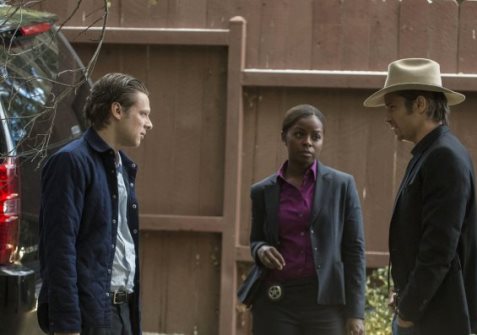
Justified 4.13: Ghosts

SPOILER WARNING: This post will appear following a new episode of Justified. It is intended to be read after seeing the show’s latest installment as a source of recap and analysis. As such, all aspects of the series up to and including the episode discussed are fair game.
jst_413_Ghosts_0020_595_slogo

The final scene of last week’s episode left the viewers with absolutely none of that eponymous “Peace of Mind,” but that was probably the point. You’ll recall Augustine’s henchman Picker was at work installing a rocking chair for Winona that she didn’t order. I spent the week wondering what the game was. Is a bomb or some other devious device planted in the chair? And the title of this week’s episode, “Ghosts,” didn’t offer any consolation. I mean, “Ghosts” doesn’t exactly scream “don’t worry, she’ll be fine.”

I’m still not quite sure how those four goons got into Winona’s house, or what the chair had to do with it, but the play fails pretty spectacularly. In fact, the finale turned out sunny for Raylan without him having to put much effort in (you know, relative to his other doings). Raylan quickly dispatches three of the thugs after one gets too close while punching him in the stomach, and he’s able to kill the last when he lifts his gun from Winona’s belly to Raylan. Classic introduced-just-to-die Justified villain move. As Raylan says later in the episode, “they always pull,” and you don’t pull on Raylan Goddamn Givens!

Once the authorities arrive at the scene, Raylan talks with Art and Assistant U.S. Attorney David Vasquez about the motivations for the attack. Raylan quickly discovers what we already knew, Nick Augustine was behind the whole thing, and the scheme’s purpose was a final, flailing attempt to get at Drew Thompson. What else? But that’s not the most interesting part of the conversation. Raylan brings up Augustine, calling him “this Nicky fella,” and Vazquez quickly responds with the man’s full name. Raylan then jokes, “oh good, you’re familiar,” to which Vasquez responds, “more than I’d like to be.” We’ve known for quite a while that the Tonins have a mole in either the Marshals’ or U.S. Attorney’s office. It’s how Augustine found out Shelby wouldn’t talk until he knew Ellen May was safe almost as fast as the Marshals who heard him say the words. Now I may be reading too much into this, folks, but I don’t think so: David Vasquez is the mole, hence his being more familiar than he’d like to be. Plus, Vasquez relays almost as much information about the Tonins to the Marshals as vice-versa. Sure, a good prosecutor might know plenty about the latest “Shakespearean” power struggle in the Tonin family. But I think he’s also got inside information. That wasn’t just a throwaway line.

After Raylan puts it together that Augustine is responsible for the attack on his wife, he immediately elects to go after him, despite the fact that he’s suspended (for real this time). In his defense, Raylan doesn’t know for sure what we do, that his delaying the suspension to close the Drew Thompson case is what put him (and his family) on Augustine’s radar to begin with. But that doesn’t make his decision to  ignore Art’s orders and seek revenge any smarter. His family is attacked, so he does the exact same thing that got his family attacked in the first place? As soon as he told Winona, “I’m gonna find the guy responsible for this, and I’m gonna take care of him,” I thought, aww here it goes.

Read the rest of this entry »


You can follow us on Twitter and Facebook for content updates. Also, sign up for our email list for weekly updates and check us out on Google+ as well.

WATCH THIS!

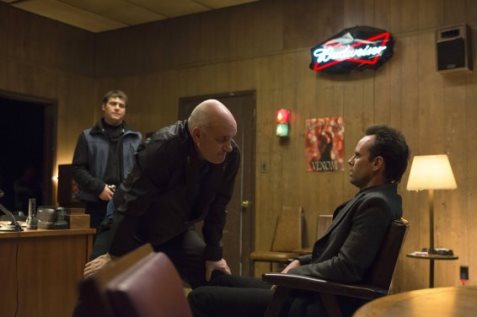
Justified 4.12: Peace of Mind

SPOILER WARNING: This post will appear following a new episode of Justified. It is intended to be read after seeing the show’s latest installment as a source of recap and analysis. As such, all aspects of the series up to and including the episode discussed are fair game.

jst_412_Peace_0636_595_slogo

Well folks, I’m man enough to admit when I’m wrong. And boy was I wrong about the Crowder/Givens Alliance I thought was hinted at in “Get Drew” before getting into motion in “Decoy.” We bloggers aren’t always perfect, if you can believe it. As it turned out, Boyd and Augustine’s mutual doublecrossing was a lot simpler than all that. Each side planned to work with the other for as long as they had something to gain from it and not a moment longer. Because there was no way of knowing when that moment would come, they each had contingency plans in place. Plans that moved forward even while the partnership was still (ostensibly) in place, including Colt shooting Mort, the aptly named Tonin sniper. But as we saw this week, inter-gang alliances can reassemble just as easily as they fall apart. Because in the crime business it’s less about what you’ve done for me lately than what you can do for me now.

With Drew Thompson in custody, the game should be over, but he refuses to cooperate with the investigation of the Tonins until he knows Ellen May is safe, a fact that’s relayed to the Tonins via a mole in the Marshals’ office (or perhaps the U.S. Attorney’s). So begins another game of hide and seek, only the tables have turned: this time, it’s the bad guys who have the inside scoop and the Marshals who have to do the seeking. Suddenly, Nick Augustine needs the Crowders again, so he goes to see cousin Johnny. It makes sense, Johnny is easily the most vulnerable of the bunch. Both Boyd and the Tonins have put a target on his back, the former due to his now public betrayal and the latter because betrayal or not, his last name’s still Crowder. So a new alliance is forged when Johnny calls Limehouse on Augustine’s behalf, and ends the moment he fails to broker an agreement. But Augustine doesn’t have time to waste, so he immediately calls Boyd and offers him the deal of the century: the money to get Ellen May and his cousin Johnny. He does all this with Johnny standing right in front of him, using the man’s own cell phone. As Omar Little would say, “It’s all in the game though, right?

So Ava heads to Noble’s Holler to buy back Ellen May. She and Limehouse have one of those conversations that’s meant to get right to the heart of a person, to show who they really are. In so many words, Limehouse asks her if buying back Ellen May will really give her that eponymous peace of mind she’s been seeking all season. He tells her he’s “been wonderin’ lately what it is makes us forget who we are,” referring to the fact that he’s been forced to sell off parts of the Holler his clan has owned since Emancipation. But he’s also talking about Ava, and how he doesn’t even know who she is anymore. “I can’t do this,” he says, “and you shouldn’t either.” It’s no coincidence it’s the proposed buying and selling of a human that gets him thinking about all this.

There’s just one issue though, and it’s that Limehouse has already get Ellen May go. He’d already pondered the last question he asked Ava, “All these things you’ve done, with no mind to the consequences to other people, are you gonna have peace of mind when this is all over?” And his answer was no. Limehouse offered Ava the opportunity the make the same decision, to strive to be a better person, but she never even considered it. None of that matters though, Ellen May is gone, so the choice was purely hypothetical. Maybe part of the reason Limehouse let her go was out of fear that he’d have a harder time sticking to his convictions with the temptation of $300,000 cash being stuck in his face. But the more important factor was the similarly themed conversation he’d had with Ellen May earlier, one of those “hatchet conversations” that “cuts through the bullshit.”

Read the rest of this entry »


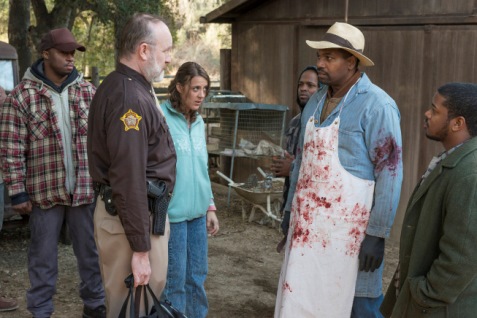
Justified 4.11: Decoy

SPOILER WARNING: This post will appear following a new episode of Justified. It is intended to be read after seeing the show’s latest installment as a source of recap and analysis. As such, all aspects of the series up to and including the episode discussed are fair game. jst_411_Decoy_0173_595_slogo

Last week, I predicted the Crowders and the Marshals would forge a temporary alliance to fight, or rather survive, the onslaught of their common foe: the Tonin crime family, as personified by Nick Augustine (Mike O’Malley). The logic was simple: Despite having Drew Thompon in custody, the Marshals’ game was far from over. As Raylan put it, “We’re standing in a field, we haven’t done shit.” They needed to find a way to get both themselves and their prize catch out of Harlan alive. That left Boyd and company in a similar position. The Crowders had two options: “We make a case to Theo, or we run.”

As I watched the opening scene of “Decoy” for the first time, the apparent inaccuracy of my prediction had me disappointed. Although he remained plenty bold in sticking to his demand for $500,000, it appeared Boyd was simply going to aid the Tonins in finding Drew, and as a matter of course, Raylan. I can’t say for certain, because the writers took great care in ensuring the details behind the Crowders doublecrossing the Tonins were not made explicit (yet). But folks, I’m almost positive my original prognosis was correct.

Looking back, Boyd’s inclusion of Raylan as one his plan’s necessary casualties should’ve been my first hint. But hindsight is 20/20, or so they say. Boyd will never kill Raylan, directly or otherwise, nor will Raylan kill him. And that’s not just because the writers would be nowhere without their two main characters. These are men who have known each other for a long time, and they play by different rules than most archenemies. They’re Harlan County’s version of Batman and the Joker. Their’s is the game that never ends. No matter who or what enters the fold, be it northern carpetbaggers or Black Pike Coal. Deep down inside, being a “robber” would be a lot less fun for Boyd if Raylan wasn’t the “cop” (and, once again, vice-versa).

We’ve talked a lot this season about the ways Harlan seeps into its residents’ very souls. Last week, Boyd spoke at length about why Raylan should have become a criminal along with he and Arlo. Because to Boyd, being from Harlan and being an outlaw are one and the same. One of the major elements of Raylan’s character, however, has been trying to escape Harlan, both geographically and emotionally (I’m referring specifically to the little Arlo in the demon costume that’s always sitting on his shoulder). But the roots are so deep they always tear him back. Still, the desire to get away is what makes him scoff at Boyd’s comment, as well as get a little sheepish when he had to explain that he knew about some roads that weren’t on the map. In terms of action and plot events, the secret alliance came about because both sides needed to overcome a foe greater than themselves. But the real reason the Marshals, or Raylan rather, would make a deal with Boyd Crowder is because they are both Harlan County, Kentucky to the motherfucking bone. We see it as Boyd leads Tonin’s men into Raylan’s trap (the eponymous decoy, or one of many, at least). In what has become the classic Raylan move, he lets them walk so he can (legally) shoot them some other day, Boyd included. As Boyd walks away, Raylan reminds him of promise he’d just made, that they’ll “do this again sometime.” Boyd’s response? “You can count on it, Raylan.” The game goes on.

Read the rest of this entry »


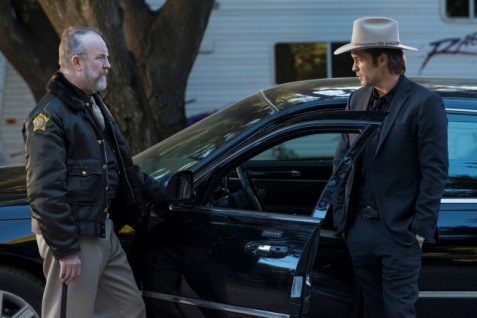
Justified 4.10: Get Drew

SPOILER WARNING: This post will appear following a new episode of Justified. It is intended to be read after seeing the show’s latest installment as a source of recap and analysis. As such, all aspects of the series up to and including the episode discussed are fair game.

J

“Get Drew” is one of those episodes with a very literal title. When it begins, the word is out on Drew Thompson’s identity, and everyone’s scrambling to find him. It ends with Drew in the Marshals’ custody. Generally, that’d put an end to the chase. Generally putting the cuffs on the bad guy means the game is over, the Marshals won. But not this time, not with Drew Thompson. That’s why when the Marshals start to celebrate, Raylan remarks that, “we’re standing in a field, we haven’t done shit.” Next week’s episode will likely be very similar to this one, only now the criminal element will be scrambling to “get Drew” via the Marshals, who will be doing their damndest to “get out of Harlan alive.” Art’s speech on how “awesome” Drew is reinforces why his being in the law’s custody isn’t near enough to make Theo Tonin give up the chase:

First thing we’re gonna do is acknowledge that this guy is awesome. I mean he shoots Theo Tonin, fakes his own death in a spectacular fashion, pushes a guy out of an airplane while he’s flying it, parachutes into Harlan County with enough coke and cash to jumpstart the economy of a small country, and then he has the balls to get a job in law enforcement not once but two times, he spends a couple days riding around with you while you’re looking for him, and now he’s run off with a hooker that’s half his age. That’s some badass shit.

The thing is, the Marshals may not be the only ones trying to get to safety. When Wynn Duffy hears that the Marshals have Drew, he immediately prepares to run to Canada, which his extraordinarily uninformed henchman calls, “running like a little bitch.” The Crowders have been placed in a similar position. Theo may see them as having failed him and want them taken out both as a consolation prize and a small distraction until he can get to Drew. The Crowders and the Marshals now have a common enemy scarier than both of them put together. I foresee a temporary alliance so they can all escape with their lives. But that’s next week.

The major focal point of last week’s episode, “The Hatchet Tour,” as well as my discussion of it was the way Harlan’s past influences its present. We can see the way each and every Harlanite allows their fate to be determined by the actions of their parents and grandparents. That theme continued in “Get Drew.”

Read the rest of this entry »


Justified 4.09: The Hatchet Tour

SPOILER WARNING: This post will appear following a new episode of Justified. It is intended to be read after seeing the show’s latest installment as a source of recap and analysis. As such, all aspects of the series up to and including the episode discussed are fair game.

J

The season’s big mystery has officially been solved. The answer to the question of Drew Thompson’s identity has been answered: It’s Sheriff Shelby Parlow, hiding in plain sight this whole time. At first I was a little disappointed in this discovery. In part because I hoped all those hints last week were red herrings. It seemed silly to devote one episode to the audience figuring things out and another to having the characters do it. I felt like the writers were just serving up more delays to stretch out a storyline that really isn’t big enough to command a whole season, because it’s the best they could come up with. We know who Thompson is, all that’s left is to cuff him, and they’re going to drag out that out for four more episodes? I felt cheated.

Then, something occurred to me which put it all in perspective. This season wasn’t actually about figuring out who Drew Thompson was. Not really. As I’ve mentioned, one of the big themes has been Raylan’s preparing for fatherhood and Arlo’s influence on just what kind of Dad he’ll be. What I didn’t put together until this week, however, was how that was actually a smaller part of another, greater theme, perhaps the season’s most significant. And that’s how the history of Harlan, its people and their ancestors, impacts its future. The Arlo/Raylan/fatherhood idea is just a smaller piece of that greater puzzle.

The biggest sign pointing us in the direction of this idea was Raylan’s recollection of an old feud between the Givens and another Harlan clan. The way Raylan remembers it, Arlo got pinched for assault after he beat the crap out of a man named Johnson McClaren because his dog was shitting on their lawn. The thing escalated, the Givens are gearing up to go after the McClarens and calling on their allies, the Crowders, to go after the Sorensens, who were kin to the McClarens. That is, until Raylan’s mother Frances called a meeting for all the clans to get together and hash it out. Frances, who Raylan says had some French blood in her, once told her son that the term “hash it out” comes from the french word “hatchet,” like an axe, to “cut through the bullshit.”

Only, that old story didn’t really go down the way Raylan thinks it did, as Shelby points out. In truth, “the dog was incidental,” and Johnson McClaren had “verbally assaulted” his mother, making “implications around town as to her proclivities,” and pushed it too far. That’s when Arlo “saw fit to shove a pound of dog shit down his mouth.” But Frances “took the high road, called a truce, although she had every right to be affronted. Your daddy was protecting her honor.” Raylan looks at Shelby with a look of disbelief, saying “Arlo did that?” It goes against everything he believes his father to have been.

Read the rest of this entry »


Justified 4.08: Outlaw

SPOILER WARNING: This post will appear following a new episode of Justified. It is intended to be read after seeing the show’s latest installment as a source of recap and analysis. As such, all aspects of the series up to and including the episode discussed are fair game.

J

I criticized last week’s episode of Justified because it didn’t seem to bring us much closer to solving the season’s big mystery. It gave Raylan an unrelated one (alright, two) off storyline while Boyd inched towards finding Drew Thompson. Well, “Outlaw,” appears to be the writers’ forcing a collective foot in my mouth. It all but came out and said that the hard-working and dedicated Sheriff of Harlan County, Shelby Parlow, is in fact the man we’ve been looking for all along. And there he was, right under our noses.

For those that didn’t catch the hints, they came mostly during Shelby’s conversation with Ellen May about reinventing one’s self, starting over. He came home to find her digging through his ex-wife’s things, namely a necklace depicting St. Christopher, “patron saint of travelers, sailors, pilots, and bachelors.” Pilots, folks. Ellen May also happened to be wearing that ex-wife’s clothes, and remarked that they made her feel like a different person while also reminding her who she truly is. Shelby’s response? “Must’ve been a year after I first joined the sheriff’s department that I could put on my uniform without feeling like I was wearing a costume.” Now who would feel more like a fraud in a police uniform than an ex-criminal? He also says that “if you pretend to be something long enough, it’s not pretending.” In other words, at this point, he really is Shelby Parlow.

Only there’s a reason they did all that without coming out and saying it. And maybe that’s because the writers just want us to think that Shelby is Drew, just so they can pull the rug out from under us later on. Nobody greeted Shelby by saying “Hello, Drew.” I’m sure there will be a scene like that next week, whether or not it’ll be Shelby standing there when the camera flips around and fades to black remains to be seen. A couple things are holding me back from being positive Shelby’s our man. First of all, his would-be ex-wife, Eve Munro, tells Raylan she hasn’t seen Drew in 30 years, while Shelby tells Ellen May his wife left him 25 years ago. Secondly, look at all these people working so hard to protect Drew from being found out: They’re giving up deals to be moved to cushy prisons, not to mention risking (and often losing) their lives. At this point, if Shelby is Drew, what kind of power does he hold that people are willing to do so much for him? It’s not a dealbreaker, but it’s the last remaining piece of the puzzle.

Yet despite what I said last week about the downsides of the show dragging its feet with the main storyline, with all the other stuff that happened this week, the theoretical revelation of Drew Thompson’s identity almost seems like a sidenote. Because “Outlaw” gave us some great stuff.First of all, someone died. Not just some meaningless character who arrived on screen just in time to leave it, which is the style of most of the deaths in Justified. No, this was a real, major character: Arlo Givens. One of this season’s big themes has been Raylan’s preparations for fatherhood. Of course, Raylan’s relationship with his own father plays a large part in what he believes it means to be a father. If nothing else, Raylan’s got one play in his book: do the opposite of what Arlo did. But in spite of what a mean son-of-a-bitch Arlo was, fathers and sons are fathers and sons, so our badass marshal actually shed a tear! But I’m getting ahead of myself.

Read the rest of this entry »


The Light from the TV Shows: A Chat with Billy Campbell (“Killing Lincoln”)

Billy Campbell got his initial break in Hollywood when he pulled a recurring role on “Dynasty” in 1984, started to escape from the small screen somewhat in 1991 by playing the title in Disney’s highly underrated “The Rocketeer,” and has since bounced back and forth between TV and film, most recently spending two seasons on AMC’s “The Killing.” This Sunday, however, Campbell can be seen in another “Killing,” when he steps back through the mists of time to play American’s 16th President in the National Geographic original movie, “Killing Lincoln,” based on the book by Bill O’Reilly.

During the Winter 2013 TCA Press Tour, Campbell took some time – more than his publicist was expectingly, frankly, not that we were complaining – to chat with Bullz-Eye about his surprise over being pitched the role of Lincoln, his strong views over Disney’s mishandling of “The Rocketeer,” his even stronger statements to the bloggers who bitched about the Season 1 finale of “The Killing,” and how he was only one audition away from getting the role of Commander William T. Riker on “Star Trek: The Next Generation.”

US - 8537 - NGCI - 038757

Bullz-Eye: To begin at the beginning, how did you find your way into “Killing Lincoln” in the first place? Did you audition for the gig, or did they actually come looking for you?

Billy Campbell: I didn’t audition. They… [Hesitates.] What did they do? [Laughs.] They approached me months before this happened, and I…well, they didn’t approach me. My manager called me and said, “I got this weird sort of feeler: would you be interested in playing Lincoln?” And I burst into laughter, and I thought, “Ridiculous! I’m not Lincoln!” Nevertheless, we sent them a photo which I thought was Lincoln-esque—or a photo that I thought was the least non-Lincoln-esque—that I could find, and I forgot all about it. And then months later I got a call from my agent saying, “You’ve been offered Lincoln.” And I was…amused. But I accepted. And that was it.

Read the rest of this entry »


The Light from the TV Shows: “Game of Thrones” begins anew (and so does “The Killing”)

As we enter into the final quarter of the traditional broadcast TV season, where many of the mid-season entries are already beginning to wrap up their runs (“Alcatraz,” for example, aired its two-hour finale on Monday) and most of the series that kicked off way back in the fall are in that depressing twilight period just prior to their last run of new episodes before season’s end, many of your favorite premium cable programs are taking advantage of the semi-lull by coming back with a vengeance.

This past Sunday, of course, AMC brought us the return of “Mad Men,” which you probably already knew, since it managed to pull in 3.5 million viewers, a none-too-shabby increase of 21 percent over the series’ previous season premiere. This Sunday, the network has another series coming back, though it’s probably safe to presume that the numbers won’t be nearly as impressive for this one. But, look, if your excuse for not liking “The Killing” is that they didn’t resolve Rosie Larsen’s murder by the end of the season, go peddle your wares somewhere else, because I’m tired of hearing people whine about that. So what if it hasn’t been resolved yet? A show’s allowed to keep its viewers in suspense, isn’t it? If you didn’t like it because you thought it was boring, that’s one thing. If you’re really complaining because the producers promised “a very, very satisfying ending to Season 1” and reneged on that promise, though, I say that you may be well within your rights to be frustrated, but don’t say, “Ugh, they lied, therefore the show sucks,” because that’s just lame.

I do think AMC must be resigned to the return of “The Killing” being slaughtered both by the critics and in the ratings, however, since even though it’s coming back this Sunday night at 8 PM for a two-hour season premiere, the homepage of the network’s press resource center is still busy trumpeting last week’s return of “Mad Men.” For my part, while I do think the series dragged quite a bit in places and reached the point of ridiculousness with how many times Sarah Linden bailed on her planned departure (if I was Ray McDeere, I probably would’ve broken off my engagement to Sarah somewhere around Episode 1.3), I was perpetually gripped whenever Michelle Forbes and Brent Sexton were portraying parental grief, and I am steadfast in my disagreement with anyone who says that Episode 1.11 (“Missing”) was an unnecessary detour away from the case, because that may have been my favorite episode since the pilot. If you didn’t like that episode, you probably also watched “Twin Peaks” and complained about how they spent too much time focusing on Audrey Horne when they could’ve been figuring out who killed Laura Palmer…and I’m here to tell you that you can never spend too much time focusing on Audrey Horne.

Quick sidebar: if you didn’t watch “Twin Peaks,” this is Audrey Horne:

This concludes your moment of Sherilyn Fenn zen. We now return to our regularly scheduled column…provided we can all get our concentration back.

Oh, right, now I remember where I was…

Read the rest of this entry »


Related Posts