Author: Jeff Morgan (Page 2 of 5)

Fancy: The startup that’s sticking it to Pinterest

I can’t remember exactly when I first heard about Pinterest, but once I heard it was “invite only” I knew I wasn’t interested. Honestly, the only “invite only” service I’ve been excited about in recent memory was Google+, and then only because I thought it might actually give Facebook a run for its money. It obviously failed to do so and, as a result, I’ve pretty much made it a rule that I won’t be bothering with any other “invite only” services (and yes, I’m using quotation marks to imply sarcasm because in the case of nearly every startup that has tried it, the limit is just a hype tool and a gimmicky one at that) unless the service promises to detonate 2,000 pounds of C4 in Facebook’s server facility or post daily videos of Rick Santorum getting slapped with a variety of aquatic wildlife.

“If you aren’t interested then why write this article.” Shut up, self. No one asked you. Besides, I’m only writing the article in order to talk about another service that feels like Pinterest but has a very different and very interesting goal. That service is Fancy, which unfortunately does not own fancy.com and so has been relegated to thefancy.com. Regardless, the service is interesting, particularly to investors. Fancy allows users to “fancy” items (the site’s version of “like”) that, oddly enough, are actually for sale.

The basic idea is to highlight the social aspect of digital commerce. I’ve already been conditioned not to buy–or in most cases even look–at anything with less than a three-star rating on the average ecommerce site. Even three stars is a stretch for certain products and media. Computer components? Forget it, three-stars. I’m a four-star+ kind of guy. Books? I’ll dabble in three star so long as there’s a witty and prosaic review in the top ten reviews. I might jump down to two stars if some large contingent of fellow consumers found the review helpful. You can bet your sweet ass I’m not touching a one-star anything. Sorry, Michelin travel guide; you are now defunct.

Fancy makes those recommendations much more social by connecting profiles as with any other social network. The difference lies in the built-in commerce system, which allows for both integrated purchasing and selling. The selling is what really interests me. Merchants can basically log in to Fancy and bid to sell products to the consumers that fancy those products. This is social buying so totally different from even models like Groupon that it’s sure to be something to watch.

Granted, Fancy isn’t all good. For now the site is organized around high-end products, otherwise known as shit-I-can’t-afford. There are some things that slip through the iron curtain, like this flashy pair of bamboo sunglasses, but the site owners have said they want to market to the high-end crowd, which essentially means the site isn’t for me. Take this small sampling of products as an example. Burberry snowsuit for a baby? $350. Swiss watch with faux blackboard and chalk face? $1,750. A teak bath? Nearly $10k, and that’s if you live in London.

The site is also designed to function around products that can be bought and sold, not simply ideas, which I see as another serious limitation if the owners won’t broaden the scope. For now, a lot of Etsy products are in the mix, which I think is great. But the site has to be more than just an Etsy reskin.

If Fancy really can do what founder Joseph Einhorn says, he will have dreamt up the next frontier of shameless consumerism.

“Rather than go to Amazon or Google and searching for stuff I intend to buy, in the future in the commerce game, I think getting hotel destinations, finding cool products, or discovering fashion items will be done through the people I admire and trust. From a consumer perspective, I’m able to go to this website, where I’m finding out about the coolest stuff in the world, and instead of clicking, signing up, and giving my address and contact info to a million different websites, I am able to shop right inside, whether it’s on the website or the iPad, iPhone, or Android app, and go all the way through to checkout in an integrated experience.”

That’s one compelling pitch.
Engagement Party: The Story Behind the Google+ Stats

I was sitting at home the other night, catching up on the latest episode of “Parks and Recreation” with my girlfriend when the above Galaxy Nexus commercial ran in the pre-run slot. In case you aren’t the video-watching type, the ad starts with the words “It’s your social network, all mixed together. With Galaxy Nexus by Samsung, now you can organize your contacts by circles, like you do in real life.” Despite the fact that I’m an avid nerd and have written about Google+ on several occasions, I’m still not clear on whether the phone allows you to organize your existing social network or if the commercial is just trying to hype Google+. In fact, Google+ is only mentioned as a sidenote to Verizon’s 4G LTE network. Why the ambiguity? Because Google+ isn’t a selling point.

A few days after I saw that commercial — which has been airing since December — Google announced that it now has 90 million unique users worldwide. That number far surpasses most of the third-party estimates for the service (comScore had Google+ just over 66 million users in November) so a lot of people are throwing around words like “impressive,” “amazing,” and “astounding growth.” To me, it is none of these things. Let’s face it, Google+ had a ton of hype leading up to launch. It is, after all, a Google product. Unlike Buzz and Wave, Google’s failed social projects, Google+ had a clear and consistent purpose. Let’s also not forget that one of the most discussed topics in the tech industry today is who will take down Facebook. Everyone is waiting for Goliath to fall and Google+ was the first serious contender. With all of those things in mind, I think 90 million is a pretty reasonable turnout.

But frankly, even 90 million doesn’t matter, because 90 million is just the number of unique users signed up for Google+. Those 90 million people are not on Google+ every day. I would guess a fair number of them have only been on Google+ once, and they haven’t gone back. The numbers I really want to see are about the world’s engagement with Google+, that is, how many people are using the service on a regular basis? Larry Page might be “super excited” about 90 million, but he’s less than thrilled to share real engagement numbers. The best he could say was, “I have some amazing data to share there for the first time: +users are very engaged with our products — over 60% of them engage daily, and over 80% weekly.”

As with the Verizon ad I mentioned, it’s the wording here that counts. There is really no reason for Page to tag “our products” on the end of his engagement statement unless that was exactly what he meant. Google+ users are using other Google products at the 60 percent daily, 80 percent weekly margins. Of course, he won’t confirm that, and neither will anyone else at Google. But why word things the way he did? If +users were actually engaged with the service at the levels Page is talking about, he’d be a good bit more than “super excited” to share the news. Those would be some impressive numbers, and I would happily agree that Google+ is showing “astounding growth.” Those numbers would, by percentage, be higher than engagement at Facebook.

Shortly after Page’s “super excited” announcement, Google altered its sign-up process to include forced entry into Google+. Want a Gmail account? You now have a Google+ account, too. I hardly need to say that this is indicative of disingenuous assessment of user engagement. With the new integration of social into Google’s search, it’s no wonder engagement — with other Google products — looks so good. Google has also made opting-out of the social project more complicated than it has been in the past. It looks like I can delete my Google+ profile and all of the associated features or I can keep it. No middle ground, and it’s worth noting that I can’t do this opting out until I’ve already opted-in.

The strangest part of all of this to me is that this seems very unlike Google. I have always loved Google for its open policy on the kinds of things I’m sharing and not sharing, participating and not participating in. As with any web service, usage implies a certain level of acquiescence with data sharing, but at least I felt like I had some options for limiting the extent to which that data was being shared. These recent developments around Google+ leave me with a super foul taste in my mouth, Larry, and it’s not one I’m likely to forget any time soon.

SOPA blackouts just might kill the bill

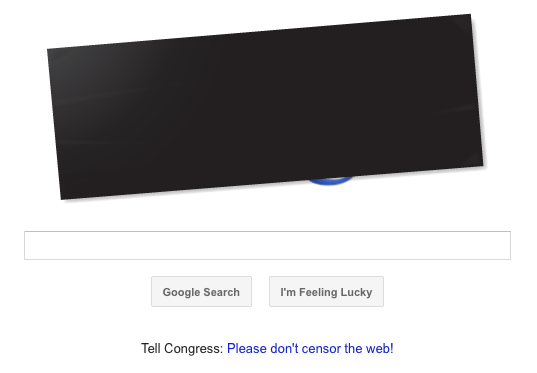
This past Wednesday, the world went dark. Quiet. Well, part of it anyway. If you’re reading this article I’m going to assume you visited at least one of the 115,000 websites that had made alterations to their frontpages in a “blackout” protest against the Stop Online Piracy Act. For Wikipedia, it meant displaying a mostly black page with the Wikipedia logo and an explanation of the ramifications of the bill. While some sites went for similar service-outages, others made small changes to raise awareness. Google simply put a big black box over the logo on its homepage. Participation hit every corner of the web, from content aggregators like Reddit to the porn networks. It seemed like everyone was opposed to the bill, even if just for a day. I thought it must be a fluke.

It wasn’t. Millions of people signed an anti-SOPA petition that Google had put together, and that was just one petition. Several sites held similar petitions and email drives, all of which reported hugely successful numbers. Still, the biggest number on the day of the blackout was eighteen. Eighteen is the number of Senators who changed position on the bill. Changed. In some ways that’s an inspiring figure – it’s fantastic to see that activism can produce change. On the other hand, it’s more than a little disconcerting that people in office were ready to pass a bill that could have such a negative impact on the most valued aspects of the web, namely that it is free and open.

Wednesday wasn’t an all-out victory over thoughtless legislation against the internet. The day also saw the US Department of Justice seize and shut down file-sharing site Megaupload. I’m not going to claim that the site hasn’t been involved in any criminal activity — it very likely has — but as several other sites have mentioned, the indictment has a few inconsistencies. In one instance, the indictment charges that “a member of the Mega Conspiracy made a transfer of $185,000 to further an advertising campaign for Megaupload.com involved a musical recording and a video.” That seems not only within the confines of the law but daily business practice. As Ars Technica points out, “When Viacom made many of the same charges against YouTube, it didn’t go to the government and try to get Eric Schmidt or Chad Hurley arrested.”

That’s where Anonymous came in. You knew they wouldn’t stay out of this one. After Megaupload went down, the hacker collective organized DDoS attacks against just about everyone involved in the Megaupload case, including the DoJ, the MPAA, and the FBI. In short, Anonymous took a piss all over the good vibrations of the blackout, and certainly the goodwill of anyone who may have been on the fence about the whole SOPA thing. It goes without saying that Anonymous hurt the conversation just as much as the blackout may have added to it, and that’s not something lawmakers will soon forget.

This is why I think the blackout’s effort to kill SOPA could still be a “maybe.” While the bill does look like it has been pulled off life support, the Megaupload indictment and the Anonymous attack stand as two steps back after that one big step forward. I’m hoping the internet pulls through, but I’m not nearly as confident as I was Wednesday night.

SOPA inspires widespread web activism

Censored

I’ve been hesitating to write about SOPA for a few reasons, but mainly for the fact that there are a number of far more knowledgeable individuals writing about the topic. I knew I had something though when web users started targeting companies that support the SOPA bill. The most recent wave of companies to renounce their SOPA ties include Sony, Nintendo, and Electronic Arts. The movement didn’t start there, though. It started on Reddit as a force against GoDaddy, the popular domain name registrar. The social content site didn’t stop there, though. They’re also going after legislators who favor the bill, like Wisconsin representative Paul Ryan.

We’ve seen focused activism from the internet before, but never quite on this scale. In just a couple of days GoDaddy lost more than 40,000 domains and, although hard statistics are tough to nail down, something to the tune of $500,000. That’s not exactly small money. Then again, roughly the same number of people registered new domains in the same time frame, so it’s difficult to say just how much of an effect the movement will have on the domain registrar.

It is having an impact on the SOPA bill and the bill’s supporters, though, as evidenced by the aforementioned media companies’ stance change and the impact on Paul Ryan’s campaign. That’s not to say web activism is without its flaws. In another recent news story, Redditors rallied against Ocean Marketing’s Paul Christoforo, who horribly mismanaged one customer relationship over email. Unfortuntely the company that hired Christoforo for marketing was caught in the crossfire and took a lot of negative press on Amazon and other review sites.

I find this type of mistargeted web activism just as disconcerting as I find the SOPA activism heartening. SOPA is a terrible idea, supported for the most part by people who don’t understand the way the internet works today. But so much of the experience on sites like Reddit revolves around feeling like a part of the collective “we” that people often get caught up in the movement without considering where the gun is being pointed.

Lamar Smith

I do, however, find it difficult to hold activist groups to such a high standard without doing the same with the politicians crafting this legislation. Lamar Smith, who wrote the SOPA bill, said the following about Reddit:

“It’s a vocal minority. Because they’re strident doesn’t mean they’re either legitimate or large in number. One, they need to read the language. Show me the language. There’s nothing they can point to that does what they say it does do. I think their fears are unfounded.” A simple look at the GoDaddy numbers could show anyone just how legitimate a force sites like Reddit can be, to say nothing of the fact that Smith clearly doesn’t understand how vague language in a bill like SOPA can affect its interpretation down the road.

Microsoft dropping CES – part of Steve Jobs’ legacy?

Steve Ballmer.

Earlier this morning, Microsoft made waves by announcing that it would be pulling out of the Consumer Electronics Show. The announcement was made by Frank Shaw, Microsoft’s head of communications, on the company blog. CEA, the organization that runs CES, claims the opposite, that they chose to give Microsoft the boot. In any case, this is a pretty serious blow to the trade show, and it points to the growing sentiment that trade shows have lost their relevance. As I’m sure some of you remember, Apple did essentially the same thing when it backed out of MacWorld in 2008.

Really, it doesn’t much matter who dropped whom; the end result is the same. CES just took a huge hit, and it’s a hit the CEA should have seen coming. For my part, I’m willing to bet Microsoft backed out. As the company stated, their product releases haven’t lined up with CES keynotes, which is certainly true. There was this other company that held its own keynotes for major product releases, where it would show off finalized versions of products that were ready to ship the same day. You know, that company with the second largest market cap in the world. I’m sure you know who I’m talking about.

Also, as the CEA, why kick Microsoft off the keynote? Who will take their place? Remember, this is the CES. This isn’t a developer’s conference. There won’t be major web properties making keynotes for CES. So who fills Microsoft’s space? More importantly, who forks over the cash to do so knowing the CEA may give them the boot next year? No one. That’s who.

If anything, Microsoft is trying to take control of its hype cycle, in exactly the same way Steve Jobs took control of Apple’s. There is one key difference – the products. Microsoft hasn’t gotten into the hardware game, which makes a product keynote much duller than the Apple counterpart. So much of Apple’s product launch success is tied into showing off a complete product. Microsoft can’t do that, at least not without the help of manufacturers, and manufacturer issues remain a huge source of complaint against Microsoft products. Still, I think moving to Microsoft-sponsored events gives the company a chance to more closely connect with its own fanbase, which Microsoft could really use.

The idea that the CEA would kick Microsoft just makes no sense. Trade shows have been losing traction for years. The last thing the CES needs is a disappearing act from one of the biggest draws for the show.

« Older posts Newer posts »

© 2025 Bullz-Eye Blog

Theme by Anders NorenUp ↑