Whether you use them for GPS fitness and nutritional intake information, physical activity and life sign monitors, or merely to combine all that you love in your smartphone in something compact, stylish, and wrapped around your wrist, wearable gadgets are only now beginning to captivate public attention in dramatic ways. With untold health-related and even virtual reality-based technologies on the horizon, it’s time for your company to get ahead of the curve and start investing in wearable technology in a major way.
As can be gleaned from this graphic, the data sent and received by wearable devices around the world is anticipated to increase (and almost double) in each year from now until the end of the decade. The market for wearable tech is estimated to reach close to 13 billion dollars per year by 2018, and according to Forbes, over 70 percent of young adults aged 16 to 24 desire some form of wearable tech. Just as mobile applications emerged, then irrevocably changed the way customers interact with brands, wearable technology is set to make a profound and fascinating impact on popular culture, consumerism, and lifestyle branding in the near future.
Sam Rockwell, Rosemarie DeWitt, Jared Harris, Kennedi Clements
Gil Kenan
“Poltergeist” is the worst kind of remake. Director Gil Kenan’s film is neither terrible nor good, but rather flat-out uninspired. This is a remake that brings nothing new to the table. Instead of updating the classic 1982 film, it’s a stale and safe retread. The story is almost exactly the same, and although most horror remakes don’t usually stray too far from the source material, screenwriter David Lindsay-Abaire (“Rabbit Hole”) hardly ever makes this version feel fresh. Beat by beat, “Poltergeist” is a lame cover song.
After falling on hard times, Eric Bowen (Sam Rockwell) has to move his family – his wife, Amy (Rosemarie DeWitt), and their three children – to a cheap neighborhood. The neighborhood is actually quite nice from the looks of it, but there’s a catch: the house they bought is built on an old graveyard, and the bodies in the ground rise up to terrorize the Bowen family. After the abduction of the Bowens’ youngest daughter, it’s obvious why the family has to stay in their haunted house – they can’t call the cops or just leave her there – but this is still a horror movie where characters make incredibly stupid mistakes, and these decisions never come across as believable character traits or flaws, but instead, cheap tricks to achieve scares or move the plot along.
The film mostly consists of expected jump scares. Kenan and his DP, Javier Aguierresarobe, try to build an unnerving atmosphere with roaming camerawork, but they never build any real tension. Technically speaking, their work is more than competent, but none of their aesthetic choices ever add up to more than a few pretty frames, all serving a lifeless purpose. The third act comes close to conjuring up some scares, but by that point, it’s impossible to get invested in anything that’s happening on screen.
On a trip to Europe during the years 1872 to 1873, a 26-year-old colonel from Kentucky, M. Lewis Clark, visited multiple horse racing facilities in England and France. He also met with European horse racing leaders, including Vicompte Darn, French Jockey Club vice president, and Admiral Rous of England. Clark wanted to create a jockey club in Louisville, for horse racing. He returned home and created the Louisville Jockey Club and Driving Park Association in 1874.
After selling subscriptions for $100 each to 320 people, he leased 80 acres of land from his uncles, John and Henry Churchill. Clark opened the famous Churchill Downs horse track, along with a grandstand, a porter’s lodge, a clubhouse, and six stables, in 1875. Nearly 20 years later, the Louisville Jockey Club appointed a new president, William F. Schulte, who constructed a grandstand featuring the beautiful twin spires that are the symbols of the Kentucky Derby. In 1903, after 28 years in business, Churchill Downs finally turned a profit.
“Fin de siècle” is French for “end of the century, which means that we’ve all missed our opportunity by 15 years to have a Fin de Siècle at the most appropriate point possible, assuming we were old enough to drink in 2000. Or, if you want to look at it the other way, we’ve all got 85 years to work on preparing the perfect Fin de Siècle in time for 2100.
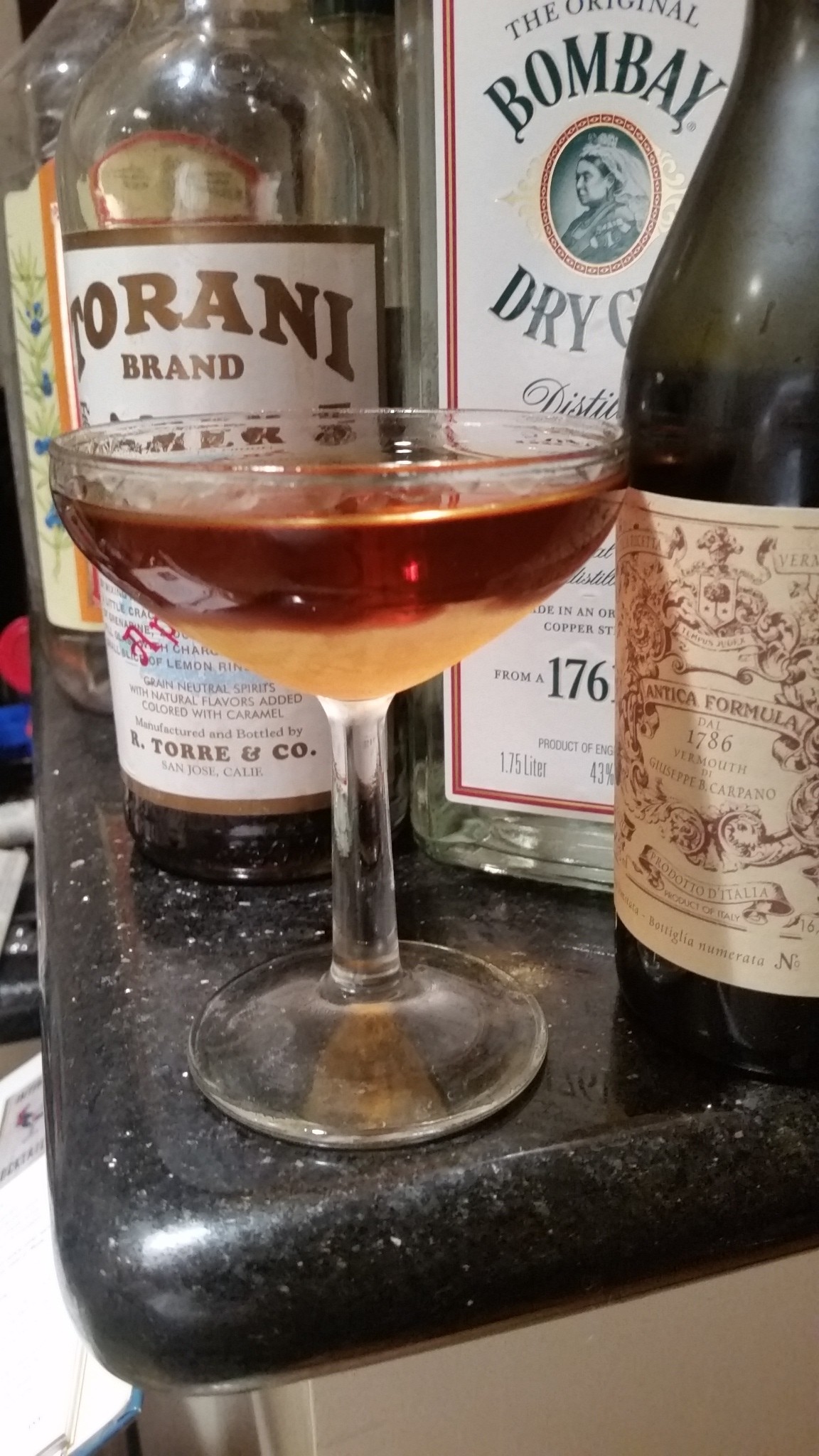
The truth is, however, that the real roots of this post go back not to Y2K but to last week. My copy of Ted Haigh’s Vintage Spirits and Forgotten Cocktails having been destroyed by a backed-up sink…yes, I leave cocktail books on the sink sometimes and, yes, I’m paying the price…I found myself seeing a number of somewhat similar cocktails in Robert Hess’s accurately named The Essential Cocktail Guide. Like last week’s drink, today’s drink contains sweet vermouth, orange bitters, and Torani Amer, substituting for Amer Picon — easily the most commonly called-for modern day cocktail ingredient that you can’t find anywhere in North America.
The main difference, aside from the proportions, is that our base spirit is changed out from whiskey to gin. The result is a bit lighter and drier, but no less tasty and sophisticated.
The Fin de Siècle
1 1/2 ounces gin
3/4 ounce sweet vermouth
1/4 ounce Torani Amer (or Amer Picon, if live in Europe or own a time machine)
1 dash orange bitters
Combined all ingredients in a cocktail shaker or mixing glass with plenty of ice. Stir vigorously — or shake, gently, if you’re feeling rebellious — and strain into a chilled cocktail glass. Toast anything that has come to conclusion or shortly will, including your tasty Fin de Siècle. Nothing lasts forever, after all, least of all a good cocktail.
*****
I saw a few recipes online for this that mentioned Plymouth Gin, but most people seem to use your more garden variety London Dry style gin. I used premium (but I guess not super premium) Bombay Dry Gin and good ol’ value-priced Gordon’s Gin, both with results that were more than satisfactory.
I actually found that,much more than with the gin, my choice of sweet vermouth made a far more dramatic difference in the flavor. I was very happy with my Fin de Siècle when I used Noilly Pratt — my personal default sweet vermouth in slight preference to Martini or Cinzano. Still, there was no topping the slightly bitter, almost chocolate-like undercurrents of Carpano Antica; sometimes you just can’t argue with the cocktail snobs. If you want a sweeter drink that’s nevertheless not too offensive, I had decent luck replacing Torani Amer with Amaro CioCiara, suggested by some as another Amer Picon substitute.
Finally, yes, you can shake this drink but that’s not my preference this time around. For starters, this is second cousin to a gin martini. (We’ll be getting to it’s first cousin very soon). I really do think there may be something to the idea that shaking can “bruise” gin, i.e., add a slightly unpleasant bitterness. Mainly, though, I don’t think the additional water/ice crystals that shaking generates really flatters the Fin de Siècle. I think this may be a drink that wants to be cool, but not ice cold.
Now, have a great Memorial Day weekend. Maybe it’s a good time to remember what life could be, if only we were all nice enough and smart enough.
Everyone is a beginner at some point in their life, we all have to start from scratch in so many of the things which later come naturally to us. Perhaps the biggest and most important example comes with driving.
It’s entirely natural to feel nervous when you’re a learner and even when you first take to the roads by yourself. Even instructors were beginners once and they probably all had their own nervous starts to their driving career.
Consider these top tips from the pros to help you become a confident road user…
There’s no shame in failing
Many candidates do not pass at the first try, and there’s nothing wrong with that. There’s always something good you can take away from the experience: you’ll know what to expect next time, and you’ll know which aspects of driving you can practice more on. Your examiner will debrief you at the end of the test and help you understand where you can improve. Some of the best pros failed first time – it’s not a bad thing if you learn and improve.






 “Fin de siècle” is French for “end of the century, which means that we’ve all missed our opportunity by 15 years to have a Fin de Siècle at the most appropriate point possible, assuming we were old enough to drink in 2000. Or, if you want to look at it the other way, we’ve all got 85 years to work on preparing the perfect Fin de Siècle in time for 2100.