


Tag: Michael Keaton (Page 1 of 2)

Movie Review: “Spotlight”

Starring
Mark Ruffalo, Michael Keaton, Rachel McAdams, Brian d’Arcy James, Liev Schreiber, John Slattery, Stanley Tucci
Director
Tom McCarthy

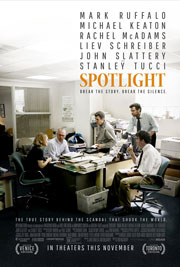
Writer/director Tom McCarthy’s reputation took a pretty hard hit following the release of his abysmal fantasy-comedy “The Cobbler,” but he’s quickly redeemed himself with “Spotlight,” an excellent, no-nonsense newspaper drama that falls closer in line with his previous work. It also happens to be one of the finest movies of the year and a safe bet for a Best Picture nomination. Though the film is fairly low-key for a potential awards contender, “Spotlight” relies on some top-notch acting and writing to recount the fascinating true story about a group of journalists who lifted the lid on a massive child molestation scandal within the Boston archdiocese that changed the way we looked at the Catholic Church forever.

Set in 2001, the movie begins with the arrival of the Boston Globe’s new Editor-in-Chief, Marty Baron (Liev Schreiber), an outsider from Miami who was brought in by the newspaper’s parent company to help shake up the newsroom and stop the leak in the dwindling subscriber base. When Marty takes an interest in a recent column about a local priest who was accused of sexually abusing children in his parish, he convinces editor Walter Robinson (Michael Keaton) – who leads the four-person investigative team (played by Mark Ruffalo, Rachel McAdams and Brian d’Arcy James) known as Spotlight – to drop what they’re doing and discreetly poke around to see if there’s more to the story. Robinson reluctantly agrees, but is skeptical that they’ll find anything of substance. As the team begins to dig further into the list of allegations, however, they expose a decades-long cover-up that’s bigger and more far-reaching than any of them could have possibly imagined.

Continue reading »

Movie Review: “Minions”

It’s easy these days to take for granted the influence that Pixar has had on storytelling for animated films in particular and child-friendly entertainment in general. Prior to the release of “Toy Story” in 1995, there was no guarantee that adults would be entertained at all by a child-friendly film, never mind be entertained as much as the kids were (even Pixar’s now-parent company Disney was guilty of that), and in fact, most movies didn’t even bother pretending to appeal to both kids and adults. As Exhibit A, I submit 1994’s “Monkey Trouble,” starring a pre-“American Beauty” Thora Birch. Nobody likes this movie.

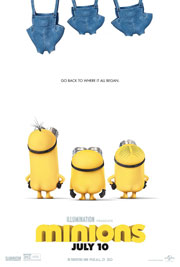
Pixar destroyed the notion that animated movies were simply kids’ stuff, and made films that were literally fun for the whole family. “Minions,” on the other hand, is a throwback of sorts to the pre-Pixar era, the movies that make a couple of dated references to give the parents a chuckle, but are otherwise devoid of a single plot piece or angle that would engage anyone from tweens up. In fact, the movie has no story at all. It’s just one ridiculous setup after another, and none of it makes any sense, but that’s almost beside the point; the minions, much like the “Penguins of Madagascar,” are simply funnier in small doses.

The opening credits show the evolution of the minions from the dawn of time, gleefully following behind the biggest fish in the sea and then land animal, as Geoffrey Rush gently explains to us that their life’s purpose is to serve the world’s most despicable creature (more on that later). That creature changes a number of times over the years, but after a mishap involving a certain vertically challenged army general, the minions go into hiding…and completely lose their sense of purpose. Minions Kevin, Stuart, and Bob dare to seek out a new evil ruler, and after a long journey lands them in New York (it is now 1968), they have found their new boss: Scarlet Overkill (Sandra Bullock), the most villainous villain alive. The minions impress her, and she hires them for a job: steal the crown of Queen Elizabeth (Jennifer Saunders, holler!). At this point, the film’s screenwriter presumably fell asleep for weeks on end, and his screenwriting software finished the job.

Continue reading »

Movie Review: “Birdman or (The Unexpected Virtue of Ignorance)”

Starring
Michael Keaton, Edward Norton, Emma Stone, Zach Galifianakis, Naomi Watts, Andrea Riseborough, Amy Ryan
Director
Alejandro González Iñárritu

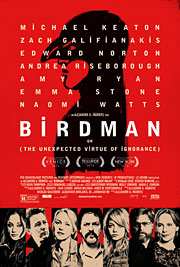
Alejandro Gonzalez Iñarritu was part of the Mexican Invasion that took Hollywood by storm in the early naughts alongside such visionaries like Guillermo del Toro and Alfonso Cuarón. But after his little-seen 2010 drama “Biutiful,” he went on an unexpected sabbatical that left many wondering if he’d ever return. Iñarritu spent the last four years licking his wounds over the mixed reception of that film (as well as globe-trotting Oscar bait “Babel”), but he’s officially back with what’s arguably his best movie to date: “Birdman or (The Unexpected Virtue of Ignorance),” a daring piece of filmmaking that’s as refreshingly original as it is wildly ambitious. The movie doesn’t always work – in fact, it’s sometimes as messy as the characters that inhabit it – but it’s also the type of magical cinematic experience that, just like fellow countryman Cuarón’s “Gravity,” you can only gaze in childlike wonder as it unfolds before you.

Michael Keaton stars as Riggan Thomson, a washed-up actor best known for playing a superhero called Birdman in a series of successful Hollywood blockbusters. Desperate to revive his career and earn a little credibility in the process, Riggan mounts an adaptation of the Raymond Carver short story “What We Talk About When We Talk About Love” on Broadway. When one of the actors is injured in a freak accident, Riggan’s indebted co-star, Lesley (Naomi Watts), recommends her boyfriend and theater luminary Mike Shiner (Edward Norton) as a last-minute replacement. There’s no denying that Mike is a talented actor, but his unconventional methods lead to a clash of egos between him and Riggan, and with only days to go until opening night, the whole production becomes in danger of shutting down before it even begins – especially if the cynical and malicious voice in Riggan’s head (a manifestation of his Birdman alter ego) has anything to say about it.

Continue reading »

The Light from the TV Shows: A Chat with Pam Grier (TV One’s ‘Unsung Hollywood’)

Fans of TV One’s documentary program Unsung, which shines the spotlight on performers whose mainstream profiles aren’t as substantial as they perhaps out to be, will be pleased to learn that the network is branching out with the series, expanding its coverage beyond the world of music and into the field of acting. Tonight marks the premiere episode of Unsung Hollywood, which kicks off with a look at the life and career of Pam Grier, and Bullz-Eye was fortunate enough to be able to sit down with Grier and discuss the episode and how it came about while also chatting a bit about her career…but without giving away too much about the program, of course.

Pam Grier as Kit Photo: Max Vadukal/Showtime Photo ID: LW3_21D-05

Bullz-Eye: How did you find your way to Unsung Hollywood? Did they pitch you on the idea?

Pam Grier: I had turned them down several times, because I wasn’t interested, but then I saw one of their episodes. My mom was so enthralled by one of the shows they had done on musicians – they did an excellent job – and she said, “I didn’t know that!” And, of course, no one knows what inspired the music and the tenacity of people to get their music played and all that except for the musicians. So we talked, and they said what they were going to do, and I said, “Okay, but you know it’s very difficult to get photographs.” Because as I learned from doing my book (Foxy: My Life in Three Acts), you have to have the rights if someone owns the photographs, and if someone else is in it, you have to get the rights from those people.

I said, “I don’t know if I can do that, because you’re going to get maybe five pictures, because a lot of people do not want to participate.” So I said, “I don’t want to marginalize it, but I can only give you so much, and I don’t know when I can do it.” But they kind of gave me an outline, and I said, “Oh, I think we can do this…so I just have to find the time!” And I did. And I think they did an excellent job.

Continue reading »

Movie Review: “RoboCop”

Starring
Joel Kinnaman, Gary Oldman, Michael Keaton, Abbie Cornish, Jackie Earle Haley, Samuel L. Jackson
Director
Jose Padliha

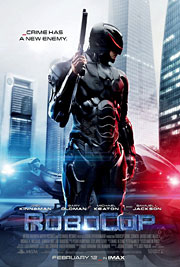
At the rate that Hollywood is plowing its way through Paul Verhoeven’s sci-fi catalog, you’d expect Vegas bookies to start slashing the odds on an eventual “Starship Troopers” remake. Though it’s only been two years since fanboys got their panties in a bunch over Len Wiseman’s “Total Recall” reboot, many of those same fans have been dreading the release of the new “RoboCop.” It will probably come as a surprise, then, that the film isn’t nearly as bad as people feared it would be. In fact, it boasts a better cast, better effects and a better story, even if the 1987 original – which is admittedly pretty cheesy by today’s standards – is still the better movie. So why bother with this remake? For starters, because it’s not really a remake at all, instead taking the basic premise and carving its own path that falls more in line with current politics.

The year is 2028, and with the exception of the United States, the rest of the world is now policed by a robot military force operated by technology giant OmniCorp. The government has blocked the use of robots in the U.S. due to the belief that they can’t be held accountable for killing, so OmniCorp CEO Raymond Sellars (Michael Keaton) decides to give the American public someone they can identify with by putting a man in a machine. And it’s not long before they find the perfect subject when Detroit cop Alex Murphy (Joel Kinnaman) is critically injured in a car bombing after he’s targeted by a local drug kingpin. With the help of Dr. Dennett Norton (Gary Oldman), a pioneer in robotic prosthetics, Sellars convinces Alex’s wife, Clara (Abbie Cornish), that the procedure is the only way to keep him alive. But the very thing that makes Alex unique (his emotions) also affects his performance in the field, and when Norton tries to counteract that by programming his brain to act more like a machine, Alex’s human side begins to fight back as he investigates his own murder.

Continue reading »

« Older posts

© 2025 Bullz-Eye Blog

Theme by Anders NorenUp ↑