Tag: cocktails (Page 16 of 62)

Drink of the Week: The Quaker’s Cocktail

The Quaker's Cocktail.It’s probably not a big surprise that someone who writes a cocktail blog would be a nonbeliever, although there’s also no denying the connection between various groups within the Judeo-Christian tradition and demon heavenly alcohol. Think of your Benedictine  and Chartruse monks, and, Lord help us, the Manishewitz that introduced me to recreational mind-altering substances one Passover night long ago.

Yet, this agnostic secular Jew with occasional pantheistic fantasies — on a dark night of the soul, I might cry out for the help of the Force or whatever it is that Mr. Spock communes with — has nothing but good feelings about the Society of Friends, better known as the Quaker faith. Sure, it gave us Richard Nixon, who clearly was not overly governed by its pacifistic teachings, but all the Quakers I’ve met personally have been the kind of mighty nice folks who occasionally give Christianity a good name.

I’ve also had nothing but good feelings about this little known concoction, a delightful exercise in friendly persuasion I stumbled over in The Savoy Cocktail Book. Like most of the Quaker folk I’ve come across, this is a smart, simple little drink that’s tasty yet, for a cocktail, oddly wholesome. It also embodies the Society of Friends’ admonishment that attitude adjustment only be done in moderation. This is a drink that is strong enough to be relaxing, tasty enough to be satisfying, but also one that is relatively low calorie and not too big in the buzz department if you keep it to just one.

The Quaker’s Cocktail

3/4 ounce brandy
3/4 ounce light rum
1/4 ounce fresh lemon juice
1/4 ounce raspberry syrup

Combine the liquids and syrup in a cocktail shaker with plenty of ice. Shake vigorously, and strain into a chilled cocktail glass. Contemplate the lovely flavors that _________________ graced our planet with and maybe even think about the many reasons why it would really be a far better place if we could figure out a way to study war no more.

*****
It’s a fairly frequent experience with me that I love a drink the first couple of times I have it, and then find myself less entranced over time. This actually didn’t happen with the Quaker’s Cocktail. Indeed, every time I tried the drink my feelings about it’s near perfect balance of sweet and tart flavors only grew more positive. Results were consistently delightful with both inexpensive Reynal and even cheaper Martell brandy.

My rums ran a broad gamut and while higher end products such as Myers Light Rum, Papa Pilar’s Blonde Rum, and Bacardi Maestro de Ron all yielded outstanding results, the same could also be said for plain old Bacardi light rum. I also tried both Torani raspberry syrup and the more old fashioned and viscous Smucker’s style. The Torani version distributed the sweetness a bit more efficiently, but both were dandy.

All I can really say is that this is good drink that should be a lot better known…much as I really wish there were as many members of the Society of Friends as there are, say, Southern Baptists. Really, I have no idea if many actual Quakers have ever enjoyed a Quaker’s Cocktail, but I really think it would deepen anyone’s appreciation of creation.
Drink of the Week: The Corpse Reviver #3

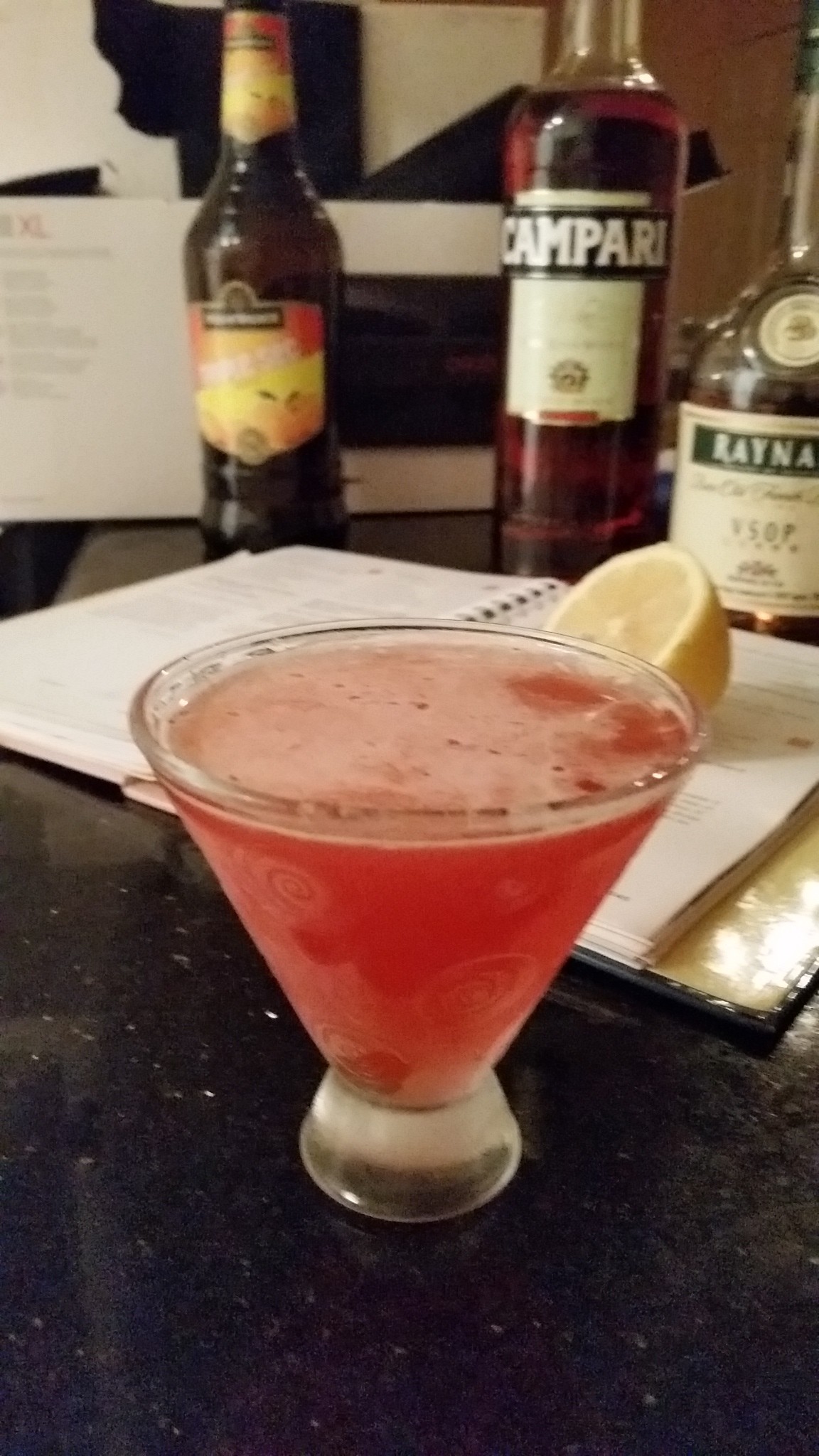
the Corpse Reviver #3.Halloween is just about here and I can’t think of a better time to do yet another in the long series of drinks known as Corpse Reviver. This is my fifth entry in what amounts to a veritable cocktail subgenre — you can see the others here, here, here, and here — and also the third in a recent series of drinks stolen straight from Robert Hess, video star and author of “The Essential Bartender’s Guide.” (See the other two here, and here!)

The Corpse Reviver #3 is perhaps the least well known drink bearing the name, which originally meant that these were originally considered to be appropriate morning hangover “cures.” Indeed, Hess on his Drinkboy website admits that he isn’t even sure where he first saw this recipe. It’s not in “The Savoy Cocktail Book,” which features three other corpse reviving recipes. You will also find radically differing drinks,also claiming to be Corpse Reviver #3 around the Interwebs.

I might eventually get around to looking at those, but this recipe is the one that got my attention, and I think it’s pretty dandy. It’s  reddish, on the sweet side, but balanced out with bitter and tart flavors, so I think it’s a pretty appropriate Halloween treat while your watching scary movies, trying not to be embarrassed about your “Sexy Donald Trump” costume, or what have you.

The Corpse Reviver #3

1 ounce brandy
1 ounce Campari
1 ounce triple sec, Cointreau or Grand Marnier
1/2 ounce fresh lemon juice

Combine the ingredient in a cocktail shaker, shake very vigorously, and strain into a well-chilled cocktail glass. If it turns out well, savor the drink. After all, corpse revivers that actually work are not in abundance.

****

This is a drink that can work really well, but watch your choice of ingredients. I really enjoyed my Corpse Reviver #3 when it was made with Reynal brandy, my not-quite-Cognac default brew. I experimented twice with an Armenian brand that’s easy to find in my North Hollywood neighborhood, Ararat. It seemed fine the first time, but a second experiment found that the more complex, harsher and sweeter brew threw off the balance of the drink.

I had more luck making high end substitutions for the triple sec called for in Hess’s recipe. Both Cointreau and Grand Marnier added a bit of additional bitterness to the drink that I think a lot of people would prefer and I certainly didn’t mind.

In any case, every version of the drink  I made came out nice and reddish and, when shaken enough, really cold which I think is kind of essential for this one. As for being a hangover cure, I wouldn’t know, though let’s say I have my doubts. Now, excuse me while I try to revive the corpse of classical Hollywood horror.

James Bond: The Spectre of a Boozehound

bond

007 is many things – a near superhero, seemingly unafraid of death or anything else; a relentless womanizer, though occasionally heartbroken; and, of course, an inveterate boozer. One part connoisseur, one part super-functional alcoholic, there was a time when he appeared to never let the opportunity pass to show off his knowledge of all types of fermented beverages.

As of this writing, just a week before the worldwide release of the 24th canonical James Bond film on November 6, we don’t know for sure what JB will be imbibing in his newest adventure, although reports of an olive brine-infused dirty martini made with Belvedere Vodka have been circulating. We can tell you that, while a couple of true loves have come and gone through James Bond’s world over six decades of novels and films, his deep and intense relationship with booze is likely to remain eternal. What follows is a brief education on Mr. Bond and his deeply committed relationship with demon alcohol.

Shaken, not stirred

Ask any cocktail snob and they will tell you that, generally speaking, cocktails that do not feature fruit juices should be stirred, not shaken. Shaking is said to harm the taste of gin and “cloud” drinks  of all types with ice crystals, making them a tad less pretty. James Bond’s creator, Ian Fleming – a snob of the highest order but not exactly a cocktail snob in the modern sense – simply detested stirred drinks and wanted them all shaken, all the time. So, when Bond ordered a martini, it was always shaken and never stirred. Personally, we think he’s wrong about gin martinis but right about vodka martinis.

The 21st century Bond derided the shaken/stirred controversy in the funniest line in 2006’s“Casino Royale” (“Do I look like I give a damn?” said a thoroughly stressed out 007 to a clueless barman.) He does, however, look on admiringly watching a shaken martini being made in 2012’s “Skyfall.”

Continue reading »

Drink of the Week: The Delmonico

Image ALT text goes here.The Internet tells us that there are over 611,000 full service restaurants located in the United States. We’ve all grown-up with the idea that, pretty much wherever we are, there will always be a meal, and perhaps a bit of relaxation, to be had at a sit-down establishment of some sort. That wasn’t always so.
Cooking for other people has to be one of the world’s oldest professions, but the restaurant somewhat as we know it is a relatively modern invention going back only as far as 18th century France. The identity of the first true restaurant to open here in the New World nation of the United States is probably a mystery, though the old Delmonico’s in New York claims the mantle of the first restaurant allowing customers to order items a la carte, as opposed to getting an entire meal for a fixed price. While countless establishments in New York and nationwide still bear the Delmonico’s name and serve alleged representations of the famed Delmonico steak (whatever that is), there is a lot of confusion about what the name “Delmonico” actually signifies. There is slightly less confusion about exactly what is or was the restaurant’s presumed house cocktail. Still, I can’t tell you who invented the Delmonico, but I can tell you that I’m stealing my recipe from the same place as last week.

This is a fairly serious drink for fairly serious drinkers. Not a lot of sweetness, but — as Robert Hess points out — quite a few botanical flavors courtesy of gin and both sweet and dry vermouth, plus a bit of grounding from brandy. It’s a nice change of pace for martini lovers and others who don’t need their cocktails to envelop them in a haze of familiar flavors. In other words, it’s a drink for grown-ups.

The Delmonico

1 ounce gin
1/2 ounce brandy
1/2 ounce sweet vermouth
1/2 ounce dry vermouth
1 dash orange bitters
1 lemon or orange twist (highly desirable garnish)

Combine all of the liquid ingredients in a cocktail shaker or a mixing glass. Shake or stir according to your preference — I did it both ways — and strain into a chilled cocktail glass. Add the citrus peel and prepare yourself for an adult cocktail experience.

*****

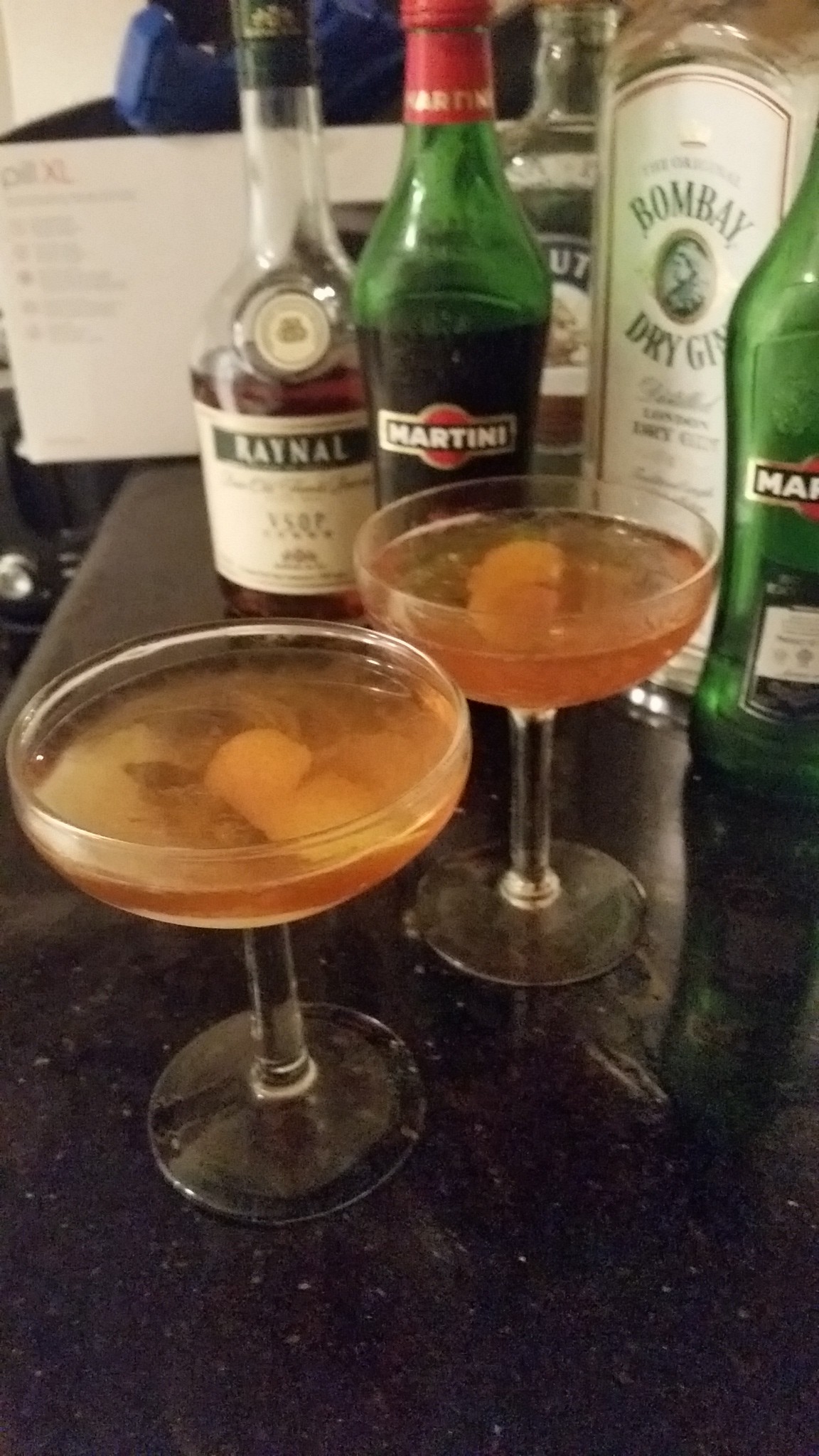
Because I didn’t feel the desire to go out and spend a bunch of cash on delicious high-end vermouths I sensed might not work anyways, I stuck to good old $4.99-for-a-small-bottle Martini for both my sweet and dry vermouths on the Delmonico. My brandies were Martell and Raynal — not very different. I nevertheless did try the Delmonico several times with a few different gins, both stirred and shaken. Shaking made for a more easygoing, but less interesting drink. Bombay Dry worked well — producing a very complex and adult but nevertheless tasty brew, and I suspect that Beefeater, Robert Hess’s very similar choice, would work about the same. Plymouth Gin added a slightly sweeter note and was just fine.

Still, the surprising best result turned out to be the cheapest gin I used, James Bond’s favorite, Gordon’s. It’s a nicely smooth gin that can work very well in a martini since it’s floral element isn’t overly pronounced. Here, it allows the sweeter flavors to coexist more peacefully with the remaining floral notes of the gin and dry vermouth.

Finally, David Wondrich circa 2007 has an interesting alternative take on Delmonico with slightly less gin and Angostura instead of orange bitters. It’s not bad, either.

Drink of the Week: The Captain’s Blood

the Captain's Blood.You’ve never heard of the Captain’s Blood and, until about 24 hours prior to when I began writing this, it didn’t register with me, either. I stumbled over this variation..I’m tempted to say “improvement”…on the classic daiquiri in Robert Hess’s trusty 2008 “The Essential Bartender’s Guide,” though this precise recipe is actually from Hess’s vlog.

It’s apparently a fairly old drink, and it’s name — quite probably drawn from the 1922 Rafael Sabatini pirate novel and/or its swashbuckling 1924 and 1935 film adaptations — suggests a prohibition or post-prohibition provenance. Yet, even among lost beverages, the Captain’s Blood is a bit of a dark horse. Among the better known cocktail tomes, it only appears to have shown up in David A. Embury’s 1948 “The Fine Art of Mixing Drinks.” The Embury recipe is severe indeed — the sweetest ingredient is dark rum. Fortunately, the Robert Hess version has just the right amount of sweetness.

The Captain’s Blood

1 1/2 ounces dark rum
1/4 ounce fresh lime juice
1/4 ounce simple syrup
1-2 dashes aromatic bitters
1 lemon twist (optional, but desirable, garnish)

Combine the rum, juice, syrup, and bitters in a cocktail shaker, add ice, and shake. (If you’re having a hard time measuring a mere quarter ounce, note that 1 and 1/2 teaspoons, i.e., half a tablespoon, is the same  as 1/4 ounce.) Strain into a chilled, smallish cocktail glass and add your lemon twist if you’ve got it. Try not to drink this one too quickly, as it has a lovely aroma, but it tastes good enough that you might find it gone in about 45 seconds anyway.

****

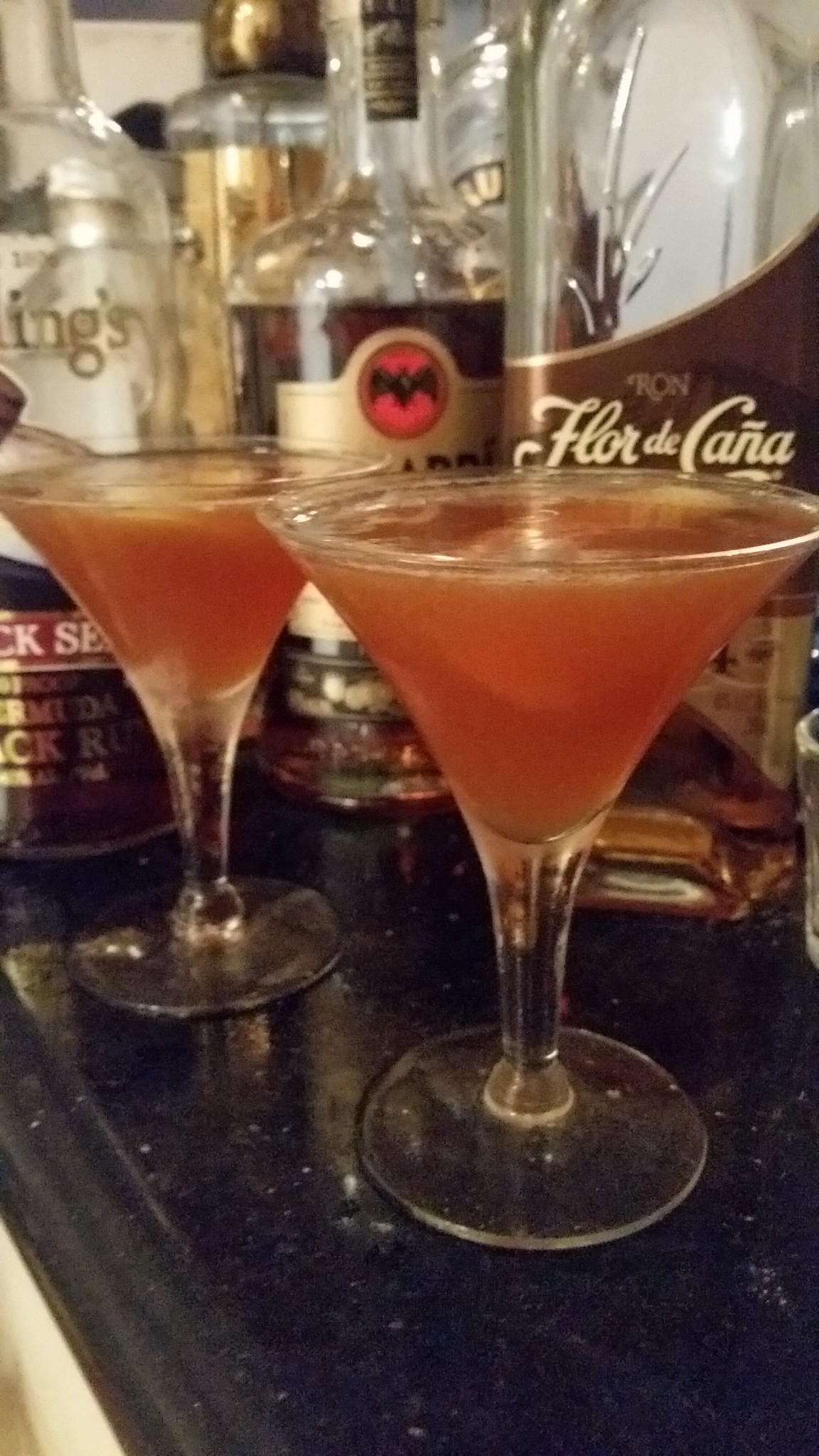
My first night out, I tried this drink with several different premium brands — Bacardi 8 (Robert Hess’s choice), Gosling’s Black Seal, and my old pal Brugal 1888, and the results were consistently very, very good. Later selections were a bit less stellar. Papa Pilar’s absolutely delicious dark rum seemed to overpower the thing while, conversely, Flor de Cana dark rum seemed a wee bit dry.

And there’s no getting around the seafaring connotations of this drink which has made it an occasional offering at tiki themed bars, though mostly in highly adulterated versions, I suspect. You can find recipes online that call for super-sweet Rose’s Lime Juice or maraschino. Who knows, they might not be bad. On the whole, however, I’m not in any mood to mess with the Captain’s Blood.

« Older posts Newer posts »

© 2026 Bullz-Eye Blog

Theme by Anders NorenUp ↑