Author: Bullz-Eye Staff (Page 5 of 303)

Three Quality of Life Improvements to Create a Distinct Home Office Setup

When you work for someone else, you’re at the mercy of their technology. They have to staff a building full of people, and they may not be hip to the latest trends in distributed computing and shared memory. They may not have ideal terminals that are responsive or offer the degree of control that you’re used to. There are security reasons for some of these decisions, but a lot of it comes down to what a company can afford. Even if the upgrade is free, as with Windows 10, IT techs still need to be paid to install the operating systems.

Continue reading »

Can Hence Disrupt the Kentucky Derby this Year?

Hence won the Grade-3 Sunland Derby ($800,000) about a month ago on March 26, but can he pull off an upset at the Kentucky Derby next month? The Calumet Farm homebred colt does have some unpredictability about him, and if you have plans to bet on the Kentucky Derby online, you should be keeping an eye out for him. Let’s take a quick look at the racehorse and some of his history to see if he really does have a chance this year.

Continue reading »

Four Car Designs That Reflect America

You can tell a lot about the past if you look at the styling of the objects made. The styling of American automobiles is a good example. Automobile designs reflect the mode and culture of the different eras they were designed in. For example, the rounded bodies of 1940s cars were a deliberate rejection of the antiquated angular designs of the 1930s cars; the elevated tail fins of the 1950s cars reflected America’s fascination with aircraft and space travel; and the beefy muscle cars of the 1960s illustrated the passion that car buyers were developing for raw performance. With help from Hoffman Automotive of Hagerstown, a local Chrysler, Dodge, Jeep, Ram dealer in Hagerstown, MD, we survey a few interesting examples of cars that really represent the feelings of the times.

1948 Tucker – In the 1930s, cars were becoming faster and more powerful, and this led to more people were being hurt and killed in car accidents. Detroit’s car makers did little to make their vehicles safer because, frankly, there weren’t federal regulations and car buyers weren’t demanding it. Then in the early ’40s, a forward-thinking automotive designer named Preston Tucker decided that he could build “a safer car” and had a hunch that it was what car buyers wanted.

In 1945, Tucker founded Tucker Motors to make his safety cars. The first step was to secure funding, and he used some rather creative techniques to do so. For example, he sold dealerships to those who wanted to carry the Tucker line, and it came with promises of tremendous profits. After monitoring this interesting sales technique for a while, the Securities and Exchange Commission (SEC) jumped in and shut Tucker down in 1948. The result was that Tucker built just 51 cars before the company went silent.


Continue reading »

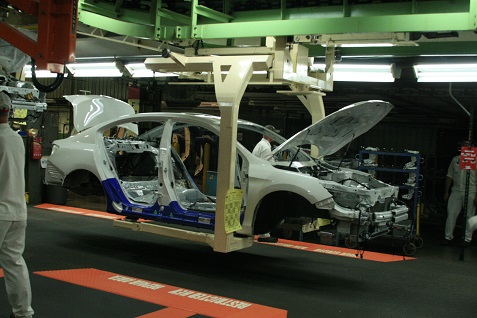
How the Assembly Line Changed Everything

One of the first major products to be manufactured via assembly line was the automobile. What many people don’t know, though, is that the assembly line did far more than speed up the production of just cars – it also created the concept of parts uniformity and interchangeability. These concepts improved the efficiency of assembly of thousands of consumer products and established the United States as the preeminent source of consumer and industrial goods during the 21st century. Let’s go back to the beginning.

Continue reading »

All About Automatics

The first transmissions were manual. This required the driver to shift between gears so that a vehicle can be speeded up or slowed down while the engine rotated within an optimum speed range. For many decades, manual transmissions were tricky to drive but good enough for most drivers. Some just never liked the coordinated shifting and clutching procedure involved, though. The car manufacturers were quite cognizant of this issue, and as a result, many were privately experimenting with self-shifting transmissions during the 1930s.

Continue reading »

« Older posts Newer posts »

© 2026 Bullz-Eye Blog

Theme by Anders NorenUp ↑