

Blog Zones
Blog Topics More Blog Zones

Justified 4.10: Get Drew

SPOILER WARNING: This post will appear following a new episode of Justified. It is intended to be read after seeing the show’s latest installment as a source of recap and analysis. As such, all aspects of the series up to and including the episode discussed are fair game.

J

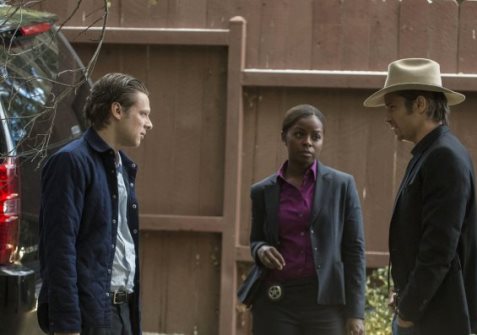
“Get Drew” is one of those episodes with a very literal title. When it begins, the word is out on Drew Thompson’s identity, and everyone’s scrambling to find him. It ends with Drew in the Marshals’ custody. Generally, that’d put an end to the chase. Generally putting the cuffs on the bad guy means the game is over, the Marshals won. But not this time, not with Drew Thompson. That’s why when the Marshals start to celebrate, Raylan remarks that, “we’re standing in a field, we haven’t done shit.” Next week’s episode will likely be very similar to this one, only now the criminal element will be scrambling to “get Drew” via the Marshals, who will be doing their damndest to “get out of Harlan alive.” Art’s speech on how “awesome” Drew is reinforces why his being in the law’s custody isn’t near enough to make Theo Tonin give up the chase:

First thing we’re gonna do is acknowledge that this guy is awesome. I mean he shoots Theo Tonin, fakes his own death in a spectacular fashion, pushes a guy out of an airplane while he’s flying it, parachutes into Harlan County with enough coke and cash to jumpstart the economy of a small country, and then he has the balls to get a job in law enforcement not once but two times, he spends a couple days riding around with you while you’re looking for him, and now he’s run off with a hooker that’s half his age. That’s some badass shit.

The thing is, the Marshals may not be the only ones trying to get to safety. When Wynn Duffy hears that the Marshals have Drew, he immediately prepares to run to Canada, which his extraordinarily uninformed henchman calls, “running like a little bitch.” The Crowders have been placed in a similar position. Theo may see them as having failed him and want them taken out both as a consolation prize and a small distraction until he can get to Drew. The Crowders and the Marshals now have a common enemy scarier than both of them put together. I foresee a temporary alliance so they can all escape with their lives. But that’s next week.

The major focal point of last week’s episode, “The Hatchet Tour,” as well as my discussion of it was the way Harlan’s past influences its present. We can see the way each and every Harlanite allows their fate to be determined by the actions of their parents and grandparents. That theme continued in “Get Drew.”

Read the rest of this entry »


You can follow us on Twitter and Facebook for content updates. Also, sign up for our email list for weekly updates and check us out on Google+ as well.

WATCH THIS!

Justified 4.09: The Hatchet Tour

SPOILER WARNING: This post will appear following a new episode of Justified. It is intended to be read after seeing the show’s latest installment as a source of recap and analysis. As such, all aspects of the series up to and including the episode discussed are fair game.

J

The season’s big mystery has officially been solved. The answer to the question of Drew Thompson’s identity has been answered: It’s Sheriff Shelby Parlow, hiding in plain sight this whole time. At first I was a little disappointed in this discovery. In part because I hoped all those hints last week were red herrings. It seemed silly to devote one episode to the audience figuring things out and another to having the characters do it. I felt like the writers were just serving up more delays to stretch out a storyline that really isn’t big enough to command a whole season, because it’s the best they could come up with. We know who Thompson is, all that’s left is to cuff him, and they’re going to drag out that out for four more episodes? I felt cheated.

Then, something occurred to me which put it all in perspective. This season wasn’t actually about figuring out who Drew Thompson was. Not really. As I’ve mentioned, one of the big themes has been Raylan’s preparing for fatherhood and Arlo’s influence on just what kind of Dad he’ll be. What I didn’t put together until this week, however, was how that was actually a smaller part of another, greater theme, perhaps the season’s most significant. And that’s how the history of Harlan, its people and their ancestors, impacts its future. The Arlo/Raylan/fatherhood idea is just a smaller piece of that greater puzzle.

The biggest sign pointing us in the direction of this idea was Raylan’s recollection of an old feud between the Givens and another Harlan clan. The way Raylan remembers it, Arlo got pinched for assault after he beat the crap out of a man named Johnson McClaren because his dog was shitting on their lawn. The thing escalated, the Givens are gearing up to go after the McClarens and calling on their allies, the Crowders, to go after the Sorensens, who were kin to the McClarens. That is, until Raylan’s mother Frances called a meeting for all the clans to get together and hash it out. Frances, who Raylan says had some French blood in her, once told her son that the term “hash it out” comes from the french word “hatchet,” like an axe, to “cut through the bullshit.”

Only, that old story didn’t really go down the way Raylan thinks it did, as Shelby points out. In truth, “the dog was incidental,” and Johnson McClaren had “verbally assaulted” his mother, making “implications around town as to her proclivities,” and pushed it too far. That’s when Arlo “saw fit to shove a pound of dog shit down his mouth.” But Frances “took the high road, called a truce, although she had every right to be affronted. Your daddy was protecting her honor.” Raylan looks at Shelby with a look of disbelief, saying “Arlo did that?” It goes against everything he believes his father to have been.

Read the rest of this entry »


Justified 4.08: Outlaw

SPOILER WARNING: This post will appear following a new episode of Justified. It is intended to be read after seeing the show’s latest installment as a source of recap and analysis. As such, all aspects of the series up to and including the episode discussed are fair game.

J

I criticized last week’s episode of Justified because it didn’t seem to bring us much closer to solving the season’s big mystery. It gave Raylan an unrelated one (alright, two) off storyline while Boyd inched towards finding Drew Thompson. Well, “Outlaw,” appears to be the writers’ forcing a collective foot in my mouth. It all but came out and said that the hard-working and dedicated Sheriff of Harlan County, Shelby Parlow, is in fact the man we’ve been looking for all along. And there he was, right under our noses.

For those that didn’t catch the hints, they came mostly during Shelby’s conversation with Ellen May about reinventing one’s self, starting over. He came home to find her digging through his ex-wife’s things, namely a necklace depicting St. Christopher, “patron saint of travelers, sailors, pilots, and bachelors.” Pilots, folks. Ellen May also happened to be wearing that ex-wife’s clothes, and remarked that they made her feel like a different person while also reminding her who she truly is. Shelby’s response? “Must’ve been a year after I first joined the sheriff’s department that I could put on my uniform without feeling like I was wearing a costume.” Now who would feel more like a fraud in a police uniform than an ex-criminal? He also says that “if you pretend to be something long enough, it’s not pretending.” In other words, at this point, he really is Shelby Parlow.

Only there’s a reason they did all that without coming out and saying it. And maybe that’s because the writers just want us to think that Shelby is Drew, just so they can pull the rug out from under us later on. Nobody greeted Shelby by saying “Hello, Drew.” I’m sure there will be a scene like that next week, whether or not it’ll be Shelby standing there when the camera flips around and fades to black remains to be seen. A couple things are holding me back from being positive Shelby’s our man. First of all, his would-be ex-wife, Eve Munro, tells Raylan she hasn’t seen Drew in 30 years, while Shelby tells Ellen May his wife left him 25 years ago. Secondly, look at all these people working so hard to protect Drew from being found out: They’re giving up deals to be moved to cushy prisons, not to mention risking (and often losing) their lives. At this point, if Shelby is Drew, what kind of power does he hold that people are willing to do so much for him? It’s not a dealbreaker, but it’s the last remaining piece of the puzzle.

Yet despite what I said last week about the downsides of the show dragging its feet with the main storyline, with all the other stuff that happened this week, the theoretical revelation of Drew Thompson’s identity almost seems like a sidenote. Because “Outlaw” gave us some great stuff.First of all, someone died. Not just some meaningless character who arrived on screen just in time to leave it, which is the style of most of the deaths in Justified. No, this was a real, major character: Arlo Givens. One of this season’s big themes has been Raylan’s preparations for fatherhood. Of course, Raylan’s relationship with his own father plays a large part in what he believes it means to be a father. If nothing else, Raylan’s got one play in his book: do the opposite of what Arlo did. But in spite of what a mean son-of-a-bitch Arlo was, fathers and sons are fathers and sons, so our badass marshal actually shed a tear! But I’m getting ahead of myself.

Read the rest of this entry »


Justified 4.07: Money Trap

SPOILER WARNING: This post will appear following a new episode of Justified. It is intended to be read after seeing the show’s latest installment as a source of recap and analysis. As such, all aspects of the series up to and including the episode discussed are fair game.

J

During the first scene of “Money Trap,” Art tells Raylan he doesn’t have high hopes about the Marshals finding Drew Thompson. What he may as well have said was that he doesn’t have high hopes they’ll find him for another another five or six episodes. When a show builds a season around a mystery, the audience knows damn well it won’t be solved until the end of the season. What separates good shows that follow this formula from bad ones is whether the audience remains entertained by the characters’ various adventures as they inch closer to their final goal as well as intrigued by each ensuing thickening of the overarching plot. As I discussed last week, Justified’s rich dialogue and colorful characters generally ensure the former is taken care of. But I have to admit the idea that saying they’re “inching” towards solving the mystery is a bit of an overstatement. “Money Trap” didn’t seem to bring us much closer to finding Drew Thompson, and the longer it takes the less inclined I am to give a damn.

Neither Boyd nor Raylan made much headway in the hunt for Drew Thompson this week. In the aforementioned opening scene, Art tells Raylan that their only leads are Arlo and former Harlan County Sheriff Hunter Moseley, both of whom happen to reside in a local penitentiary. Isn’t that convenient? Raylan is none too eager to visit his father, so when a local cop informs him his old pal Jody Adair (Chris Chalk) is on the loose, he’s happy to take a turn down distraction avenue. Raylan even admits it, saying some people “do as much as they can to avoid [their fathers].” He’s never met the woman he says it to (Adair’s ex-wife’s house sitter), yet even she immediately understands the implication, replying, “you just showed your cards.”

You’ll recall the fugitive Jody Adair as the subject of the season premiere’s crime-of-the-week plotline. This week we found out he murdered bail-bondsman Sharon Edmunds and her associate after a filmmaker friend named Kenneth (Michael Gladis) helped him escape their custody. Things happen as they often do in Justified: Raylan saves girl from criminal, criminal escapes by jumping out a window, Raylan finds criminal, Raylan shoots criminal, Raylan gets laid. It’s entertaining, but in the end that’s really all that can be said in its defense. It has exactly zero relation to the Drew Thompson mystery. Still, if you’re going to have a major character’s subplot amount to nothing but distraction, it might as well be an entertaining distraction.

It’s only at the very end of the episode, after the criminals are dead and the sex has been had, that Raylan finally gets around to visiting Arlo. He does exactly what Art suggested to him, stuffing a file to make it look like the Marshals have a lot more evidence on Drew than they do. But Arlo tells Raylan to shove it, even after finding out the “son he never had,” Boyd, has been employed by Theo Tonin to search for Drew. The last thing Raylan wants to do is delay Arlo’s execution, which is only days away, but he’s forced to play the only card he’s got: offering his daddy a deal. The Marshals know Drew’s alive and that he’s in Harlan, so they’re willing to commute Arlo’s sentence to life imprisonment and move him to a “country club jail” if he’ll just point them in the right direction. Arlo’s got no interest in that either, so Raylan leaves. But not before saying he’s “gonna be glad when [he] hears the news” that Arlo’s been executed. Even still Arlo appears unconcerned. The episode ends with him walking down the prison halls with a look on his face that could be construed as a smile. Men like Arlo are never happy to die, so he’s sure to have another trick up his sleeve.

Meanwhile, Boyd and Ava attended a swingers party at the home of another former sheriff of Harlan County, Tillman Napier. While the undertaking was ostensibly related to the main plot—they were going to “pull them old horndogs off their women, find their history in Harlan, and see which one of them could be Drew,” as Ava put it—in truth, they took distraction avenue the whole way to the swanky neighborhood of Clover Hill.

Boyd doesn’t get any closer to finding Drew this week than Raylan. He thinks there’s a chance that two or three of the rich folk at Napier’s party might be Thompson. But in the end all he’s really left with is a few more trails to sniff. The more important development of the night is Boyd finding out he’s not as high on the criminal foodchain as he likes to think. A few of the other men at the party “ask” him to kill a man named Frank Browning, and react with near disbelief when Boyd inquires as to what he’d get in return. “I think you’re missing the point,” one man responds, “your daddy got the point. Crowders do what we say.” Another interjects, “Let me be crystal clear: Kill Frank Browning or we’ll destroy you.” Men like Boyd and Arlo don’t take kindly to threats. The fact is Boyd would likely have killed the man with a smile on his face, for the right price, but being told to do one thing might just make him inclined to do another. The problem is Boyd’s got a whole lot of enemies right now, some that he isn’t even aware of yet, it might not be in his best interest to make any new ones, especially among such powerful men.

One last thing: the jig is up for Colton. Johnny finds out from Teri that Colton’s been “tweaking” and it was him who put the beating on her, not to mention that he never killed Ellen May. Teri doesn’t need to say much before Johnny’s able to put things together. Perhaps he’s smarter than we give him credit for, and much more of a danger to Boyd than we think.

Check out the preview for next week’s episode below and follow the writer on Twitter @NateKreichman.


Justified 4.06 Foot Chase

SPOILER WARNING: This post will appear following a new episode of Justified. It is intended to be read after seeing the show’s latest installment as a source of recap and analysis. As such, all aspects of the series up to and including the episode discussed are fair game.

jst_406_FootChase_0030_FULL

I praised last week’s episode, “Kin,” for returning to the formula most often employed when Justified is at its best: Boyd plus Raylan equals some captivating television. And while those two characters are the key ingredients, the same idea applies to the show in general—its greatest moments come from squeezing its wide array of colorful characters together and enjoying the results. All in all, “Kin” was going to be a hard act to follow, but I found this week’s offering especially disappointing because it quickly diverted away from that tried and true formula. “Foot Chase” seemed to set everyone off on their own individual adventures (and I do mean everyone). That’s not to say it wasn’t an exciting hour of television—as I’ve said repeatedly, if Boyd Crowder’s around count me in—but it certainly won’t be remembered as one of Justified’s best. 

With so many characters off doing their own thing, most of the episode’s dialogue can be divided into two groups: First, conversations between members of the main cast who we see interacting all the time, and second, between a single regular and various one-off or rarely recurring characters. The one exception to this, and perhaps as a result the episode’s strongest plot line, was Raylan and Shelby joining forces in the hunt for Drew Thompson.

Early on, Raylan speaks with some local cops on the scene at Josiah Cairn’s house, and he acts like his usual jerk self. When one of them asks if there’s any particular reason he’s treating them, and I quote, “like a couple of bleached assholes,” Raylan considers it for a moment and responds, “not particularly.” We discover later that the disdain likely stems from his lack of respect for Sheriff Shelby, although I doubt Raylan is self-aware enough to make that connection himself. When Shelby asks if the reason Raylan doesn’t trust him is that he thinks he’s in Boyd’s pocket, Raylan quips back, “I think Lynyrd Skynrd’s overrated; I know you’re in Boyd’s pocket.” Shelby admits that he used Boyd to get elected, but that is allegiance is and always has been to the law. It’s interesting reversal of perspective, given that Boyd would say it was in fact he that was using Shelby.

Of course, the audience knows Shelby is done being used, because we know the details of Ellen May’s disappearance. But understandably, words aren’t enough to change Raylan’s mind. So Shelby sets out to prove it to him by putting Boyd in cuffs and bringing him in for questioning. Boyd warns him of the dangers of this decision, saying, “Son, you are turning a corner you can’t walk back around.” I found two things about that line intriguing: There’s what it says about Boyd (and Walton Goggins’ performance) that he can call Shelby “son,” in spite of their actual ages, and not sound silly. Because that’s just the kind of respect Boyd Crowder commands. And there’s the fact that Shelby, who reminds us himself that he was a supermarket greeter not too long ago, is tenacious enough to turn that corner so forcefully.

Read the rest of this entry »


Justified 4.05: Kin

SPOILER WARNING: This post will appear following a new episode of Justified. It is intended to be read after seeing the show’s latest installment as a source of recap and analysis. As such, all aspects of the series up to and including the episode discussed are fair game.

J

Almost every popular television drama has that character: the breakout, the one who isn’t the protagonist but becomes a fan favorite (and thus often a big part of the show’s advertising strategy). Boardwalk Empire has Richard Harrow, The Wire had Omar, The Walking Dead has Daryl Dixon, Sons of Anarchy has Chibbs, Breaking Bad has Jesse Pinkman, not to mention Mike Ehrmantraut. The list goes on. We often wish this character got more screentime, but understand that part of the draw is that we’re always left wanting more. That’s not the case in Justified (or Breaking Bad). Unlike those other shows, its story doesn’t follow one main character while the breakout badass ducks in and out. Instead, its version of the trope, Boyd Crowder, has become so vital that he’s every bit as much the protagonist as Raylan is (ok, he’s a deuteragonist if you really want to get technical about it, nerd). Pretty impressive considering Walton Goggins’ name wasn’t even in the opening credits until season two.

Those of you who know their Justified trivia know that Boyd was originally supposed to die from the bullet Raylan put in his stomach in the pilot episode, as he did in the Elmore Leonard short story on which it was based (“Fire in the Hole”). In fact, Goggins only agreed to be in the show to begin with as a favor to his friend Timothy Olyphant.  But after both creator Graham Yost and test audiences saw how electric the character (and the actor’s performance) was, it was decided Boyd would live to fight another day. The move was even approved by Leonard, who tends to get upset when adaptations of his work stray to far from the source material. It’s not unusual for this kind of character to have their death cancelled—Jesse Pinkman, for instance, was originally meant to die at the end of the first season of Breaking Bad.

So where am I going with all this? Here: As Boyd has slowly risen through the ranks from one-off to co-protagonist, the writers have generally woven him into the story pretty gracefully. He had his side adventures and independent activities, but the first three seasons each had a single decidedly main plot, and Boyd always played an important role in its events. That is, until this year, when they’ve had nary any interaction at all. Until this week.

Prior to “Kin,” the writers appeared to be floundering for both a reason and a method to keep Boyd around. Save an interaction here or there, you could’ve edited his and Raylan’s plotlines into two separate shows that happened to share a setting, assuming you already knew all the characters. It seemed the two were each along their respective merry ways, and despite Boyd having very little to do in what was meant to be “Raylan’s show,” he was simply too good a character to toss out the window for a reason as “trivial” as not having anything to do with the plot (not that I’m complaining, I’d watch a show that was only about Boyd). But Justified’s bread and butter was, is, and will always be the intersection of the two characters.Whether it’s Boyd versus Raylan or Boyd and Raylan forming a tenuous alliance to take down some common foe, the whole is always greater than the sum of its parts. Boyd himself put it best (as usual) when he and Raylan found themselves locked in the hill people’s makeshift cell, “You wanna start a fight, Raylan? Nine times out of ten I’d be more than happy to accommodate. But right now I think we got more pressing concerns.” What made “Kin” such a special, exciting episode is that Boyd’s entrance into the rat race to find Drew Thompson delivered a return to that basic, ever-electric formula. We even got both versions of it: Boyd and Raylan have different reasons for wanting to find Thompson, but they work together against the aptly-named hill people.

Read the rest of this entry »


Hidden Netflix Gems: Raising Arizona

It’s Saturday night and you need something to watch. Never fear, Hidden Netflix Gems is a weekly feature designed to help you decide just what it should be, and all without having to scroll through endless pages of crap or even leave the house. Each choice will be available for streaming on Netflix Instant, and the link below will take you to its page on the site. Look for a new suggestion here every Saturday. 

This week’s Hidden Netflix Gem: Raising Arizona (1987)

Even if you haven’t heard of Joel and Ethan Coen, you’ve sure as hell heard of some of their films. The brothers have jointly written, directed, and produced such modern classics as Fargo, The Big Lebowski, O Brother, Where Art Thou?, No Country for Old Men, and True Grit. Their work bounces around in time, space, and genre—the Coens never make the same movie twice—and they’ve been renowned for it over the past three decades, with 13 Academy Award nominations and four wins.

Before all those accolades, the Coen brothers made their debut with 1984′s Blood Simple, a neo-noir thriller. Not wanting to make a reputation as one-trick ponies, they avowed to make to their next project as different from their first as possible. Out of that desire, the one-of-a-kind screwball comedy Raising Arizona was born.

Our protagonist is Herbert I. “Hi” McDonnough, played by the polarizing Nicolas Cage, who can make or break a movie depending on whether or not he fits his character. Hi is the type of lovable nitwit that often fills Coen fare: an erudite idiot reminiscent of Lebowski’s Dude, if he’d been born in an Arizona trailer park and had a penchant (though not necessarily a skill) for robbing 24-hour convenience stores. Luckily, Cage slips into Hi’s skin masterfully, right down to the wacky hairdo and funny accent (“Temp-ee, Arizona”). The performance remains one of his best to date, although ultimately Adaptation takes the cake.

Opposite Cage is Holly Hunter as the tight-lipped policewoman, Edwina or “Ed,” who’s always taking the recidivist Hi’s mugshot photos. After one particularly fateful arrest, Hi finds Ed in tears and learns that her fiance has left her. He proposes after his latest release from prison, and the two get married and move into a tiny trailer in the Arizona desert, which Hi lovingly calls a “suburban starter home.” One of the film’s many sources of comedy is the contrast between the upbeat world of Hi’s narration and that of the more objective reality we see on screen.

Hi does his best to “stand up and fly straight” after settling into married life, getting a job in a machine shop, but finds it difficult “with that darned Reagan in the White House.” Nonetheless, as time passes, the couple want to take the logical next step and start a family. Unfortunately, “biology is against them,” as they receive the unhappy news that Edwina is “barren,” and they’re denied the chance to adopt because of Hi’s criminal record.

Read the rest of this entry »


Justified 4.04: The Bird Has Flown

SPOILER WARNING: This post will appear following a new episode of Justified. It is intended to be read after seeing the show’s latest installment as a source of recap and analysis. As such, all aspects of the series up to and including the episode discussed are fair game.

Justified has always walked the fine line between serial and episodic storytelling. There are times when a full episode that doesn’t add to the season’s overarching plot can seem like filler, no matter how much awesome dialogue there is. But some of the show’s best episodes have come in a “crime of the week” package. How could you forget season one’s “Long in the Tooth,” in which guest star Alan Ruck played a cartel accountant turned dentist for the downtrodden? Justified’s fourth season has continued to walk the tightrope between those two formats.

In the two episodes prior to this week’s installment, the more serialized Waldo Truth mystery featured prominently while Raylan’s various episodic(ish) comings and goings made their presence known but, for the most part, blended into the background. The reverse was true in the premiere as well as “The Bird Has Flown,” in which a situation that’s been developing in bits and pieces over the last three weeks—the Raylan-Lindsey-Randall love triangle—was finally given center stage.

“The Bird Has Flown” is thematically linked by the ideas of choices and consequences, cause and effect. First of all, there’s the question at the center of every love triangle: which one will she choose? Until last week’s closing scene, it seemed pretty clear Lindsey wanted nothing to do with her ex-con ex-husband. Or it did up until Raylan returned home to find his place ransacked, anyway. After that things seemed just as clear: we (and Raylan) had only been led to believe Lindsey was interested in Raylan because it was part of her and Randall’s scam. But when we returned this week, all clarity had gone from the situation. You could say Lindsey made a series of choices throughout the episode as her loyalties wavered back and forth between Raylan and Randall. You could also say that all that wavering wasn’t a series of choices but her failure to make just one. Either way, you’d be right.

As it turned out, nobody—including Lindsey—knew who she would choose until Rachel’s beanbag shotgun entered the equation. She shoots Raylan once, to Randall’s delight, only to turn to her ex and unload once, twice, and after being greeted by an empty click on the third pull, she decides to turn the gun into a melee weapon. The answer was just as murky as the question. Lindsey didn’t pick A) Raylan or B) Randall, but C) none of the above (or perhaps D) me, myself, and I). Nonetheless, when she tells Raylan where the money is—although she’s actually referring to what they bought with the money—he smiles and says “I knew you liked me.” And when Randall asks how many times Lindsey shot him, Raylan replies, “a couple more times than she shot me.” That’s Raylan for you, no woman could ever dislike him, Lindsey was just too smart to risk the legal consequences of being around when he came to.

Read the rest of this entry »


Justified 4.03: Truth and Consequences

SPOILER WARNING: This post will appear following a new episode of Justified. It is intended to be read after seeing the show’s latest installment as a source of recap and analysis. As such, all aspects of the series up to and including the episode discussed are fair game.

“Truth and Consequences” has a more literal title than most episodes of Justified (sure, they packed in a pun, but that’s almost cheating when the character central to the season’s big mystery has a name like “Waldo Truth”). It begins with Boyd paying a visit to the Last Chance Holiness Church, still struggling to figure out what game the preacher and his sister are playing. He’s sure there’s a game, though, there has to be. Boyd would never go to all the trouble the St. Cyrs have if he wasn’t getting something out of it, so he can’t believe anyone else would either. So what’s the truth he’s not seeing?

Half-jokingly, Boyd questions Cassie’s claims that she was merely “putting her brother to sleep,” implying the two are sexually involved and that the sibling act is merely part of their scheme (either that or it’s incest, after all, it’s Kentucky). But that isn’t it, and to his surprise, it isn’t that Cassie uses her brother’s faith and charisma to extort local criminals, either. Cassie turns down Boyd’s “donation,” insisting that what he’s smelling isn’t a con but the fact that “unlike the rest of these sorry souls, we’re not afraid of you.” Boyd quips back, “In that case, ma’am, I think we’ve misjudged each other,” words that turn out prophetic.

Having tried the carrot, Boyd decides to try the stick—sending his henchmen in to intimidate the St. Cyrs—which results in the one who isn’t Colton (apparently his name is Jimmy) being bitten to death by snakes, or so it seems. Given the severity of his injuries, Jimmy should’ve died hours before he got medical help. And just like that, a lightbulb goes off in Boyd’s head. So he heads back to the Last Chance Holiness with another gift, only this time, “it’s not to the church, it’s to the congregation. And it ain’t money, it’s knowledge.”

The main characters aren’t the only ones dealing with truths and consequences this week. Billy St. Cyr’s faith (and hubris) is cemented by the fact that he and his followers continue to survive snakebites without medical assistance. Seeing it as proof of divine intervention, he fearlessly handles snakes as a testament to his omnipotent and benevolent God. As it turns out, however, Boyd was right. There was a scheme afoot, and Cassie had the wool pulled over the eyes of her brother and his congregation both. She’d been “milking” the snakes of their venom to ensure their bites wouldn’t be fatal.

Ever the true believer, Billy insists on handling Boyd’s “gift” nonetheless, though his sister begs him not to. Having gotten what he came for, Boyd too tries to talk him out of it, saying, “You know what, son? I once stood where you’re standing now, mistaking my own hubris for God’s touch. That ain’t religion, son, that’s self-glorification. Best you leave this thing alone.” After that, things go about as you’d expect. Billy is bitten and, given his conviction, I’m willing to bet he’ll die as a result. The preacher was presented with the truth, refused to recognize it, and now he’ll face the consequences. For now, it seems the St. Cyrs weren’t out to get the Crowders. They were nothing but true believers in a place with no room for such. Boyd did what he did not because they were affecting his business interests, but to come to terms with the man he was, the man he saw reflected in Billy St. Cyr’s face.

Read the rest of this entry »


Justified 4.02: Where’s Waldo

SPOILER WARNING: This post will appear following a new episode of “Justified.” It is intended to be read after seeing the show’s latest installment as a source of recap and analysis. As such, all aspects of the show up to and including the episode discussed are fair game.

The second episode of Justified’s fourth season didn’t offer much in the way of action. You probably could’ve watched it with a blindfold on and not missed out on much. That’s not to say it wasn’t entertaining, however. In fact, quite the opposite. There’s little on television more entertaining than a trademark Boyd Crowder speech, and his verbal battle with preacher Billy will likely be remembered as one of the best scenes in the series’ history. It was also a reminder that Walton Goggins is one of the past decade’s best character actors. While he’s finally getting rewarded with roles in big-time movies like Lincoln and Django Unchained, between Shane Vendrell and Boyd Crowder, how he hasn’t won a single Best Supporting Actor Emmy (and has only one nomination) remains a mystery to me.

Leading up to that confrontation, Billy and the Crowders poke and prod at each other from afar, mostly using Ellen May as a conduit. It starts when the easily convinced hooker shows up to tell Ava about her conversion, quoting “Palms number 62.” Ava is quick to ensure the fear of Crowder outweighs the fear of God by reminding Ellen Mae that she was the one who “saved her soul.” So Ellen Mae mopes back to the Last Chance Holiness, only to be converted yet again.

Up to that point, Boyd remained casually detached from the situation. He’s got more pressing concerns, namely finding someone to blame for the decline of his oxy sales. Cousin Johnny, determined to ensure that someone not be him, is quick to point the finger at Billy and his church. Boyd meets the idea with skepticism, however, noting that people in Harlan County “party Friday and Saturday and get saved on Sunday.” He doesn’t think one more church is going to change that, and declines Ava’s suggestion that they go see what all the hubbub’s about, stating that he “doesn’t like churches” (no doubt because of the way his own stint as an evangelist ended). But Billy gets Boyd’s attention by sending a group of hymn-singing children into his whorehouse, scaring away customers.

Though Sheriff Shelby insists Billy’s history of moving from one destitute small town to the next suggests he’s nothing more than your run-of-the-mill pulpiteer, Boyd reads a different story between the lines: The St. Cyrs (Billy and his sister, Cassie) keep their tent tied down just as long as it takes to bring enough addicts, whores, drunks, gamblers and other characters of ill repute into the fold. When the leaders of the local criminal element notice their revenue streams drying up, Billy and Cassie make a simple proposition: Pay up and we’ll be on our way. It remains to be seen what the St. Cyrs’ motivations really are. It seems more likely that a drop-off in oxy sales could have more to do with Dixie Mafia heroin dealers “accidentally” moving into Crowder turf, and that Boyd’s giving the St. Cyrs all that credit because that’s the way he would run that hustle. It’s just too early to tell, the possibilities are endless.

Anyway, all this leads to that ultimate showdown of the orators. The preacher vs. the ex-preacher, the sinner vs. the saint. The two trade bible verses, and Billy talks a lot about helping the wicked to see the light. Boyd turns that around though, pointing out the hubris inherent in the preacher’s willingness to pass judgment on those he does not know. Then he goes on the offensive, calling Billy a “false prophet” and begging the congregation to “test the spirits!” He says Billy goes from town to town, taking people’s hard-earned money and giving them nothing but empty promises in return. Billy’s counter is a surprising one, he says the church will no longer pass out collection plates, a smile never leaving his face. The same cannot be said for Cassie.

At first glance it appears Boyd has to chalk up a rare tally in the loss column. But, when Colton says, “that didn’t go so well,” Boyd responds, “Actually, Colton, I think we got exactly what we came here for.” See, Boyd’s always playing the game on a few different levels, using his bravado to mask his cunning. Boyd wasn’t in that tent on a search and destroy mission, but to gather intelligence. And not just about Billy, but the full extent of the problem, the individual members of the congregation, and everything he can exploit or use to his advantage. Most importantly, he learned that while Billy’s the one behind the pulpit, the charismatic face of Last Chance Holiness, Cassie’s running the show from behind the scenes.

Meanwhile, Raylan and company take the first steps towards unraveling the season’s big mystery, going in search of Waldo Truth, the name on the driver’s license found in the Panamanian diplomatic bag in Arlo’s wall. That included another fantastic scene in which Raylan, Tim, and Art get into a standoff with the Truths, an entire family of Dickie Bennetts. The Truths, of course, fail to see the irony in their gun-toting, “go ahead and shoot,” intensely anti-”gov’ment” attitude, all in an effort to protect the “draw” delivered to them from said “gov’ment.”

In contrast to the hotheaded younger Truths, however, is their matriarch, who calmly invites the Marshals in to sort things out. Eventually, “Waldo” returns home, but not really, as we soon discover. The man is an impostor, posing as Waldo Truth so that the family could continue to receive his benefit check. While Raylan’s ready to haul in every last one of them, Art decides to let them go once the information they offer helps him connect a few dots between their current predicament and an intriguing case from his early days as a Marshal. It’s now certain the man who fell out of the sky with all that cocaine was the real Waldo Truth, who disappeared with a pilot named Drew Thompson decades ago.

The episode brought some connection between the previously disparate Boyd and Raylan/Waldo Truth storylines with the return of Jere Burns as Wynn Duffy, who arrives in Harlan to deal with the dealer who wandered into Boyd’s turf. Duffy, who’s apparently been made a little colder by the time he spent with Robert Quarles, promptly shoots the dealer in the head. Boyd attempts to seize an opportunity by offering to partner up with Duffy in bringing heroin to Harlan County. Duffy turns him down saying, “I don’t even trust the way you just now said I could trust you.” But, before he leaving, he asks Boyd what he knows about Arlo offing a Dixie Mafia soldier, which, at the moment, is nothing. Boyd’s now a dog with a scent, he’d probably want to know what Arlo’s deal is just to know, but now he’s got the added incentive of proving he’d make a good partner to Duffy. Now we’ll get to watch as both Boyd and Raylan uncover the clues of the big mystery separately and on opposite sides of the law. That’s good news for us viewers, because we’ll get to see it all.

Check out the preview for next week’s episode below and follow the writer on Twitter @NateKreichman.


Related Posts